Why Does My Dog Keep Getting Fleas Even Though I Treat the Yard in Oklahoma?

The most common reason your dog keeps getting fleas after yard treatment is that the yard is only one of three places fleas are living. If you are treating the yard but not treating your dog with veterinary flea prevention AND not addressing the fleas inside your home, you are fighting on one front while the other two keep reinfesting everything. Fleas cycle between your yard, your pet, and your house. Breaking the cycle requires hitting all three at the same time.

This is one of the most frustrating situations Oklahoma pet owners deal with, and we hear it regularly from homeowners across the Tulsa area. You did the right thing by getting your yard treated, but your dog is still scratching, you are still finding fleas, and it feels like you wasted your money. You did not. But yard treatment alone is only one piece of the puzzle.

Let us walk through every reason your dog may still be getting fleas after yard treatment, starting with the most common and working through the less obvious causes.

Your Home Is Probably the Biggest Problem

This is the number one reason yard treatment alone does not solve a flea problem, and it catches most pet owners by surprise. If fleas have been on your dog at any point, they have been inside your house. Every time your dog walked through the living room, laid on the couch, slept on the bed, or rested in their favorite spot, flea eggs were falling off and landing on carpet, furniture, bedding, and flooring.

A single female flea lays 40 to 50 eggs per day. Those eggs are not sticky. They roll off your pet and into the environment like tiny grains of sand. Within a couple of days, they hatch into larvae that burrow into carpet fibers, between hardwood floor boards, into the crevices of furniture, and under baseboards. The larvae feed on organic debris and flea feces (the dark specks you sometimes notice on pet bedding) for one to two weeks, then spin a cocoon and become pupae.

The pupal stage is the real problem. Flea pupae are encased in a silk cocoon that is essentially impervious to insecticides, vacuuming, and environmental conditions. They can remain dormant inside that cocoon for weeks or even months, waiting for signals that a host is nearby: vibration, warmth, and carbon dioxide. When they detect those signals, they emerge as hungry adult fleas and immediately jump onto the nearest host, which is usually your dog. This is why you can treat the yard, give the dog a bath, and still see new fleas appear days or weeks later. Those fleas are emerging from pupae inside your home.

What to do about it: Vacuum thoroughly and frequently, especially in areas where your dog spends time. Vacuuming does two important things: it physically removes some eggs, larvae, and pupae from carpet and flooring, and the vibration from the vacuum triggers pupae to emerge, exposing them as adults that can be killed. Wash all pet bedding in hot water weekly. If the infestation is significant, consider hiring a pest control professional for an indoor treatment that includes an insect growth regulator (IGR) to break the life cycle inside your home.

Your Dog’s Flea Prevention May Not Be Working as Expected

You may already have your dog on a flea prevention product and still be seeing fleas. That does not necessarily mean the product is defective. Several issues can reduce the effectiveness of flea prevention.

The prevention product needs time to kill fleas after they bite. Most flea prevention products, whether oral medications like NexGard or Simparica or topical products like Frontline, do not repel fleas. They kill fleas after the flea bites your dog. This means new fleas from the environment will still jump on your dog. They bite, ingest the product through the blood, and die. But during the time between landing on your dog and dying (which can be several hours), you may see live fleas. This does not mean the product is not working. It means the flea load in the environment is high enough that new fleas are arriving faster than the product can kill them.

Inconsistent application undermines protection. Oral flea preventions need to be given on schedule, typically monthly. Topical products need to be applied correctly and on time. If you are a few days late on a dose, or if a topical product was applied incorrectly (too much fur blocking skin contact, applied right before a bath, or applied to a spot your dog can lick), there may be a gap in protection. During Oklahoma’s flea season, even a short gap can result in fleas establishing on your pet.

Not all products work equally well for all dogs. Some dogs respond better to oral products than topicals, and vice versa. If you have been using the same product and consistently seeing fleas, talk to your veterinarian about switching to a different active ingredient or delivery method. There are also combination products that address both fleas and ticks, which can simplify your prevention routine.

Over-the-counter products are generally less effective than prescription products. The flea products available at pet stores and grocery stores typically use older active ingredients that fleas in Oklahoma have developed resistance to. Prescription products from your veterinarian use newer chemistry that is significantly more effective. If you are using a store-bought flea collar or topical and still seeing fleas, switching to a veterinary prescription product often makes an immediate difference.

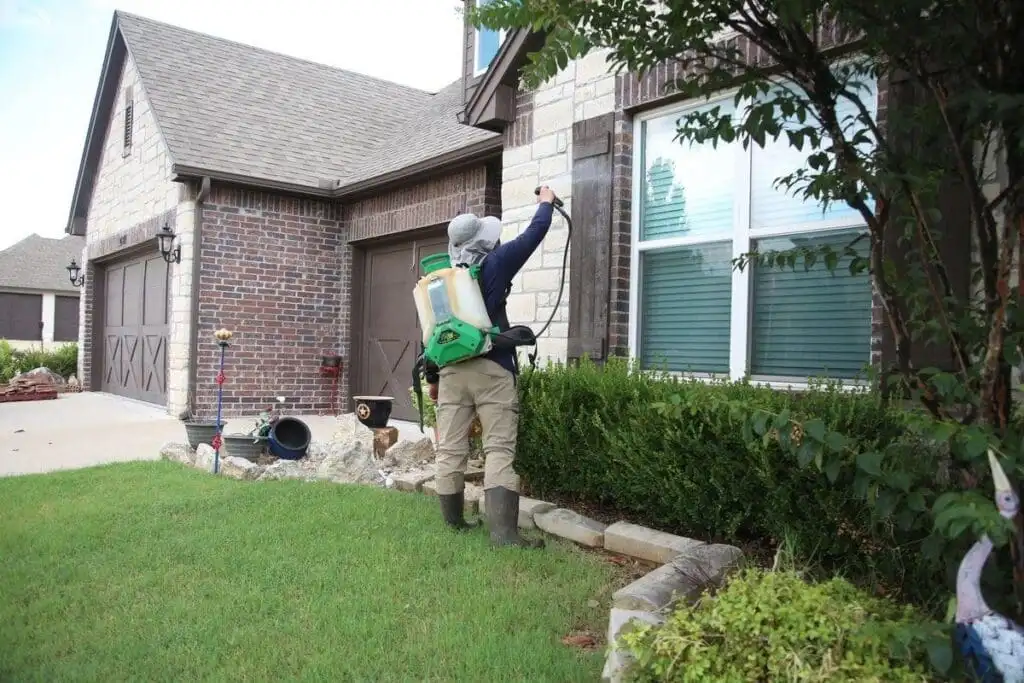
Image: A Complete Lawn Care pest control technician treating foundation areas and eaves at an Oklahoma home. Professional yard treatment is one essential piece of flea control, but it must be combined with pet prevention and indoor treatment to break the full cycle.

The Yard Treatment May Not Be Reaching the Right Areas

If you have addressed the indoor reservoir and your dog is on effective veterinary prevention and you are still seeing fleas, the yard treatment itself may need attention.

Fleas do not live in the sunny, open lawn. This is the single most important thing to understand about yard flea treatment. Flea eggs and larvae cannot survive in direct sunlight. They desiccate and die within hours of sun exposure. Fleas concentrate in shaded, moist, protected areas: under decks and porches, along shaded fence lines, in dense shrub beds, under trees with heavy canopy, in ground cover, and anywhere your dog rests in the shade. If a yard treatment focused on the open lawn and missed these harborage areas, it treated where fleas are not and missed where they are.

One treatment is rarely enough for an established population. Because flea pupae in the soil are resistant to insecticides, a single yard treatment kills the adults and larvae it contacts but does not eliminate the pupae that are already cocooned. Those pupae emerge as new adults over the following two to four weeks. A follow-up treatment is typically needed to catch the post-pupal emergence. If you had one yard treatment and expected the problem to be over, the remaining fleas may be emerging from pupae that survived the initial treatment.

The treatment interval may be too long. In Oklahoma’s warm climate, the flea life cycle runs fast. During peak season (June through September), a new generation of fleas can develop from egg to adult in as little as two to three weeks. If your yard treatments are spaced further apart than every four to six weeks during this period, fleas have enough time to complete a full generation between treatments. Tighter treatment intervals during peak season keep the population from rebounding.

Product quality matters. Not all flea treatments are equal. Professional-grade products typically include both an adulticide (kills adult fleas on contact) and an insect growth regulator (prevents eggs and larvae from developing into adults). Retail products often contain only an adulticide. Without an IGR, you are killing adults but allowing the next generation to develop uninterrupted. The IGR is what breaks the cycle in the yard.

Your Dog May Be Picking Up Fleas Somewhere Other Than Your Yard

Even with a perfectly treated yard and effective pet prevention, your dog encounters the outside world. And the outside world has fleas.

Walks in the neighborhood. Every untreated yard your dog walks past, every shaded area along the sidewalk, every patch of vegetation along the route is a potential source of new fleas. If your neighbors are not treating their yards, their flea populations are available to jump onto any warm-blooded host that passes by, including your dog on a leash.

Dog parks and off-leash areas. Dog parks are essentially flea exchange programs. Dogs from all over the area, with varying levels of flea prevention, gather in the same space. Fleas and flea eggs from one dog end up in the environment where every other dog can pick them up. If your dog visits a dog park regularly, it is a likely source of reintroduction.

Doggy daycare and boarding facilities. Any facility where multiple dogs are housed together is a potential flea source, even well-managed ones. It only takes one dog with an active flea infestation to introduce fleas to the environment where your dog then picks them up.

Visiting other homes or yards. If you take your dog to a friend’s house, a family member’s yard, or any other untreated outdoor space, your dog can pick up fleas from that environment and bring them home.

What to do about it: You cannot control every environment your dog enters, which is exactly why veterinary flea prevention is non-negotiable. Prevention products ensure that fleas picked up outside your yard die before they can reproduce on your dog and reinfest your home and yard. Think of yard treatment as protecting your property, pet prevention as protecting your dog wherever they go, and indoor treatment as cleaning up the reservoir. All three together provide complete protection.

Wildlife Is Constantly Bringing New Fleas to Your Property

Even if your dog never leaves the yard, fleas are being delivered to your property by uninvited guests.

Raccoons, opossums, feral cats, squirrels, and rabbits all carry fleas. These animals are active on most residential properties in the Tulsa area, usually at night when you do not see them. A single raccoon or opossum can carry dozens of fleas and deposit hundreds of flea eggs on your property during a single night’s visit. In Oklahoma, where wildlife is abundant year-round, this reintroduction is a constant reality.

Wildlife travels along predictable routes. Fence lines, the edges of structures, wooded borders, and the areas under decks and outbuildings are wildlife highways. These same areas are where fleas concentrate, because the animals deposit eggs along their travel routes and resting areas. Professional yard treatment targets these zones specifically because they are both the wildlife corridors and the flea breeding habitat.

Reducing wildlife harborage helps. Seal gaps under decks, porches, sheds, and outbuildings. Remove brush piles. Keep trash cans secured. Eliminate food sources like fallen fruit, unsecured pet food, and open compost. You will never completely prevent wildlife from crossing your property, but making it less attractive as a resting and nesting spot reduces the amount of flea-carrying traffic.

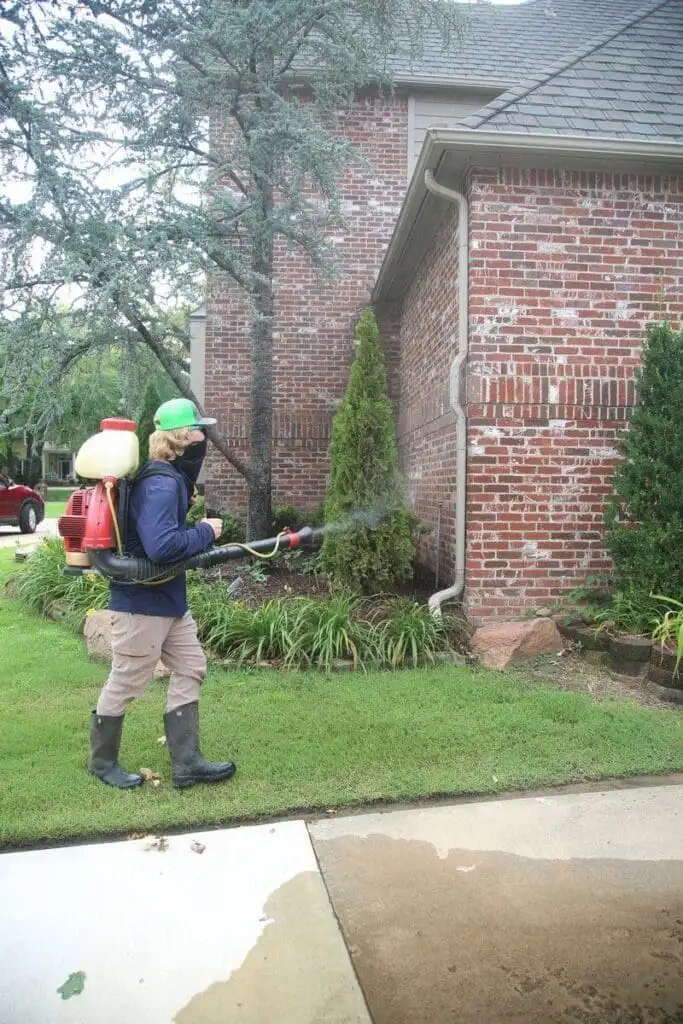
Image: A Complete Lawn Care pest control technician applying a targeted treatment to a foundation corner and landscape bed. Professional treatments target the shaded harborage areas along foundations, fence lines, and under structures where fleas breed and wildlife deposits them.

The Complete Flea Elimination Checklist for Oklahoma Dog Owners

If your dog keeps getting fleas despite yard treatment, work through this checklist. Most persistent flea problems trace back to one or more of these items being incomplete.

Is your dog on veterinary-prescribed flea prevention, given on schedule every month? Not store-bought. Not expired. Not applied inconsistently. A current, veterinary-recommended product given on the exact schedule your vet prescribes. If you are using an over-the-counter product, this is the first thing to change.

Are ALL pets in the household being treated? If you have two dogs and only one is on prevention, the untreated dog is a flea factory that will reinfest the treated dog and the entire home and yard. Every dog and cat in the household needs to be on prevention simultaneously. This includes indoor-only cats, which can get fleas from eggs and larvae brought inside on shoes, clothing, and other pets.

Have you addressed the indoor environment? Vacuum thoroughly at least twice a week, concentrating on areas where your pets rest. Wash pet bedding in hot water weekly. If the infestation is significant, consider a professional indoor treatment with an IGR.

Is the yard treatment targeting the right areas? Shaded areas, fence lines, under structures, shrub beds, ground cover, and pet resting areas. Not the sunny open lawn. If your treatment provider is only spraying the lawn, the flea harborage areas are being missed.

Are you on a consistent yard treatment schedule? Every four to six weeks during flea season (April through November in Oklahoma). One treatment is not enough. Consistency is what keeps the population suppressed. At Complete Lawn Care, our pest control program maintains this schedule automatically so you do not have to think about it.

Have you addressed wildlife harborage? Gaps under structures sealed? Brush piles removed? Food sources eliminated? Wildlife reintroduction is a constant source of new fleas that yard treatment must be maintained to address.

Is your lawn well-maintained? Consistent mowing at the proper height allows more sunlight and airflow to reach the soil surface, which makes conditions less favorable for flea development. A well-maintained lawn dries faster after rain and irrigation, reducing the moisture that flea larvae need. Complete Lawn Care’s weekly mowing service supports pest control by maintaining the turf conditions that make flea survival harder.

Have you given it enough time? Even with all three fronts addressed simultaneously, the flea life cycle means new adults can continue emerging from pupae for three to six weeks after you begin comprehensive treatment. If you started everything at the same time and it has been less than six weeks, you may be in the normal window where remaining pupae are still hatching. Give the full program time to work before assuming it has failed.

When to Call for Help

If you have checked every item on the list above and your dog is still getting fleas after six weeks of comprehensive treatment, it is time to escalate. There may be a hidden wildlife harborage (raccoon nesting under the deck), an untreated area of the yard that is producing fleas, an issue with the pet prevention product, or a significant indoor infestation that needs professional attention.

The advantage of working with a local provider like Complete Lawn Care is that you are talking to a team that knows your property, not a generic customer service line. If the program is not producing the expected results, we want to know about it. We can reassess the treatment areas, adjust the schedule, and help identify what is still fueling the problem. A persistent flea issue always has a cause, and it is almost always one of the items we have covered in this article.

With over 25 years of experience serving the Tulsa area, Complete Lawn Care understands the pest pressures Oklahoma pet owners face. Our pest control program is designed to address fleas, ticks, and other common pests through targeted treatments that focus on the specific areas where pests breed and harbor. We adjust throughout the season because conditions change, and our programs are continually refined based on what we see in the field across hundreds of properties. Our agronomy support allows us to make smarter corrections, faster, and that principle applies to our pest control work just as much as our turf care.

Break the Flea Cycle for Good

Complete Lawn Care’s pest control program provides consistent, targeted yard treatments that address fleas where they actually live. Combined with our 7-step lawn care program, weekly mowing, mosquito control, landscape maintenance, and irrigation service, we manage the conditions that support pest populations on your property. No contracts. No subscriptions. Serving Tulsa, Broken Arrow, Bixby, Jenks, Owasso, and Sand Springs.

Call us today: (918) 605-4646

Get a Free Quote at completelawncaretulsa.com

Experience. Science. Intentional Lawn Care. That’s the Complete Lawn Care Difference.

Related Posts