French Drains in Tulsa: What They Are, When You Need One, and What Installation Really Involves
A French drain is a subsurface drainage system — a trench filled with gravel and a perforated pipe that collects groundwater or slowly percolating surface water and redirects it away from problem areas through gravity flow. Whether you actually need one depends heavily on the specific nature of your drainage problem. Getting the diagnosis right before installing anything saves significant time and money.
How a French Drain Works
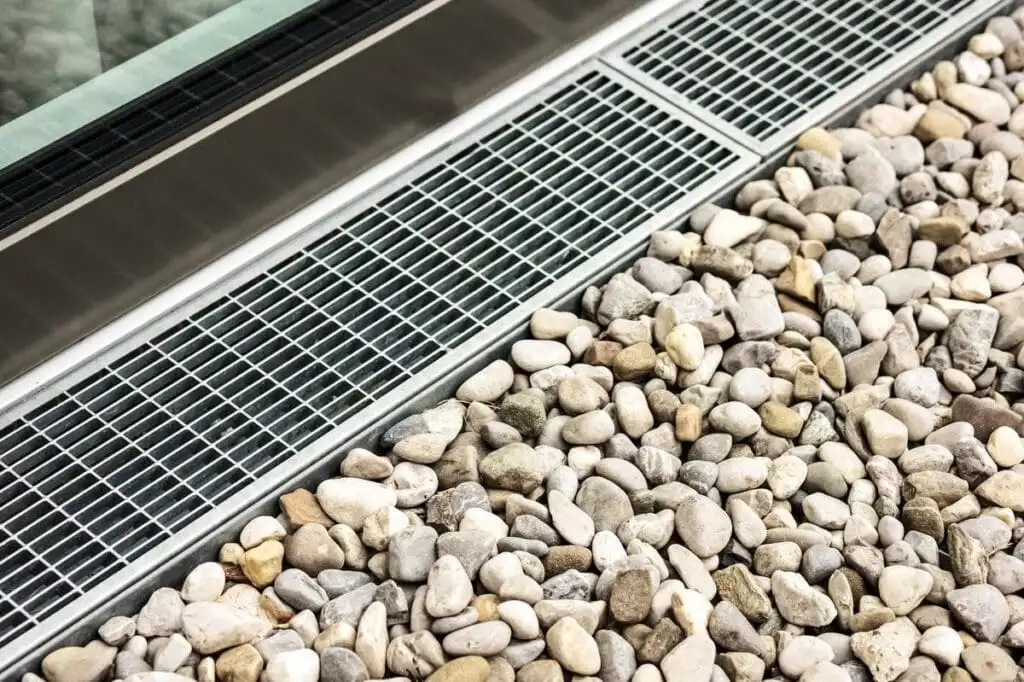
A channel drain (trench drain) with decorative grate and surrounding river rock — a surface drainage solution often confused with a French drain. A true French drain is subsurface with a perforated pipe in gravel, invisible after installation. Channel drains intercept surface flow; French drains collect subsurface water. Each solves a different problem. The operating principle is simple. Water naturally moves from higher ground to lower ground and from areas of higher pressure to areas of lower pressure. A French drain creates an artificially low-pressure zone — a trench of porous gravel surrounding a perforated pipe — that intercepts water moving through the soil and provides it an easy, fast path to exit the problem area. In Tulsa's predominantly clay soil, this interception matters because clay has very low natural permeability. Water moves slowly through undisturbed clay — often just a fraction of an inch per hour. A French drain cuts through that slow-draining clay layer and provides a gravel corridor where water can move much faster, collecting in the perforated pipe and flowing by gravity to the outlet.
Three Essential Components of a Properly Functioning French Drain
**Gravel-filled trench** Provides porosity and prevents soil from collapsing into the pipe. Missing or poorly installed gravel is one of the most common reasons French drains fail within a few years.
**Perforated pipe** Typically 4-inch corrugated or PVC. Collects intercepted water and carries it to the outlet by gravity. Must be properly sloped to function reliably.
**Fabric sock or filter cloth** Wrapped around the pipe or lining the trench walls to prevent fine soil particles from migrating into the gravel and reducing drainage capacity over time.
French Drain vs. Other Drainage Solutions: What Is the Difference?
French drains are frequently confused with other drainage systems, and the distinction matters because each type addresses a different problem. Using the wrong solution is expensive and ineffective.
French Drain (Subsurface)
Intercepts water moving through the soil — groundwater, perched water tables, and moisture that has already infiltrated but cannot drain fast enough through clay. The system is entirely underground after installation. **Best for:** yards where soil stays saturated for days after rain, areas downslope from higher ground pushing subsurface moisture toward the property, and foundation perimeter drainage.
Channel Drain / Trench Drain (Surface)
A surface-level linear drain that intercepts flowing surface water before it reaches a problem area. The drain is visible as a grated slot in the ground. **Best for:** water flowing off driveways, patios, or sloped hardscape onto adjacent lawn, fence-line areas that channel concentrated runoff, and defined surface flow paths.
Downspout Extension or Pop-Up Emitter
Captures roof runoff from downspouts and carries it through underground pipe to a pop-up emitter that releases water away from the foundation. Many Tulsa homeowners who believe they need a French drain actually just need properly extended downspouts.
Regrading
Reshaping the surface of the yard to change how water flows across it. Regrading addresses surface flow; French drains address subsurface flow. A yard with both surface and subsurface drainage problems may need both.
Do You Actually Need a French Drain? The Honest Assessment
Most drainage problems in Tulsa-area yards do not require a French drain. That is not a reason to avoid them when they are the right solution, but it is worth being honest about the common scenarios where less expensive or simpler interventions solve the problem just as well.
You Probably Do NOT Need a French Drain If…
• Water pools after rain but drains within 24 to 48 hours. This is normal behavior for Oklahoma's clay soil. Core aeration and organic matter additions will improve infiltration over time without infrastructure. • The wet area correlates with your irrigation schedule. If the problem area is always wet after irrigation cycles, the cause is likely overwatering — too long a run time for the clay's infiltration rate, or a malfunctioning head. • Water is pooling on a hard surface and flowing onto the lawn. This is a surface flow problem. A channel drain or regrading is the appropriate solution. • The low spot is a simple soil settlement depression. A shallow depression from settled soil is a grading problem. Top dressing and reseeding corrects it.
You Likely DO Need a French Drain If…
• Soil stays saturated for 3 or more days after rain in an area that does not receive concentrated surface flow — suggesting groundwater or perched water table issues. • Water seeps toward your foundation from higher ground on the property or from neighboring properties, and surface grading has not resolved the problem. • A defined zone of the yard is chronically wet across multiple seasons, even in dry periods — often indicating a naturally occurring subsurface drainage problem. • Water is flowing from uphill onto your property through subsurface soil movement, not just surface runoff. • Previous surface solutions have not held — if regrading or filling low spots has not solved a persistent drainage problem, the cause is likely subsurface.
French Drain Installation in Progress
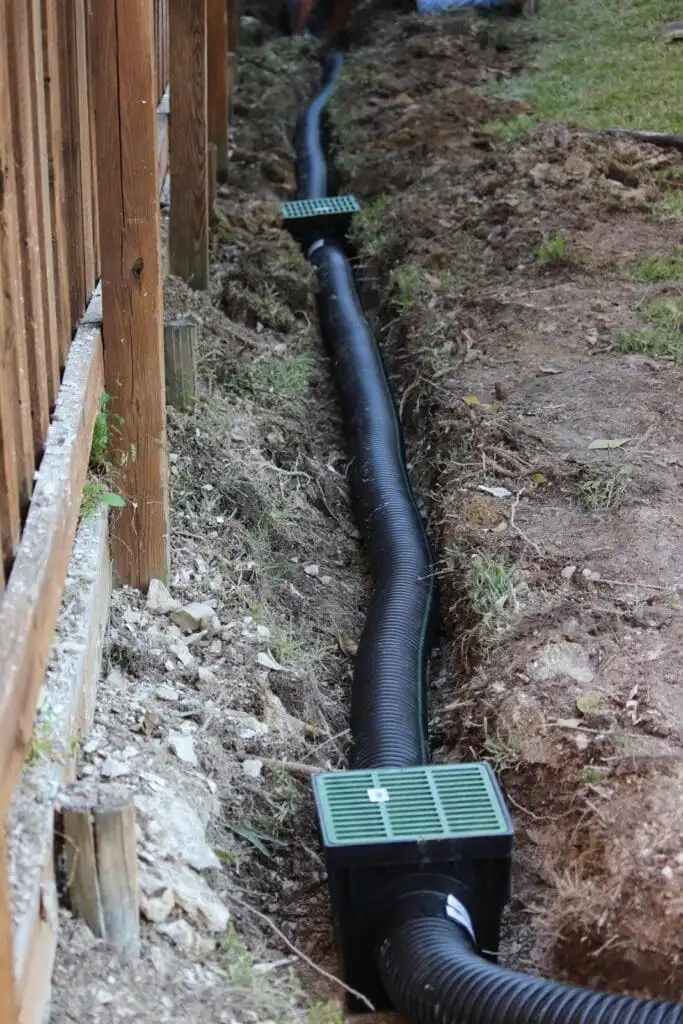
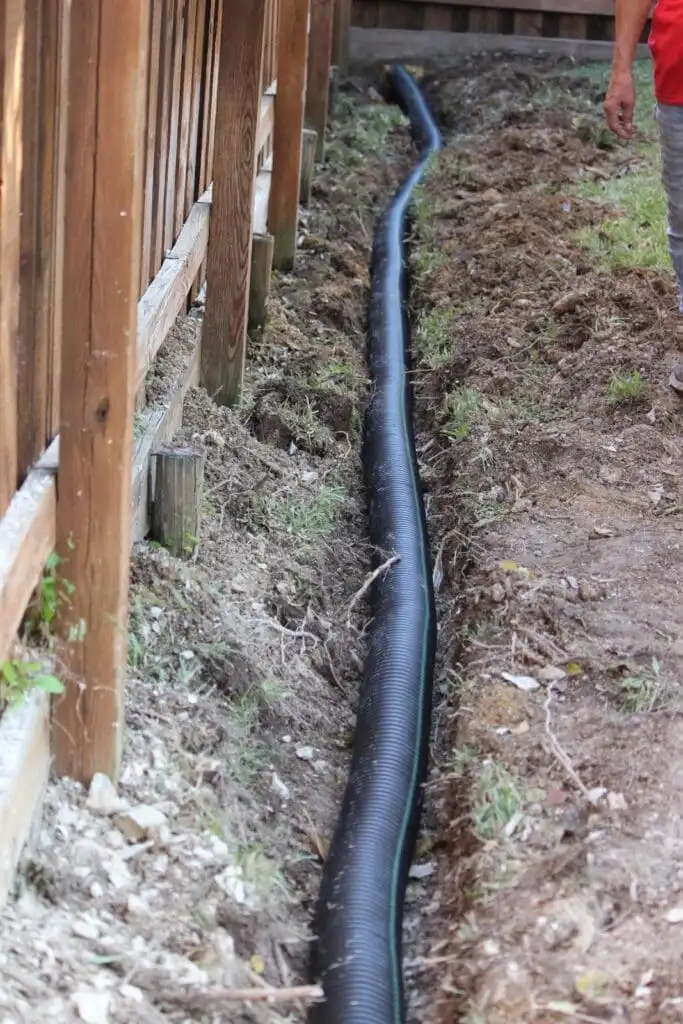
A French drain installation in progress alongside a fence line — a common problem location in Tulsa-area yards where the narrow side yard between fence and house creates a concentrated drainage corridor with no outlet. The perforated corrugated pipe is surrounded with gravel and covered, becoming invisible after backfill. This installation includes surface inlets (green grates) to also capture surface runoff entering the trench. Note: pipe perforations face downward — a detail that matters significantly in clay soils where soil fines can migrate into upward-facing perforations and clog the system.
French Drain Installation: What the Process Actually Involves
Understanding the installation process helps set realistic expectations for cost, timeline, and property disruption — and helps identify shortcuts that produce systems that fail prematurely.
1. Locate Underground Utilities First
Before any trench is opened, Oklahoma 811 must be contacted to mark underground gas, electric, water, and communication lines. This is legally required. Tulsa-area properties frequently have irrigation lines, landscape lighting wiring, and utility lines not obvious from the surface.
2. Trench Excavation
A French drain trench is typically 12 to 24 inches deep and 6 to 12 inches wide. In Tulsa's dense clay, a trenching machine or mini-excavator is the practical choice for runs longer than 20 to 30 feet. The trench must maintain a minimum 1% grade (1 inch of drop per 8 to 10 feet of run) for reliable flow.
3. Filter Fabric Installation
Landscape fabric is laid in the trench before gravel is added, lining the trench walls and extending up both sides so it can be folded over the top of the gravel after the pipe is placed. French drains installed without fabric in clay soil frequently clog within three to five years as clay infiltrates the gravel.
4. Gravel Bed and Pipe Placement
Three to four inches of clean washed gravel (not pea gravel or decomposed granite — these have too many fine particles) are placed in the bottom of the trench. The perforated pipe is placed on top with perforations facing down. More gravel is added around and over the pipe to within six to eight inches of the surface.
5. Fabric Fold-Over and Backfill
The filter fabric is folded over the top of the gravel, completely encasing the gravel bed. The remaining trench is backfilled with the excavated soil or topsoil and the surface restored — sod replacement, reseeding, or simply allowing existing grass to recover across the narrow trench.
6. Outlet Location
The French drain must terminate somewhere — a storm drain, a daylight outlet at the edge of the property where water can flow freely, or in some cases a dry well. Finding a legal, practical outlet is one of the most location-specific constraints on French drain design in Tulsa-area neighborhoods, particularly on smaller lots.
French Drain Cost Reality in Tulsa
DIY Material Cost
$5–$15
per linear foot (pipe, gravel, fabric, fittings)
Professional Installation
$25–$65+
per linear foot depending on depth, soil conditions, access difficulty, and outlet requirements
50-Foot System
$1,250–$3,250+
professionally installed
100-Foot System with Inlets
$3,000–$6,500+
with surface inlets and proper outlet — a realistic budget for larger Tulsa-area installs
Cost variables in Tulsa specifically: rocky soil areas increase labor; tight fence-line access limits equipment; clay density affects trench machine selection. Always get itemized quotes that specify pipe size, gravel type, fabric inclusion, and outlet method.
Not Sure What Type of Drainage You Need?
Complete Lawn Care serves the Tulsa area and can assess your specific drainage problem — whether it calls for a French drain, channel drain, regrading, or a downspout solution. Getting the diagnosis right before installing anything saves significant time and money.