Can You Fertilize Without Watering Your Lawn?
Fertilizing without irrigation can still benefit your lawn, but you won't get anywhere near the results you would with consistent watering. Think of it like going to the gym two days a week instead of five. The ingredients are there. The follow-through is not.
How Fertilizer Actually Works in Your Soil
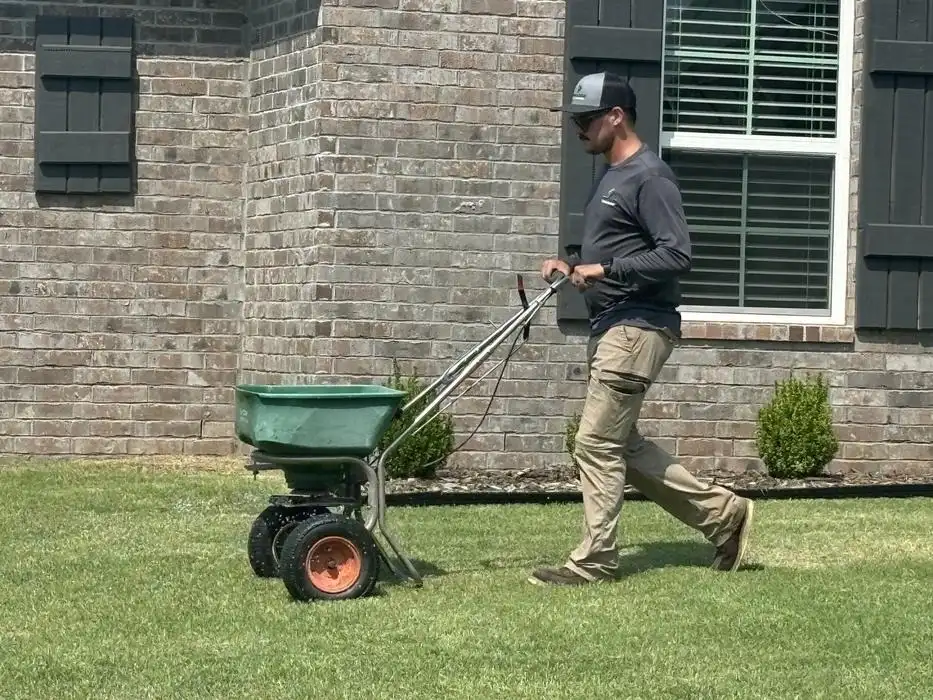
Granular fertilizers — the most common type used in professional lawn care programs — do not immediately feed your grass the moment they land on the turf. They have to dissolve first. That dissolving process requires moisture. Once water activates the granules, the nutrients break down and move through the soil into the root zone where the grass can absorb them. Without that water, the granules just sit on the surface.
Liquid fertilizer applications work somewhat faster because the product is already in solution, but even liquid applications depend on soil moisture to carry nutrients down to the roots. A dry, cracked Oklahoma clay soil in August is about the worst possible environment for fertilizer uptake regardless of the product type.
What Rain-Only Watering Actually Gets You
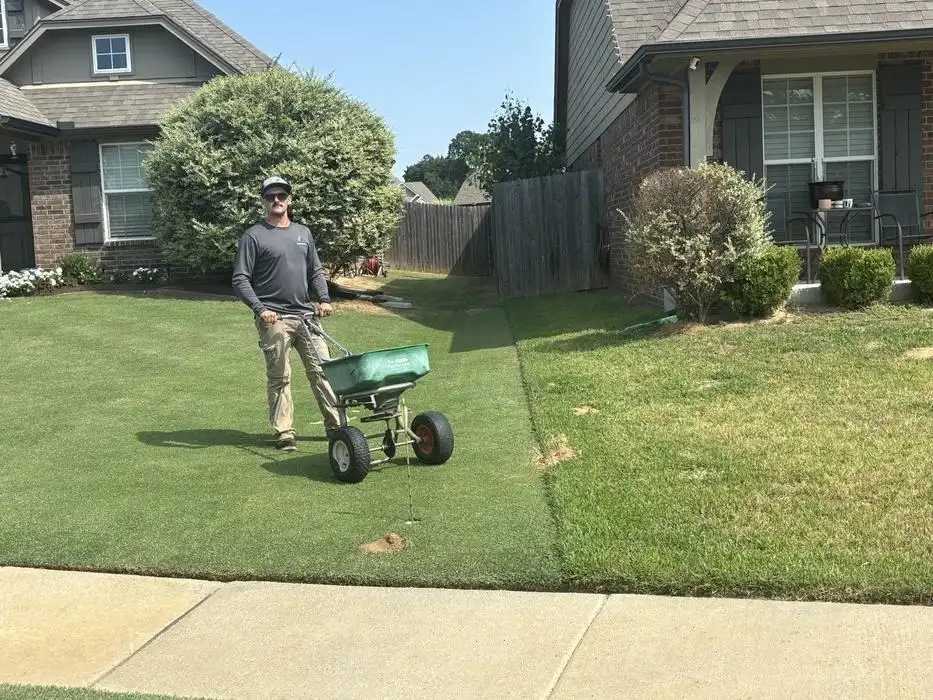
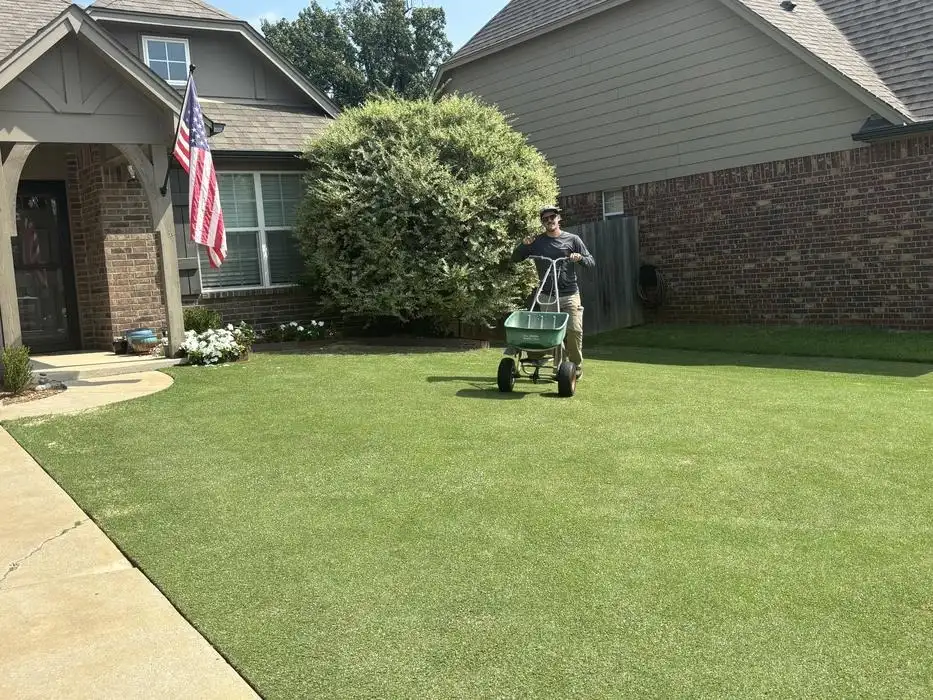
Rainfall is genuinely helpful, and in a normal Oklahoma year there is enough precipitation during spring and fall to activate fertilizer applications reasonably well. The problem is that Oklahoma's weather is unpredictable. A fertilizer application in late May might get rained on within 48 hours, or it might sit for two weeks in 95-degree heat with no rain in sight.
When rainfall is the only water source, results from a fertilizer program become inconsistent. The lawn ends up with uneven nutrition across the season, which shows up as uneven color, density, and stress tolerance. Relying on rain alone is like hoping the gym shows up at your house — it might happen, but you cannot build a plan around it.
The Risk of Fertilizing During Drought Without Watering
There is one scenario where fertilizing without water crosses from ineffective into actively harmful: applying high-nitrogen fertilizer to a drought-stressed lawn without any irrigation to water it in. When a lawn is already under heat and drought stress, applying a heavy nitrogen fertilizer and leaving it dry can cause fertilizer burn. The concentrated salts draw moisture out of the grass rather than feeding it, leaving yellow or brown streaks in the pattern of the spreader passes.
At Complete Lawn Care, we do not apply heavy nitrogen during peak drought conditions without accounting for soil moisture levels. Our applications are intentional and timed around actual conditions, not just a calendar. That kind of decision-making is what separates a science-based program from one that just follows a fixed schedule regardless of what the lawn actually needs.
How Watering Multiplies the Value of Every Application
A lawn that receives one inch of water per week — whether from rain or irrigation — will respond dramatically better to fertilization than one running on whatever moisture happens to fall from the sky. The grass stays in an active growth cycle rather than slipping in and out of stress dormancy. Nutrients get absorbed efficiently rather than sitting at the surface. Root systems stay deeper and healthier.
Sprinkler Basics
Even a basic oscillating sprinkler run for 30 minutes twice a week improves fertilizer uptake measurably compared to no supplemental watering.
Water in the Morning
Watering in the early morning, before temperatures rise, maximizes soil absorption and reduces evaporation loss.
Deep & Infrequent
Deep, less frequent watering produces deeper root systems that access soil moisture more efficiently during dry stretches.
Smart Irrigation
A properly calibrated irrigation system takes the guesswork out entirely and ensures consistent results across the season.
Should You Still Fertilize If You Cannot Water at All?
If irrigation is genuinely not an option, fertilizing is still worthwhile with a few adjustments to approach and expectations.
Time Applications Seasonally
In the Tulsa area, early spring and fall are the most dependable windows for rain-supported fertilization. Applications during these periods are more likely to get watered in naturally and produce visible results.
Choose Slow-Release Formulations
Slower-release fertilizer formulations reduce burn risk during dry spells and extend the window during which nutrients remain available to the turf even without immediate moisture.
Test Your Soil
Having your soil tested at least once a year ensures that whatever fertilizer is applied is addressing a real deficiency rather than adding nutrients the soil already has in adequate supply. Complete Lawn Care offers soil testing as a service.
The Bottom Line on Fertilizing Without Water
Fertilizing without consistent irrigation is going to the gym twice a week instead of five. You will get some results. Your lawn will be better off than if you did nothing. But you will not reach the full potential of what a well-fed, well-watered lawn can look like in the Tulsa area.
If improving your watering situation is at all possible, even incrementally, the return on that effort is significant. And if you are already investing in a professional fertilization program, making sure your lawn gets the moisture it needs to actually use those nutrients is the highest-value thing you can do to protect that investment.
About Complete Lawn Care
For more than 25 years, Complete Lawn Care has been a trusted lawn care provider in the Tulsa area. We believe great results come from experience, science, and continual improvement — not guesswork. We have implemented one of the few agronomy-supported programs in Tulsa, working directly with an industry expert who helps guide our application timing, product selection, and ongoing improvements based on proven agronomic science.
Every lawn is different, and every application is intentional. At Complete Lawn Care, we don't guess at what might work. We apply what does work. Your lawn deserves the best.
We serve homeowners and businesses throughout Tulsa, Broken Arrow, Bixby, Jenks, Owasso, and Sand Springs.
Give Your Lawn the Nutrition and Moisture It Needs to Thrive
Complete Lawn Care's 7-step agronomy-supported lawn care program is built around what Tulsa-area lawns actually need, season by season. Contact us today to learn more or to get a free quote.
(918) 605-4646 | wecare@completelawncaretulsa.com
Experience. Science. Intentional Lawn Care — That's the Complete Lawn Care Difference.