How Often Should I Sharpen My Mower Blade?
By the lawn care experts at Complete Lawn Care | Serving Tulsa, Broken Arrow, Bixby, Jenks, Owasso, and Sand Springs
For a typical homeowner mowing a residential lawn once a week, you should sharpen your mower blade at least two to three times per season — and once at the very start of the mowing season before the first cut. If you are mowing more than a quarter acre, hitting any rocks, roots, or hard debris during the season, or noticing that your grass tips look torn or frayed rather than cleanly cut, sharpen more often. A dull blade is one of the most common — and most overlooked — causes of a lawn that looks rough, browns at the tips, and struggles to stay healthy through Oklahoma's hot summers.
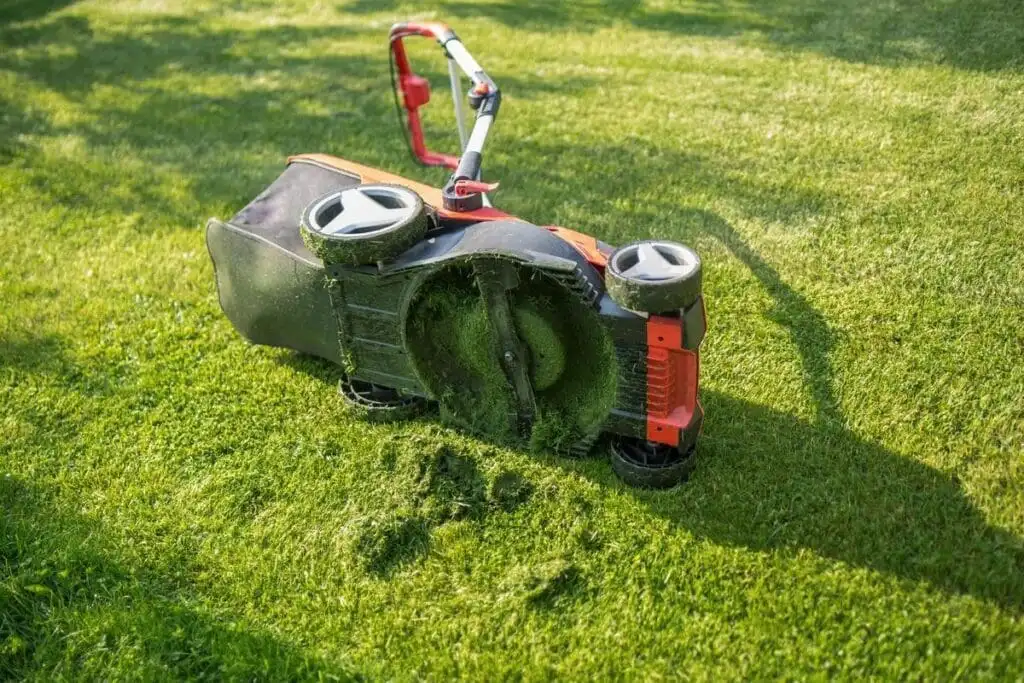
Inspecting the underside of a mower deck — blade condition and deck buildup are two of the most important factors in cut quality and turf health.
Why a Sharp Blade Matters More Than Most Homeowners Realize
A lawn mower blade does not just cut grass — it determines how your grass heals, how it defends itself against disease, and how it looks for the days following each mow. When a blade is sharp, it slices cleanly through each grass blade. The cut heals quickly, the tips stay green, and the plant recovers within a day or two.
When a blade is dull, it tears rather than cuts. Instead of a clean slice, you get a ragged, shredded tip on every grass blade across your entire lawn. Those torn tips lose moisture rapidly, turn brown or tan within 24 to 48 hours, and create open wounds that are far more susceptible to fungal disease. On a Bermuda lawn during a hot Tulsa summer — when heat stress and disease pressure are already at their peak — mowing with a dull blade is the kind of thing that turns a good lawn into a struggling one.
It also makes your mower work harder. A dull blade requires more engine power to push through the turf, increasing fuel consumption and engine wear. Over a full season, that adds up.
How to Tell If Your Blade Needs Sharpening
You do not always need to pull the blade to know it is dull. Your lawn will tell you first.
Brown or tan tips after mowing. This is the most reliable visual indicator. Look at your lawn one to two days after mowing. If the tips across the surface have a brownish cast, the blade is tearing rather than cutting. A cleanly cut lawn should still look green and fresh a couple of days after the mow.
Uneven or streaky cut. A dull or damaged blade does not cut evenly across its full length. You may notice strips of taller grass between mowing passes, or areas where the blade seems to be pushing grass over rather than cutting it.
Ragged, frayed grass tips up close. Crouch down and look at individual grass blades after mowing. A sharp blade leaves a clean, flat cut. A dull blade leaves a jagged, torn edge — sometimes visibly white and fibrous.
Increased mowing effort or vibration. A blade that is nicked, bent, or significantly dull can cause noticeable vibration in the mower deck. That vibration is also a sign that the blade may be unbalanced, which can damage the spindle over time if left unaddressed.
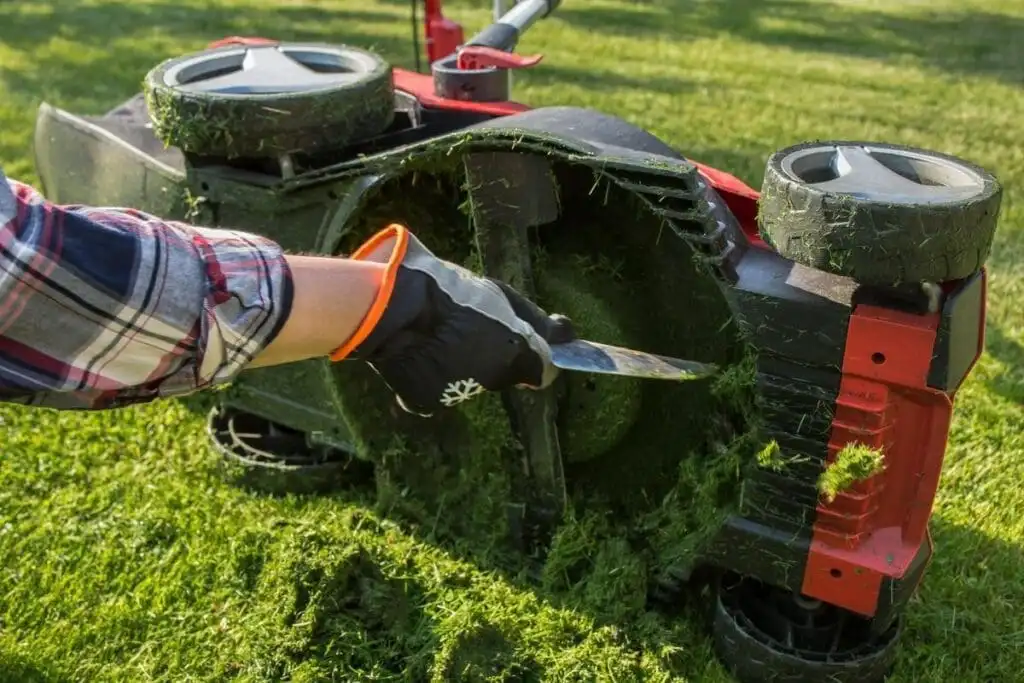
Removing a mower blade for sharpening — always disconnect the spark plug before working under the deck, and note which side faces down before removing the blade.
How Often Should You Actually Sharpen?
The standard recommendation you will find most places is once or twice a season, but that is the bare minimum for light-use homeowners with a small yard and clean conditions. Here is a more honest guide based on real-world use.
Start of every season: Always. Even if you sharpened at the end of last season, inspect and sharpen before the first cut of the year. Blades oxidize and can develop small edge imperfections from sitting over winter.
Every 20 to 25 hours of mowing time: This is a more practical guideline than "times per season" because it accounts for yard size and mowing frequency. If you are mowing a half-acre weekly, you are hitting that threshold faster than someone with a small front yard.
After hitting any hard object: Rocks, roots, buried irrigation heads, edging borders, concrete curbs — any significant impact can nick or bend a blade immediately. Inspect and sharpen after any hard strike, even if you just sharpened recently.
Mid-season check: Even without a hard impact, plan for at least one mid-season sharpening, typically in late June or July here in the Tulsa area when heat stress on turf is highest and cut quality matters most.
The cost of sharpening a blade yourself is essentially nothing beyond a file or a bench grinder and 20 minutes of time. Taking it to a shop typically runs $10 to $20. There is no good reason to mow with a dull blade when sharpening is that accessible.
What Professional Lawn Care Companies Do Differently
Here is something most homeowners never think about: at Complete Lawn Care , our crews sharpen their commercial mower blades multiple times per week during the mowing season. Not once a season. Not once a month. Several times a week.
That level of blade maintenance is standard practice in professional lawn care because it is not fair to your turf to use a dull blade. Our crews are mowing multiple properties every single day on commercial-grade equipment, and we hold our blade sharpness to a standard that most homeowners would find surprising. A blade that has mowed ten yards in a day is not the same blade it was in the morning — and we treat it that way.
This is one of the differences between a professional weekly mowing service and a DIY approach that is hard to quantify until you see the results side by side. Sharp blades mean cleaner cuts. Cleaner cuts mean healthier turf. Healthier turf means your lawn holds up better through the heat, drought, and disease pressure that Oklahoma summers bring every year.
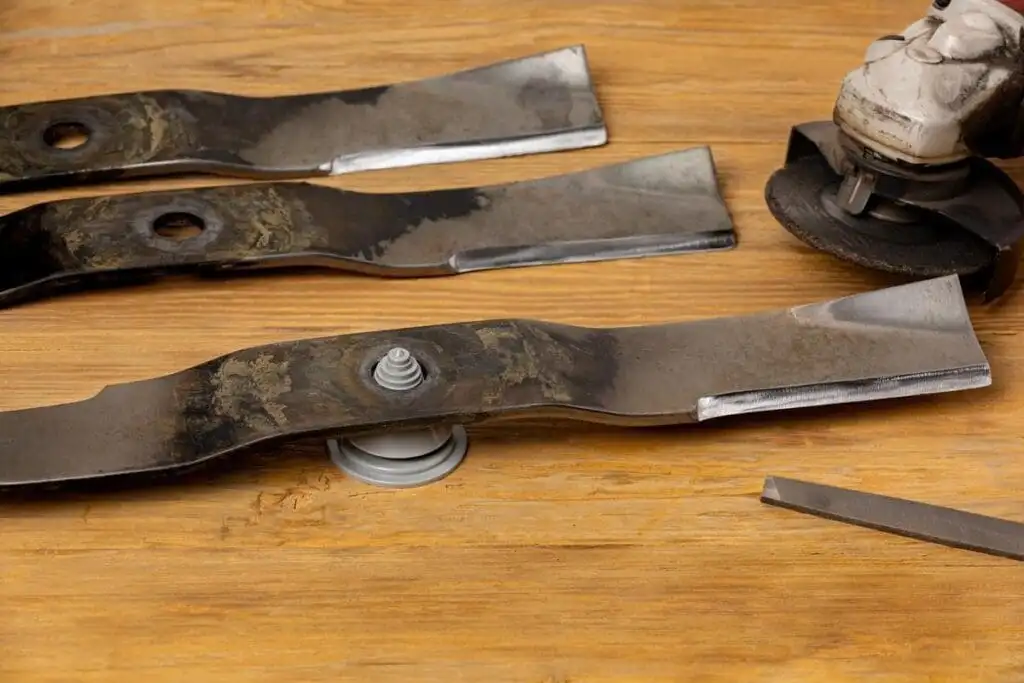
Mower blades removed for sharpening alongside a grinder and file — blade maintenance is one of the most important and most overlooked parts of proper lawn care.
How to Sharpen a Mower Blade Yourself
If you want to tackle blade sharpening yourself, here is how to do it safely and correctly.
Step 1: Disconnect the spark plug. Always do this before tipping the mower or working near the blade. It prevents accidental engine starts.
Step 2: Tip the mower correctly. When tipping a gas mower on its side to access the blade, always tip it so the air filter and carburetor face up. Tipping the other direction can flood the carburetor with oil and create starting problems.
Step 3: Mark the blade before removing it. Use spray paint or a marker to indicate which side faces down. Reinstalling a blade upside down is a surprisingly common mistake that results in zero cutting and potential deck damage.
Step 4: Remove and inspect. Once off, check for cracks, significant bends, or deep gouges. A cracked blade should be replaced, not sharpened. A blade that has been sharpened so many times that the cutting edge is very thin may also be due for replacement.
Step 5: Sharpen at the correct angle. The factory bevel on most mower blades is between 30 and 45 degrees. Use a file, bench grinder, or blade sharpening attachment for an angle grinder to restore that edge. Work evenly across the full length of the blade, removing equal amounts from each end to maintain balance.
Step 6: Check blade balance. An unbalanced blade causes vibration that wears out spindle bearings over time. Use an inexpensive blade balancer (a cone-shaped tool, often under $5 at any hardware store) to verify both ends are equal weight before reinstalling.
Step 7: Reinstall and torque correctly. Check your mower's manual for the recommended bolt torque — most are between 35 and 50 foot-pounds. A blade that comes loose mid-operation is a serious safety hazard.
Common Blade Sharpening Mistakes to Avoid
Sharpening to razor sharpness. Mower blades do not need to be razor-sharp like a knife. An edge that could scratch your fingernail is sharp enough. Over-sharpening thins the metal unnecessarily and the edge rolls over quickly under mowing conditions.
Removing too much material from one side. Even minor imbalance creates vibration. Always sharpen both ends of the blade equally, even if one side has more damage. If one end has a significant gouge that requires removing more metal, compensate on the other end to match the weight.
Skipping the balance check. This step gets skipped constantly. An out-of-balance blade that vibrates even slightly will wear spindle bearings prematurely, and spindle replacement on a riding mower or commercial machine is an expensive repair.
Ignoring the deck. While the blade is off, clean the underside of the mower deck. Grass buildup under the deck disrupts airflow and reduces cutting efficiency — even with a sharp blade. A clean deck and a sharp blade together make a noticeable difference in cut quality.
Quick Answers: Mower Blade FAQs
How do I know if my mower blade is dull without removing it? Check your lawn one to two days after mowing. Brown or tan tips across the surface are the clearest sign. You can also run your finger carefully along the blade edge (with the mower off and spark plug disconnected) — a dull blade will feel rounded rather than having any edge at all.
Should I sharpen or replace my blade? Sharpen if the blade is simply dull with minor wear. Replace if the blade is cracked, severely bent, has deep gouges that cannot be filed out evenly, or has been sharpened so many times that the metal is noticeably thin. Most residential blades should be replaced every two to three seasons with regular maintenance.
Does blade sharpness matter more for certain grass types? Yes. Bermuda grass — the dominant turf type across the Tulsa metro — is particularly sensitive to cut quality because of its fine texture and dense growth. A dull blade on Bermuda shows up quickly as a grayish, matted appearance after mowing. Zoysia is similarly affected. Tall fescue is somewhat more forgiving due to its coarser blade, but cut quality still matters for disease resistance.
Can a sharp blade actually help prevent lawn disease? Yes, meaningfully so. Torn grass tips are open wounds that provide entry points for fungal pathogens. In Oklahoma's humid summer conditions, when diseases like brown patch and gray leaf spot are already a risk on warm-season turf, mowing with a sharp blade reduces one of the controllable risk factors.
Is it worth paying a shop to sharpen my blade? For most homeowners, yes — especially if you do not own a bench grinder or are not comfortable with the process. A professional sharpening for $10 to $20 done two to three times a season costs less than one bag of fertilizer and has a direct, measurable impact on turf quality.
With over 25 years of experience, Complete Lawn Care combines proven results with science-based lawn care. We invest in leadership training, research, and agronomy expertise to ensure every application — and every mow — is intentional, effective, and continually improving. Our programs are continually refined based on real-world results and agronomic science, because your lawn deserves more than guesswork.
Want Every Mow Done Right — With Blades That Are Actually Sharp?
If staying on top of blade sharpening, mowing heights, and pattern rotation sounds like more maintenance than you want to manage, Complete Lawn Care 's weekly lawn mowing service takes all of it off your plate. Our crews arrive with commercial-grade equipment, sharp blades, and the training to know exactly how your lawn should be cut every single visit.
And if your lawn needs comprehensive fertilization and weed control alongside consistent mowing, ask about our agronomy-guided 7-step lawn care program — built specifically for Tulsa-area turf conditions and backed by science-based decision making that adjusts throughout the season.
Call us at (918) 605-4646 , email wecare@completelawncaretulsa.com, or visit completelawncaretulsa.com to get a quote. We serve Tulsa, Broken Arrow, Bixby, Jenks, Owasso, and Sand Springs.
Experience. Science. Intentional Lawn Care — That's the Complete Lawn Care Difference.