How Do I Get Rid of Fire Ants in My Lawn in Oklahoma?
The most effective way to eliminate fire ants from your Oklahoma lawn is a two-step approach: broadcast a fire ant bait across your entire yard to weaken and destroy colonies you cannot see, then follow up with individual mound treatments on any remaining visible mounds. This combination targets both the colonies you know about and the ones you do not. A single mound drench or a single bag of bait on its own will not solve a fire ant problem because fire ants build extensive underground tunnel networks with multiple queens, and colonies you have not found are constantly expanding into your yard from neighboring properties.
Fire ants are one of the most frustrating lawn pests Oklahoma homeowners deal with, and the Tulsa area has seen fire ant populations increase significantly over the past two decades. If you have stepped on a fire ant mound barefoot, had your kids stung while playing in the yard, or watched mounds pop up faster than you can treat them, you know how relentless these pests are. The good news is that fire ants are manageable with the right approach and consistent treatment. The bad news is that they are never truly gone permanently. Let us walk through what actually works, what does not, and how to keep fire ants under control in your Oklahoma yard.
Understanding Fire Ants in Oklahoma
The red imported fire ant (Solenopsis invicta) is the species causing problems in Oklahoma lawns. Originally from South America, red imported fire ants entered the United States through the port of Mobile, Alabama in the 1930s and have been steadily moving north and west ever since. They reached Oklahoma in the 1980s and are now established across the southern two-thirds of the state, including the entire Tulsa metro area.
Fire ant colonies are much larger than what you see on the surface. The mound you see in your lawn is the tip of a tunnel network that can extend several feet deep and spread 10 to 15 feet or more from the visible mound. A single mature colony can contain 200,000 to 500,000 worker ants and one or more queens. Some Oklahoma fire ant populations have multiple queens per colony (polygyne colonies), which means even higher numbers and faster reproduction.
Image: Red imported fire ants shown with a coin for scale. Fire ants are small, typically 1/16 to 1/4 inch long, but a single colony can contain 200,000 to 500,000 workers. Their small size makes early detection difficult in Oklahoma lawns.
Fire ants reproduce and spread aggressively. Mature colonies produce winged reproductive ants (alates) that swarm, mate in the air, and land to establish new colonies. These mating flights typically happen in spring and fall in Oklahoma, usually one to two days after a soaking rain when temperatures are warm and winds are calm. A single mating flight can distribute new queen ants across a wide area, which is why new mounds seem to appear out of nowhere after spring and fall rains.
Oklahoma's climate is at the northern edge of fire ant range. Severe winters can reduce fire ant populations temporarily, but they do not eliminate them. Fire ants survive cold by moving deeper into the soil, and colonies in the Tulsa area have adapted to our winters over decades of establishment. A hard winter may reduce mound counts the following spring, but the colonies recover quickly once warm weather returns.
The Two-Step Method That Actually Works
The two-step method is recommended by university extension services across the southern United States, including Oklahoma State University, because it addresses fire ants comprehensively rather than one mound at a time.
Step one: Broadcast bait across your entire yard. Fire ant bait consists of a toxicant or insect growth regulator applied to an oil-coated carrier (usually soybean oil on a corn grit base) that worker ants find irresistible. Workers forage across your lawn, find the bait particles, carry them back to the colony, and share the bait with other workers, larvae, and the queen through a process called trophallaxis (communal food sharing). Because the toxicant is slow-acting, the bait is distributed throughout the colony before it begins killing ants. When the queen dies, the colony dies.
The key to bait success is broadcasting it across the entire yard, not just near visible mounds. Fire ant workers forage up to 100 feet or more from their mound, and many colonies have no visible mound at all, especially in irrigated lawns where soil moisture allows ants to tunnel to the surface without building an above-ground structure. Broadcasting bait ensures that even hidden colonies encounter the product through their foraging workers.
Step two: Treat individual mounds that remain after two to four weeks. Bait takes time to work through a colony. Most fire ant baits take two to six weeks to eliminate a colony completely. After two to four weeks, survey your yard for remaining active mounds and treat those individually with a mound drench, granular product, or dust. This mop-up step handles any colonies that did not pick up sufficient bait or that are too large to be eliminated by bait alone.
The two-step approach is far more effective than treating mounds individually because it addresses the entire fire ant population on your property, including colonies with no visible mound. Mound-by-mound treatment is reactive and misses the majority of colonies on most properties.
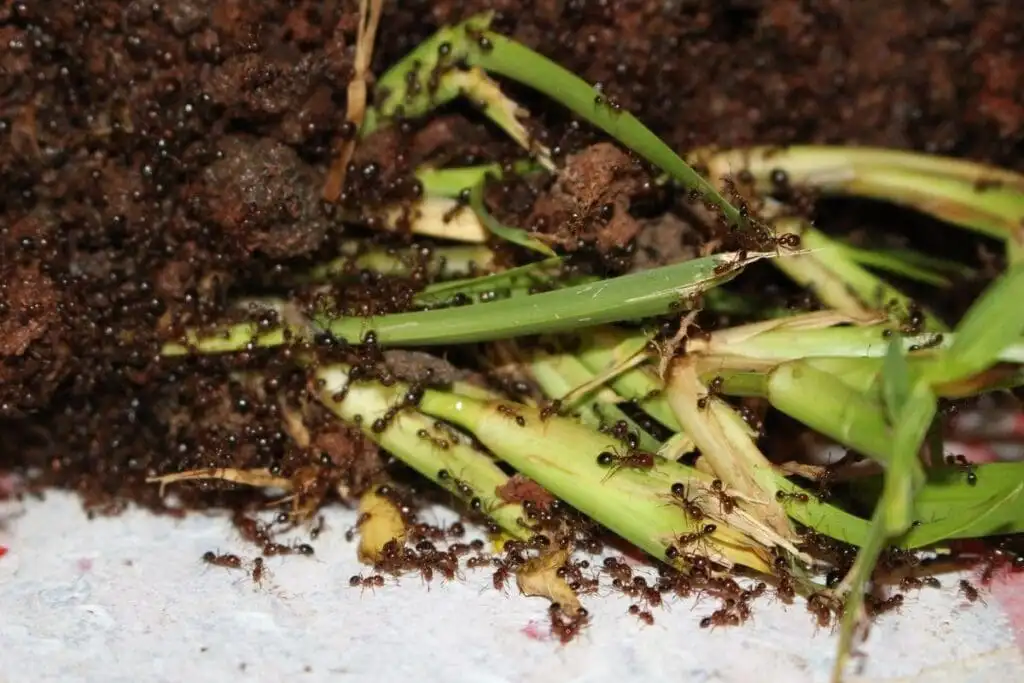
Image: Fire ants swarming through grass and soil after a mound disturbance. When a mound is disturbed, hundreds of workers emerge within seconds and will sting anything they contact. This aggressive defensive behavior is what makes fire ants dangerous for children, pets, and anyone who steps on a mound.
When to Treat Fire Ants in Oklahoma
The best times to apply fire ant bait in Oklahoma are spring (late March through May) and fall (September through November). These are the periods when fire ants are actively foraging and temperatures are moderate enough for bait to be effective. Fire ants forage most actively when soil surface temperatures are between 65 and 90 degrees Fahrenheit, which generally corresponds to air temperatures in the 70s to mid-80s.
Spring treatment catches colonies before they produce swarmers. Treating in late March through April reduces colony strength before the spring mating flights that spread new queens across your property and neighborhood. Getting ahead of the reproductive cycle is one of the most effective long-term strategies.
Fall treatment weakens colonies going into winter. A fall bait application in September or October targets colonies that built up over the summer and reduces the population entering winter dormancy. Weaker colonies are less likely to survive Oklahoma winters, which compounds the treatment effect.
Midsummer treatment is less effective. During the peak of Oklahoma summer heat (June through August), fire ants reduce surface foraging during the hottest part of the day. They forage primarily in the early morning and evening when soil surface temperatures are tolerable. Bait applied in the heat of a July afternoon may sit on the surface for hours before ants encounter it, and the oil carrier can go rancid in extreme heat, making the bait unattractive. If you treat in summer, apply bait in the late afternoon or early evening when ants are actively foraging.
Never apply bait when rain is expected within 24 hours. Moisture ruins fire ant bait. Rain washes the oil coating off the carrier, making the bait unattractive to ants. Check the forecast before applying, and only use bait when dry conditions are expected for at least 24 hours.
Individual Mound Treatments and What Works
For the mop-up step of the two-step method, or for dealing with individual mounds that appear between bait applications, several treatment types are effective.
Liquid mound drenches. Mixing a liquid insecticide with several gallons of water and pouring it directly into and around the mound is one of the most effective individual mound treatments. The liquid penetrates the tunnel network and contacts ants throughout the colony. The key is volume: you need one to two gallons of mixed product to saturate a mature mound thoroughly. A cup of product poured on top will not penetrate deep enough to reach the queen.
Granular mound treatments. Granular products are sprinkled around and on top of the mound, then watered in with one to two gallons of water. The water dissolves the product and carries it into the tunnel system. Granulars are convenient and effective when watered in properly. Without watering, the product sits on the surface and only kills ants that contact it directly.
Dust products (acephate). Acephate dust (commonly sold as Orthene) is applied directly to the mound surface without watering. Workers contact the dust, carry it into the colony on their bodies, and transfer it to other ants through contact. Acephate is fast-acting and highly effective on individual mounds, typically eliminating a colony within 24 to 48 hours. The significant downside is the odor. Acephate has a very strong, unpleasant smell that lingers for days. It is effective but not pleasant.
Professional-grade products provide faster, more thorough results. The products available to licensed pest control operators typically contain more effective active ingredients at higher concentrations than what is available at retail stores. Professional applications also benefit from the technician's experience in identifying mound locations, judging colony size, and determining the right amount of product for each situation. At Complete Lawn Care, our pest control program addresses fire ants as part of the overall pest management for your property.
What Does NOT Work on Fire Ants
Fire ants have been in Oklahoma long enough that most homeowners have tried at least one of these approaches. None of them work.
Pouring boiling water on mounds. This is the most common home remedy people try, and it is the least effective. Boiling water kills ants it contacts directly, but it cools rapidly as it penetrates the soil and rarely reaches deep enough to kill the queen, who is typically well below the surface. You may kill surface workers and feel satisfied watching them die, but the colony survives and rebuilds the mound within days. You will also kill the grass in a large circle around the mound. Boiling water is more damaging to your lawn than it is to the fire ant colony.
Gasoline, diesel fuel, or other petroleum products. Pouring gasoline on fire ant mounds is dangerous, illegal in many jurisdictions, and ineffective. It kills surface ants and some subsurface ants, but it also contaminates the soil, kills the turf, can leach into groundwater, and creates a fire hazard. Do not do this. There is no scenario where gasoline is an appropriate pest control product.
Club soda, vinegar, grits, cinnamon, and other home remedies. None of these work. The idea that grits expand inside ants and kill them is a myth. Ants do not eat solid food. They consume liquids only. Vinegar, cinnamon, coffee grounds, and other kitchen-cupboard remedies may temporarily repel ants from a small area, but they do not kill colonies or eliminate the queen. These remedies waste time and allow the colony to grow while you experiment.
Disturbing mounds with a shovel and hoping they leave. Shoveling a fire ant mound does not destroy the colony. It disrupts the top of the tunnel network and causes the ants to relocate the queen to a safer, deeper chamber. The colony may move a few feet and build a new mound, or it may rebuild in the same location. Either way, the colony survives. All you have accomplished is making several hundred thousand ants very angry and probably getting stung in the process.
Treating only visible mounds. This is the most common mistake that leads homeowners to say "I treat them but they keep coming back." On a typical Oklahoma residential property with a moderate fire ant population, the visible mounds represent maybe a third to half of the colonies present. Many colonies forage actively but never build a visible mound, especially in irrigated lawns where soil moisture makes above-ground mound construction unnecessary. Mound-by-mound treatment leaves the majority of the population untreated.
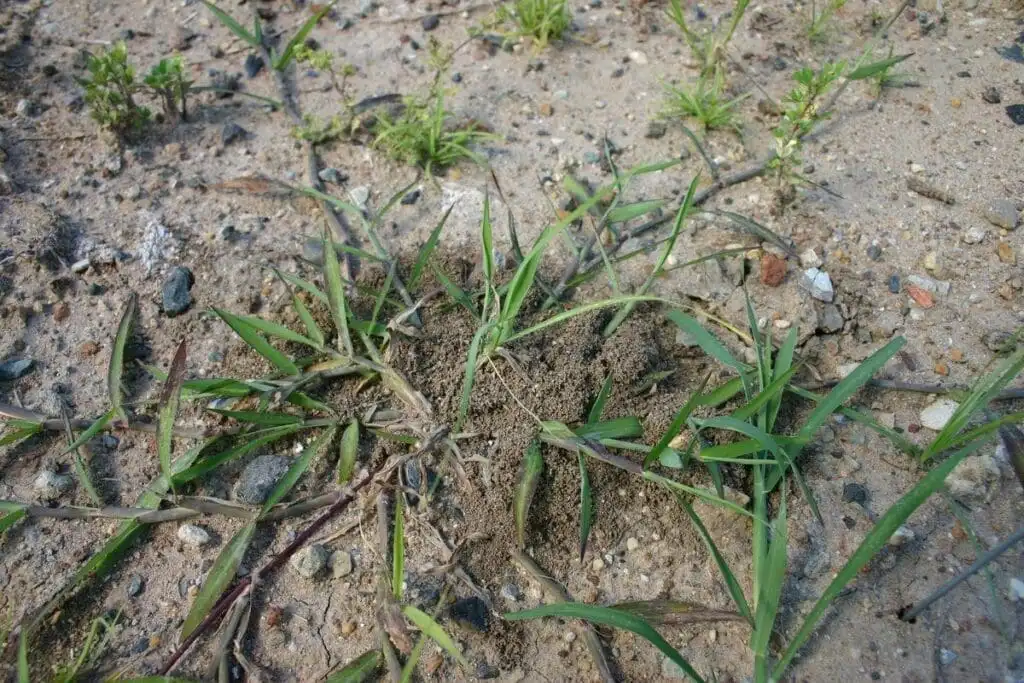
Image: A fire ant mound forming in sparse turf and soil. Fire ant mounds often appear in thin or bare areas of the lawn where soil is exposed, along edges, and in areas with poor turf coverage. Healthy, dense turf makes mounds more visible and easier to spot during regular mowing.
Why Fire Ants Keep Coming Back to Your Oklahoma Yard
Even with effective treatment, fire ants are a continuous management challenge rather than a one-time fix. Understanding why they return helps set realistic expectations.
Your neighbors' yards are untreated. Fire ants do not respect property lines. If your property is treated but the properties around you are not, fire ants from neighboring yards will continuously reinvade. Foraging workers from adjacent colonies expand their territory into your yard, and new queens from mating flights land on your property from surrounding areas. Consistent treatment maintains a hostile environment that kills reinvading ants before they can establish.
Mating flights distribute new queens constantly. After every warm, humid rain event in spring and fall, mature fire ant colonies release thousands of winged queens that fly, mate, land, and attempt to establish new colonies. You cannot prevent queens from landing on your property. What you can do is maintain a treated environment where newly landed queens and their small starter colonies encounter product before they can grow into mature colonies.
Fire ant colonies can relocate. Fire ants can move their colony to avoid unfavorable conditions. Flooding, extreme drought, soil disturbance, and even partial chemical treatment can trigger a colony to relocate. A colony that you thought you eliminated may have simply moved to a different part of your yard and resurfaced weeks later.
Oklahoma's expanding fire ant range means increasing pressure. Fire ant populations in the Tulsa area have been increasing over the past two decades as the species continues to expand northward. Mild winters have allowed fire ants to survive further north and in greater numbers than they did 20 years ago. The long-term trend is toward more fire ants, not fewer, which makes ongoing management increasingly important.
Where Fire Ants Build Mounds on Oklahoma Properties
Along sidewalks, driveways, and hardscape edges. Fire ants are attracted to the warmth that concrete and stone absorb from the sun. Sidewalk edges, driveway borders, patio perimeters, and retaining walls all radiate heat into the adjacent soil, which fire ants prefer. If you walk the edges of your hardscape, you will often find more mounds there than in the middle of the lawn.
Near foundations and utility boxes. Foundation walls warm the soil on their south and west sides, and fire ants frequently build mounds along foundation perimeters. They are also attracted to electrical fields and commonly infest electrical junction boxes, air conditioning units, traffic signal boxes, and other electrical equipment. Fire ant infestations in electrical equipment can cause short circuits and costly damage.
In open, sunny areas of the lawn. Unlike fleas and ticks that prefer shade, fire ants build mounds in sunny areas. They need warmth for brood development, and sunny lawn areas provide the soil temperature they prefer. This is why fire ant mounds are often most visible in the sunniest parts of your yard.
In landscape beds and along fence lines. While fire ants prefer warm soil for their mounds, they also build in disturbed soil areas, mulched beds, and along fence lines where the soil has been loosened by previous activity or construction.
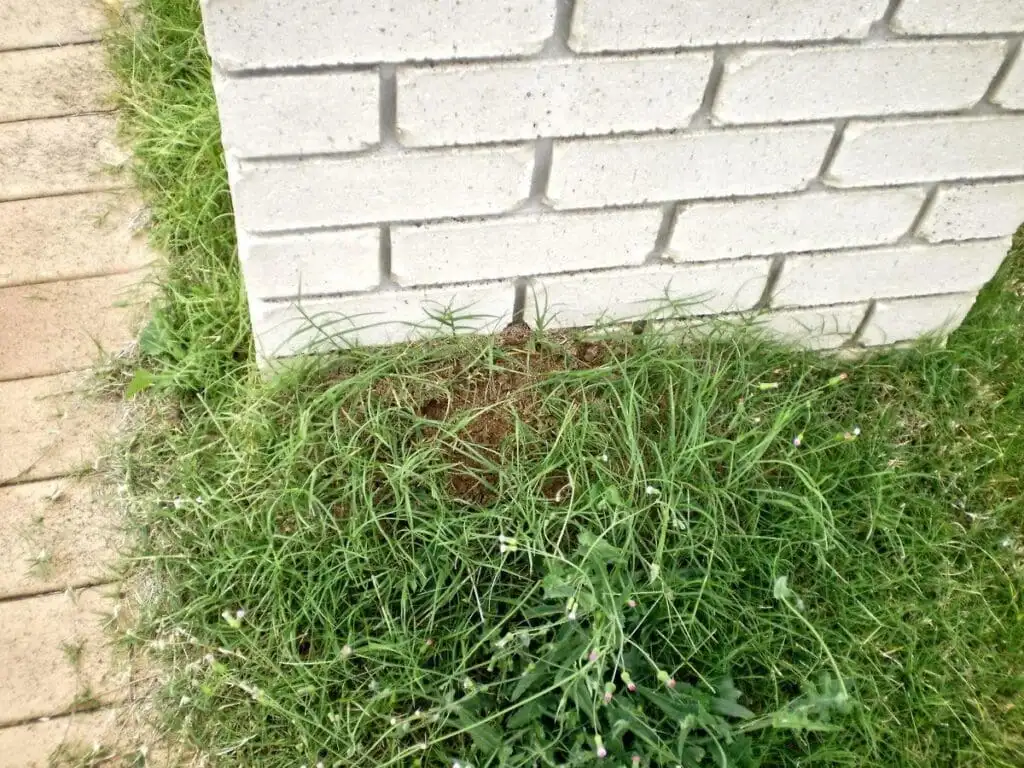
Image: A fire ant mound building against a foundation wall and sidewalk edge. Fire ants are attracted to the warmth that concrete and masonry absorb from the sun. Foundation perimeters and hardscape edges are among the most common locations for fire ant mounds in Oklahoma.
Lawn Care Practices That Help Manage Fire Ants
While chemical treatment is the primary tool for fire ant control, how you maintain your lawn affects fire ant activity and your ability to manage them.
A thick, healthy lawn makes fire ant mounds more visible and easier to treat. Thin, patchy turf with bare soil areas gives fire ants more options for mound construction and makes mounds harder to spot because there is no consistent turf surface to contrast against. Dense, well-maintained turf forces mounds to the surface where you can find and treat them. At Complete Lawn Care, our 7-step lawn care program builds the kind of thick, healthy turf that supports both lawn health and pest management.
Consistent mowing helps you spot new mounds early. When your lawn is mowed weekly, you or your mowing crew walk the entire property on a regular schedule. This weekly walkthrough is an opportunity to spot new fire ant mounds before they become large, established colonies. A small mound caught early is far easier to treat than a mature colony with hundreds of thousands of workers. Complete Lawn Care's weekly mowing service means trained crew members are on your property regularly and can flag new mound activity.
Proper irrigation management matters. Fire ants are attracted to moisture, and irrigation can create the moist soil conditions they prefer. Overwatering or having irrigation heads that create consistently wet areas can attract fire ant activity. Proper irrigation delivers the right amount of water at the right times without creating standing wet zones. At Complete Lawn Care, our irrigation repair, maintenance, and service ensures your system is watering efficiently, which helps with both turf health and pest management.
Soil health affects everything. Healthy soil supports the dense turf that helps manage fire ants, holds the right amount of moisture without staying saturated, and supports the biological activity that contributes to overall property health. Complete Lawn Care offers soil testing as a service, and we recommend homeowners have their soil tested at least once a year. Knowing your soil's pH, nutrient levels, and organic matter content allows for targeted corrections that improve turf density and overall property conditions.
Fire Ant Stings and Safety in Oklahoma
Fire ant stings are painful and, for some people, dangerous. When a fire ant mound is disturbed, hundreds of workers swarm out within seconds and climb onto whatever disturbed the mound, usually your foot and leg. They anchor with their jaws and sting repeatedly, injecting venom with each sting. A single fire ant can sting multiple times, and because dozens or hundreds of ants swarm simultaneously, a single mound encounter can result in dozens of stings within seconds.
Fire ant stings produce a characteristic white pustule. Within 24 hours of a sting, a small raised white blister forms at each sting site. These pustules are unique to fire ant stings and are the clearest indicator of what stung you. They typically last one to two weeks. Avoid popping the pustules, as this can lead to secondary infection.
Allergic reactions are a serious concern. Approximately one to two percent of people are allergic to fire ant venom, and reactions can range from excessive localized swelling to full anaphylaxis. Children, elderly individuals, and people with known insect sting allergies are at higher risk. If you or a family member has ever had a severe reaction to fire ant stings, carrying an epinephrine auto-injector (EpiPen) and having an allergy action plan is important. Seek emergency medical attention immediately for any signs of anaphylaxis: difficulty breathing, facial swelling, dizziness, rapid pulse, or widespread hives.
Pets are also at risk. Dogs and cats can be stung severely when they encounter fire ant mounds, especially around the paws, belly, and face. Puppies, kittens, and small breeds are particularly vulnerable. Pets confined to a small area (a kennel or dog run) near an active mound may sustain hundreds of stings. In rare cases, fire ant stings can be fatal to small animals. Managing fire ants in your yard is a pet safety issue as much as a human comfort issue.
When to Call a Professional for Fire Ants
DIY fire ant treatment can be effective for minor problems, but there are situations where professional pest control is the better choice.
Large properties with heavy infestations. If you are counting more than 10 to 15 active mounds on your property, the infestation is significant enough that professional treatment will be more efficient and thorough. Broadcast bait application on a large lawn requires the right equipment and consistent coverage. Professional applicators have the equipment and experience to cover the property evenly.
Properties with children and pets. When small children or pets use the yard daily, effective fire ant control is not optional. The risk of multiple stings, allergic reactions, and the anxiety of constantly watching where kids step makes professional treatment a worthwhile investment. A professional program also eliminates the need for you to handle and apply pesticide products yourself.
Recurring infestations despite DIY treatment. If you have been treating mounds individually for months and new mounds keep appearing, you are caught in the reactive cycle that only broadcast treatment can break. A professional program that includes broadcast bait applications and mound follow-up addresses the full population rather than just the visible symptoms.
Fire ants in sensitive areas. Mounds in or near playgrounds, dog runs, garden beds, electrical utility boxes, air conditioning units, and other sensitive locations require careful, targeted treatment. Fire ants are attracted to electrical fields and frequently infest electrical boxes, air conditioning units, and other equipment, causing short circuits and equipment damage. Professional technicians know how to treat these sensitive locations effectively and safely.
For more than 25 years, Complete Lawn Care has been a trusted lawn care provider in the Tulsa area. We believe great results do not come from guessing. They come from experience, science, and continual improvement. Our pest control program addresses fire ants alongside fleas, ticks, and other common Oklahoma pests through targeted treatments and broadcast applications that manage the entire pest population on your property. We adjust throughout the season because conditions, soil moisture, and pest pressure are always changing. Every lawn is different, and every application is intentional. At Complete Lawn Care, we do not guess at what might work. We apply what does work.
Take Back Your Yard from Fire Ants
Complete Lawn Care's pest control program manages fire ants as part of a comprehensive approach to the pests that affect your Oklahoma property. Combined with our 7-step lawn care program, weekly mowing, mosquito control, landscape maintenance, and irrigation service, we address the conditions that support pest populations. No contracts. No subscriptions. Serving Tulsa, Broken Arrow, Bixby, Jenks, Owasso, and Sand Springs.
Call us today: (918) 605-4646
Get a Free Quote at completelawncaretulsa.com
Experience. Science. Intentional Lawn Care. That's the Complete Lawn Care Difference.