Does Mowing Direction Actually Affect Lawn Density?
Yes — mowing direction has a real and measurable effect on lawn density over time. Rotating mowing direction encourages more upright blade growth, distributes soil compaction evenly, and allows sunlight to reach deeper into the turf canopy where new shoots develop. Over a full growing season, consistent direction rotation is one of the most impactful free changes any homeowner can make to improve lawn density.

A Complete Lawn Care crew member mows a Tulsa-area front yard. Direction rotation is a standard practice on every Complete Lawn Care visit — not because it looks impressive in the moment, but because it produces measurably thicker, healthier turf over a full season of consistent weekly mowing.
How Mowing Direction Influences Turf Density: The Three Mechanisms
The connection between mowing direction and lawn thickness is not intuitive because the cause-and-effect chain plays out over weeks and months rather than immediately after a single mow. Understanding the three mechanisms involved makes the relationship clear.
Mechanism 1: Lawn Lean Reduces Light Penetration
When grass blades lean consistently in one direction due to same-direction mowing, the canopy tilts and the lower portions of the plant receive less light. Fewer tillers develop. The lawn maintains itself but does not thicken. Over a full season, the difference between a leaning canopy and an upright one is visible in overall lawn density — particularly in warm-season grasses like Bermuda that rely heavily on lateral tiller spread for their characteristic tight, dense growth.
Mechanism 2: Compacted Wheel Paths Restrict Root Growth
Mower wheels traveling the same path every week compress the soil in those strips. In the Tulsa area's predominantly clay-based soils, this compaction accelerates quickly and is slow to reverse. Compacted soil has less pore space — meaning less room for air and water to move through. The strips of compacted soil literally produce thinner grass than the uncompacted areas between them, and over multiple seasons, these compaction differentials become visible as subtle but persistent thin lines in the lawn.
Mechanism 3: Upright Grass Cuts Better and Stresses Less
When grass leans away from the direction of travel, the blade strikes the side of the leaf rather than the tip — tearing rather than cutting. Torn tissue loses moisture faster, is more susceptible to fungal disease entry, and triggers a stress response that temporarily redirects energy away from root and tiller development toward wound recovery. Repeated tearing creates a chronic low-level stress that suppresses the aggressive growth needed for maximum density.
What Rotating Mowing Direction Actually Does to Turf
When you rotate mowing direction — even simply alternating between two perpendicular axes, or adding diagonal passes — each of the three mechanisms above shifts in a positive direction.
Upright Canopy
Blades are bent in different directions on consecutive mows, preventing permanent lean. The canopy stays more upright, allowing better light penetration to lower growth zones and supporting active tiller development.
Even Compaction Distribution
Wheel paths shift to different ground on every visit, distributing compaction pressure across the full lawn surface rather than concentrating it in the same strips. No single area bears repeated concentrated weight week after week.
Cleaner Cuts, Less Stress
The mower blade strikes grass blades at varying angles, producing cleaner cuts more consistently. Less tearing means less stress, less moisture loss from cut surfaces, and less disease vulnerability across the entire lawn.
The cumulative effect of these three improvements, sustained across a full growing season, produces a measurably denser lawn. By mid-season on a lawn mowed with consistent direction rotation versus one mowed the same direction every week, the density difference is visible to anyone paying attention.
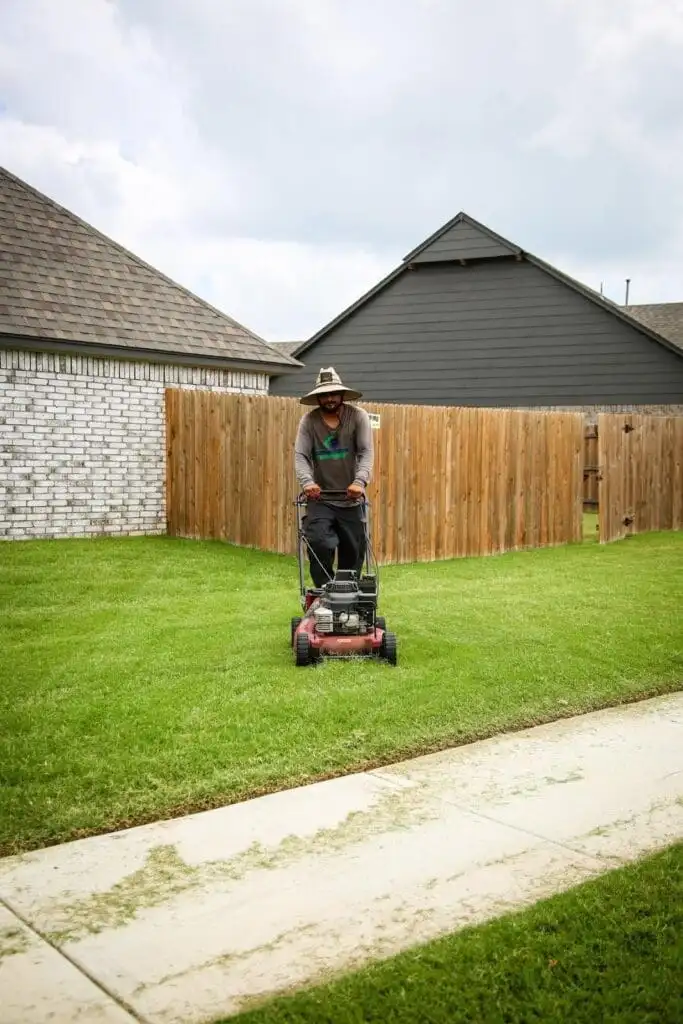
Complete Lawn Care crew maintaining a Tulsa-area backyard at proper seasonal height. The relationship between mowing height, direction rotation, and turf density is cumulative — each correct mowing decision builds on the previous one, and the results compound over a full season into noticeably thicker, more competitive turf.
Mowing Height Is the Other Half of the Density Equation
Mowing direction alone cannot overcome the damage done by consistently cutting too short. Height and direction work together, and on Oklahoma lawns in particular, cutting height has a direct influence on how thick the grass grows. Every time a grass plant is mowed, it temporarily redirects carbohydrate reserves from root development to replacing the leaf tissue that was removed. The more leaf tissue removed in a single cut, the longer and more resource-intensive that recovery period.
For the Bermuda grass that dominates most Tulsa-area lawns, maintaining the lawn at 1.5 to 2 inches during Oklahoma's peak summer heat helps preserve the root depth and shoot density that translates to a thick, competitive stand in the fall. Cutting it back aggressively during a July heat wave trades short-term appearance for real density loss over the remainder of the season.
The One-Third Rule: Most Important Height Guideline for Lawn Density
Never remove more than one-third of the grass blade in a single mow. Exceeding one-third triggers emergency leaf regeneration, pulling resources from roots and tillers. Example: Bermuda maintained at 1.5" should be mowed when it reaches ~2.25", not at 3". If a rainy stretch lets the lawn get away, raise the height for the first mow, remove one-third, then step back down over 2–3 mows. Consistent application of this rule across a full season produces measurably thicker turf.
Other Mowing Practices That Support Lawn Thickness
Direction rotation and correct height set the foundation. These additional practices further support the kind of turf density homeowners in the Tulsa area are working toward.
Sharp Blades
A clean cut closes faster and triggers less stress response than a torn cut. Sharpen mower blades at least twice per growing season — at spring startup and again mid-summer. Sharpen or replace after any hard impact with a buried root or concrete edge.
Mulching Clippings
Returning clippings to the lawn returns an estimated 25 to 30 percent of the nitrogen applied over a season, essentially providing a slow-release fertilizer with every mow. Mulched clippings decompose quickly on a healthy lawn maintained at the right height during Oklahoma's warm summer months.
Consistent Mowing Frequency
Allowing the lawn to grow significantly between mows forces you to remove more than one-third of the blade in a single cut. During Bermuda's peak growing season in June and July, weekly mowing is typically the minimum frequency needed. Some lawns may need mowing every five to six days.
Mowing in the Morning or Evening
Cutting grass during the hottest part of the Oklahoma afternoon exposes fresh-cut surfaces to maximum heat and drying stress. Morning mowing — after dew has dried but before peak heat — is the professional standard. It minimizes stress at the moment the plant is most vulnerable to it.
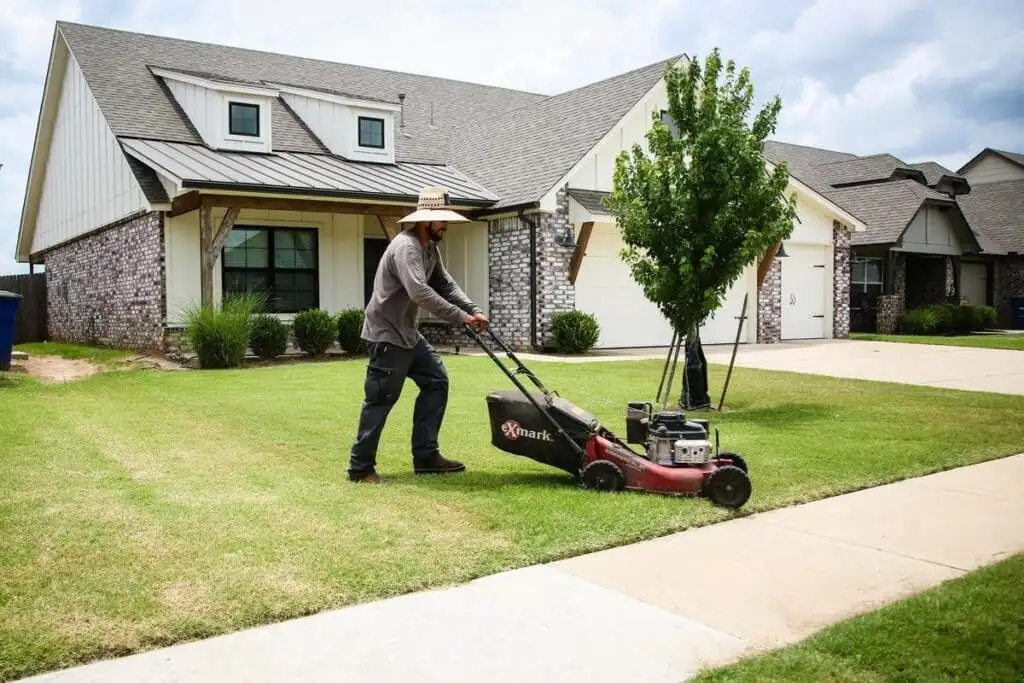
A Complete Lawn Care crew member works a Tulsa-area front yard with a commercial Exmark mower. Commercial-grade equipment maintained with sharp blades, operated at correct height settings, and directed in rotating patterns every visit produces the kind of consistent results that build lawn density over a full season.
What Mowing Cannot Fix: The Limits of Technique
Mowing practices influence density significantly over a full season, but they work within the constraints of what the rest of your lawn care program provides. A lawn that is deficient in nitrogen will not thicken significantly regardless of how precisely it is mowed. A lawn with severe soil compaction throughout will not respond to direction rotation alone until the underlying compaction is addressed through core aeration.
The most common scenario in Tulsa-area lawns where mowing improvements produce limited results: the soil pH is out of range for the grass type, and nutrients are locked up regardless of what is applied. Oklahoma's clay soils can trend toward both acidic and alkaline conditions depending on irrigation source, organic matter content, and rainfall patterns. When pH is off, fertilizer programs produce disappointing results and lawns struggle to thicken even with perfect mowing practices.
This is why Complete Lawn Care recommends annual soil testing for every lawn we service. A soil test tells you the actual pH and nutrient status of your specific soil — not a guess based on what typically works in the region. When mowing practices are correct and the soil program is calibrated to what your lawn actually needs, the two work together to produce the density that neither can achieve independently.
Mowing Direction and Lawn Thickness at a Glance
How different mowing practices play out over a full Oklahoma growing season:
Same Direction Every Mow
Grass leans, roots weaken in compacted wheel paths, light penetration drops, density declines gradually. Result: thin stripes over compaction paths; matted, flat appearance.
Alternating 2 Directions
Compaction distributes more evenly, blades stay more upright, light penetration improves. Result: more uniform density across the lawn with reduced thin-stripe patterns over a full season.
Full Rotation + Correct Height + Sharp Blades
All three density mechanisms work in your favor simultaneously. Combined with proper soil care, this produces the thickest, most competitive turf possible from mowing alone.