
Complete Lawn Care • April 2026 • Tulsa, OK
Short Answer: April is the month your Tulsa lawn transitions from dormant to actively growing, which makes it the most important month for setting the tone of the entire season. The essential spring tasks are: apply pre-emergent weed control if you have not already, put down the first fertilizer application once soil temperatures hit the mid-50s, start your sprinkler system and check for damage from winter, clean up leaves and winter debris, adjust mowing height for the growing season, and watch for early signs of weeds and pest activity. Getting these things right in April puts your lawn in a position of strength heading into the hot months. Here is the full checklist.
If you are standing in your yard this April and thinking it looks rough, you are not alone. Tulsa lawns come out of winter looking thin, tired, and patchy. That is normal. What you do in the next few weeks determines whether the lawn bounces back into a healthy, green carpet by June or whether it spends the whole summer playing catch-up.
Here is a checklist we use internally for our clients. It covers everything that should happen on a Tulsa metro lawn between now and early May.
1. Apply Pre-Emergent Weed Control (If You Have Not Already)
Pre-emergent herbicide stops weed seeds from germinating. The window for spring pre-emergent in the Tulsa area closes as soil temperatures rise. Ideally, pre-emergent goes down in February or early March. If you missed that window, there is still value in applying it in early April, but the effectiveness decreases the later you wait.
The spring pre-emergent targets crabgrass, foxtail, goosegrass, and other annual grassy weeds that plague Oklahoma lawns. Without pre-emergent, these weeds will take over thin spots in your lawn by June.
2. Start and Inspect Your Sprinkler System
April is when your sprinkler system comes out of winter dormancy. Before you start relying on it, run through each zone and check for issues. Winter freezes can crack heads, damage backflow preventers, and break underground lines. Catching problems now means they get fixed before your lawn needs consistent watering in May and June.
Things to check: each head pops up and sprays the right pattern, no zones have obvious leaks or geysers, the controller is programmed correctly for spring (shorter run times than summer), and the rain sensor is functional.
3. Clean Up Leaves and Winter Debris
Any leaves, sticks, or debris still on the lawn from fall needs to come up. This stuff smothers the grass underneath and creates conditions that encourage disease and insect activity. A thorough spring cleanup gets the lawn ready to receive sunlight, water, and nutrients.
While you are cleaning up, take note of any bare patches, thinning areas, or obviously damaged zones. These are the areas that need extra attention as the season progresses.
4. Apply the First Fertilizer Application
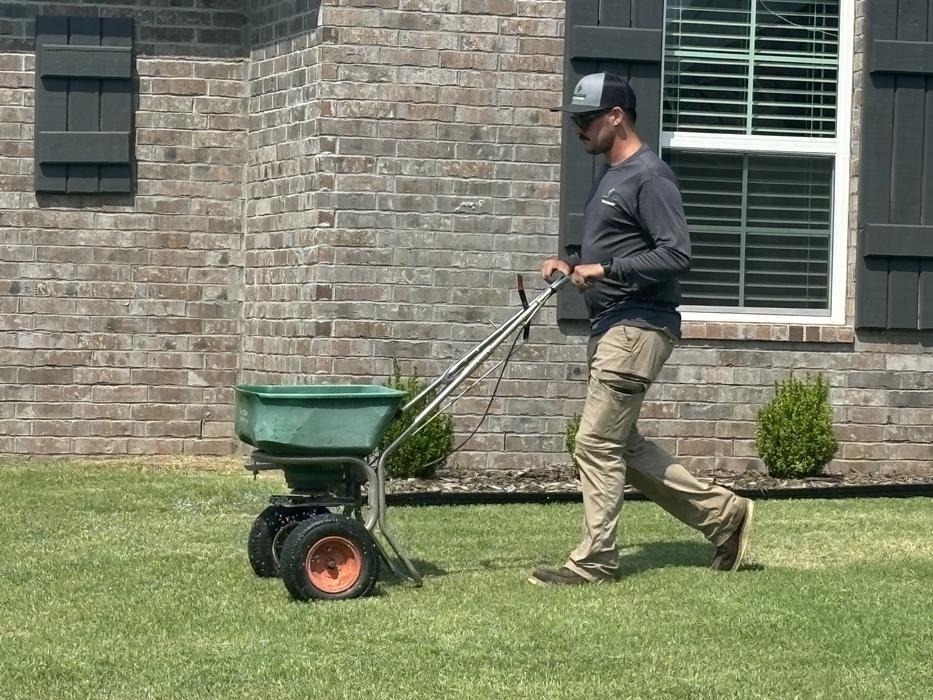
The first fertilizer application of the season goes down when soil temperatures are consistently in the mid-50s and the grass is showing early signs of green-up. In the Tulsa area, this usually means late March to mid-April depending on the year.
This first application is typically a slow-release fertilizer that feeds the grass gradually as it ramps up into active growth. Avoid the temptation to dump a quick-release high-nitrogen product on the lawn to try to push it green. That approach often burns the grass or causes rapid top growth without supporting root development.
5. Adjust Your Mowing Height
As your grass starts growing, you are back to regular mowing. For Bermuda lawns in the Tulsa area, the correct height is 1 to 2 inches. For Fescue lawns, 3 to 4 inches. For Zoysia, 1.5 to 2.5 inches.
The “one-third rule” applies: never remove more than one-third of the blade height in a single mowing. If your grass has grown taller than it should be, gradually bring it down over several mowings rather than scalping it in one cut.
Sharp mower blades are critical. A dull blade tears the grass rather than cutting it, which leaves ragged edges that turn brown and create entry points for disease. Blades should be sharpened at least twice per season for a residential user and more often for professionals.
6. Watch for Early Weeds and Pest Activity
Even with pre-emergent in place, some weeds will still appear. Winter annual weeds like henbit, chickweed, and dandelions are active in spring and can be spot-treated with a selective post-emergent herbicide. Addressing them now when they are small is much easier than letting them establish.
Pest activity also begins in April. Watch for signs of fire ants as they come out of winter, and start monitoring for early-season lawn insects. Nothing major usually happens this early, but being aware of what is normal helps you spot problems when they do develop.
7. Plan for Aeration (If Needed)
Oklahoma’s red clay soil is notorious for compaction, which limits root growth and reduces the effectiveness of water and fertilizer. If your lawn has not been aerated recently, spring is one of the two ideal windows for aeration (fall is the other).
Aeration pulls small plugs of soil from the lawn, which opens up the compacted layer and allows air, water, and nutrients to reach the root zone. The lawn visibly looks better within a few weeks of aeration.
8. Set Realistic Expectations for Recovery
A lawn that came out of winter looking rough will not be green and full overnight. Proper spring care sets the foundation for gradual improvement through April and May, with the lawn typically reaching its full appearance by late May or June. Be patient, stay consistent with the basics, and trust the process.
The pattern we see year after year is consistent: the lawns that look best by June are almost always the ones that started their spring tasks in March. The ones that wait until May have more to catch up on and less time to do it, and that gap rarely closes inside a single season.
What to Do Next
If working through a checklist sounds like more time than you want to invest, or if you have already tried DIY spring care and want a different result this year, give us a call at (918) 605-4646 or request a quote online. Here is what to expect: we respond the same day, use satellite imaging to measure and assess your property (no walkthrough required, though if you want us on site we can usually be there same day or next), and send you a customized quote within a few days. If it is a fit, your first service is typically within a week. No contracts. Cancel anytime. Let us get your lawn off to the right start this year.