
The most effective way to redirect downspout water away from your foundation is to extend the downspout discharge point at least six to ten feet from the house using either a surface extender or an underground downspout drain that carries water to a pop-up emitter or a suitable outlet well away from the foundation. A splash block at the base of the downspout is not sufficient on its own — it slows erosion at the discharge point but does not move water far enough from the foundation to prevent saturation of the soil next to the house. In Oklahoma’s clay-heavy soils, where water moves slowly and saturated soil stays saturated for days, inadequate downspout extension is one of the most common and most easily fixed contributors to foundation moisture problems, wet basements, and persistent wet areas in the lawn directly adjacent to the house.
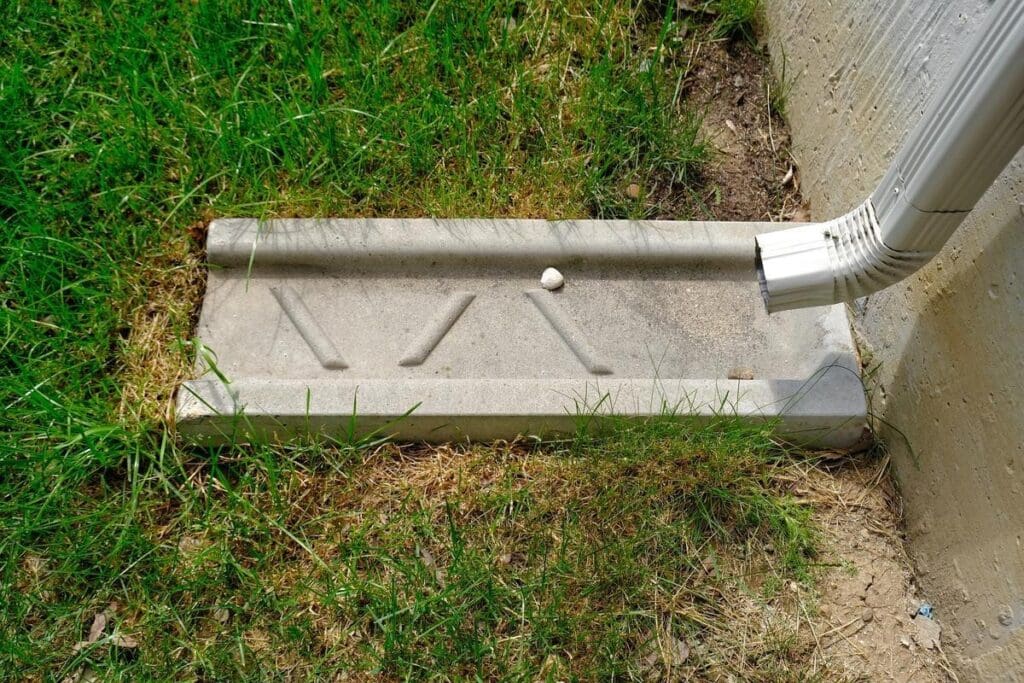
A concrete splash block at a downspout discharge — a common sight on Tulsa-area homes. Splash blocks redirect water away from the elbow point and slow soil erosion at the discharge, but they typically deposit water only one to two feet from the foundation. In Oklahoma’s slow-draining clay soil, this is rarely far enough to prevent foundation-area saturation during heavy rain events.
Why Downspout Discharge Location Matters More Than Most Homeowners Realize
A standard residential roof collects an enormous amount of water during Oklahoma rain events. During a one-inch rainfall on a 2,000-square-foot roof, approximately 1,250 gallons of water flow through the gutter system. A single downspout handling a 500-square-foot section of that roof discharges more than 300 gallons in a one-inch rain — in less than an hour during a typical Oklahoma storm. All of that water exits at one point, within a few feet of your foundation, in soil that is already among the slowest-draining in the country.
Oklahoma’s expansive clay soil — the reddish-orange clay found throughout the Tulsa metro area — is particularly vulnerable to the repeated wetting and drying cycles that inadequate downspout discharge creates. When clay soil adjacent to a foundation repeatedly saturates and then dries, it expands when wet and contracts when dry. This movement exerts pressure on foundation walls when saturated and can cause cracking and settling when it pulls away during dry periods. The foundation movement issues that Tulsa homeowners spend thousands of dollars on in pier repairs are frequently traceable, at least in part, to inadequate management of the water delivered by their downspouts.
The fix — extending the discharge point further from the house — is usually far less expensive than the damage it prevents. That is the reason most foundation repair contractors list downspout extension as their first recommendation to homeowners trying to prevent future foundation problems.
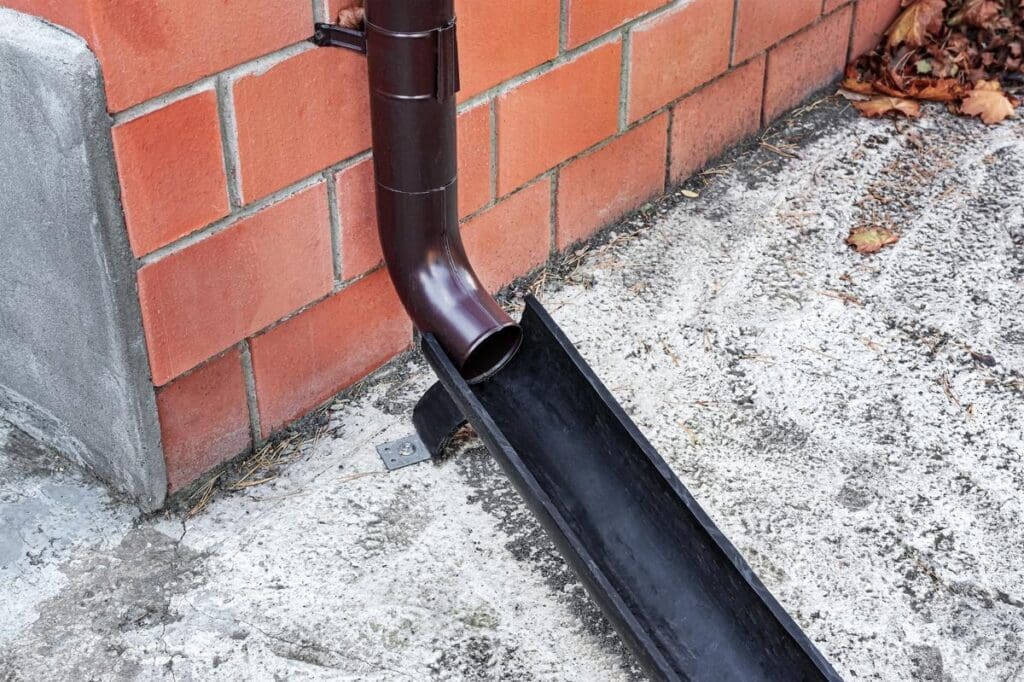
A downspout extender (downspout shoe) directing water along a hard surface away from the foundation. Surface extenders like this are effective when they are long enough — the minimum functional length on clay soils is 6 feet, with 8 to 10 feet preferred — and when the discharge end is directed toward a slope that carries water away from the property. Short extenders that simply move the discharge point 2 feet from the foundation provide limited protection in Oklahoma’s clay.
Option 1: Surface Downspout Extenders
The simplest and least expensive solution is a rigid or flexible surface extender — a length of downspout pipe or flexible corrugated tube that connects to the existing downspout elbow and directs the discharge point further from the foundation along the ground surface. These are widely available at hardware stores and are a legitimate DIY project.
The critical requirement that most product descriptions understate: the extender needs to be long enough to actually move the water out of the foundation saturation zone. On clay soil, six feet is the practical minimum, and eight to ten feet is better. The two-foot or four-foot plastic extenders sold in the impulse-purchase section of hardware stores are not adequate for protecting foundations on Oklahoma clay — they just move the saturation point two feet further than the splash block.
Surface extenders work well in situations where there is a slope away from the house or where the discharge end can reach a lawn area with adequate drainage capacity. Their limitations: they are on the surface, which means they are in the path of mowers and foot traffic; rollout and accordion-style extenders frequently get detached or crushed; and they are visible, which bothers some homeowners aesthetically. For permanent, low-maintenance downspout management, an underground system is more reliable.
Option 2: Underground Downspout Drains
An underground downspout drain system connects to the existing downspout at grade level and carries roof water through buried non-perforated pipe to a pop-up emitter located well away from the foundation — typically 10 to 20 feet out into the yard, near the property perimeter, or connected to a storm drain where local codes permit.
This is the preferred solution for most Tulsa-area homes because it removes the discharge from the lawn surface entirely, keeps the water invisible until it exits at the emitter, and is not subject to damage from mowing or foot traffic. Once installed correctly, an underground downspout drain requires essentially no maintenance and functions reliably for decades.
The key components of an underground downspout drain system:
Downspout adapter: A fitting that connects the downspout to the underground pipe at or slightly below grade level. The adapter typically includes a cleanout access point — useful for flushing the system if debris accumulates over years.
Non-perforated solid pipe: This is important — underground downspout drains use solid pipe, not the perforated pipe used in French drains. The goal is to carry water to the outlet, not to distribute it into the surrounding soil. Using perforated pipe defeats the purpose and creates a subsurface wet zone along the pipe run.
Proper slope: The pipe must maintain consistent downhill grade from the downspout connection to the outlet — a minimum of one percent grade (one inch of drop per eight feet of run) to ensure reliable gravity flow. Insufficient slope produces standing water in the pipe that can freeze and crack it in winter, and causes silt accumulation that eventually clogs the system.
Pop-up emitter: A small device installed at the outlet end that opens under water pressure and releases flow, then closes when the flow stops to prevent soil, debris, and rodents from entering the pipe from the outlet end. Pop-up emitters are far superior to open-end pipe outlets for long-term system reliability.
How to Install an Underground Downspout Drain: Step by Step
- Call 811 before digging. Oklahoma’s free dig-safe utility marking service must be contacted before opening any trench. Irrigation lines, landscape lighting wiring, gas lines, and cable are all commonly found in the area between the foundation and the lawn. This call is legally required and practically critical.
- Plan the outlet location. Identify where the discharged water will go. The emitter should be placed where water can flow away from the property, not pool against a fence or flow toward a neighbor’s foundation. The outlet must be lower than the connection point to ensure gravity flow. Map the pipe run from downspout to outlet and measure the total elevation difference available.
- Excavate the trench. Dig a trench 8 to 12 inches deep along the planned pipe run. The trench should be just wide enough to lay the pipe comfortably — typically 6 to 8 inches wide. Maintain consistent downhill slope from connection to outlet. In Tulsa’s clay soil, hand digging is practical for short runs; a trenching tool or small power trencher makes longer runs manageable.
- Lay the pipe. Use 3-inch or 4-inch solid corrugated or PVC pipe. Corrugated black polyethylene pipe is the most commonly used — it is flexible enough to follow slight curves in the trench, connects easily with push-fit fittings, and is durable in Oklahoma’s soil conditions. Connect the downspout adapter at the upper end and the pop-up emitter at the lower end.
- Backfill and restore the surface. Backfill the trench with the excavated soil, tamp lightly, and restore the lawn surface. The trench typically becomes invisible within one to two growing seasons as grass fills back in.
- Test the system. Run a garden hose into the downspout or wait for the next rain and verify that water flows freely from the pop-up emitter. Confirm the emitter is popping open under flow and closing when flow stops.
| Underground Downspout Drain: Tulsa-Area ConsiderationsTypical DIY material cost: $50-$150 for a 15-20 foot run (pipe, adapter, emitter, fittings).Professional installation: $300-$800+ depending on run length, access, and outlet options.Multiple downspouts can be connected to a single underground line to minimize trenching.Avoid routing pipe under driveways or hardscape without adequate burial depth and pipe strength.In neighborhoods with curb-and-gutter, check whether connecting to the storm sewer inlet is permitted. Many Tulsa-area municipalities allow this; always verify with the city before connecting.Freeze protection: bury pipe at least 6 inches deep and ensure pop-up emitter drains when closed. |
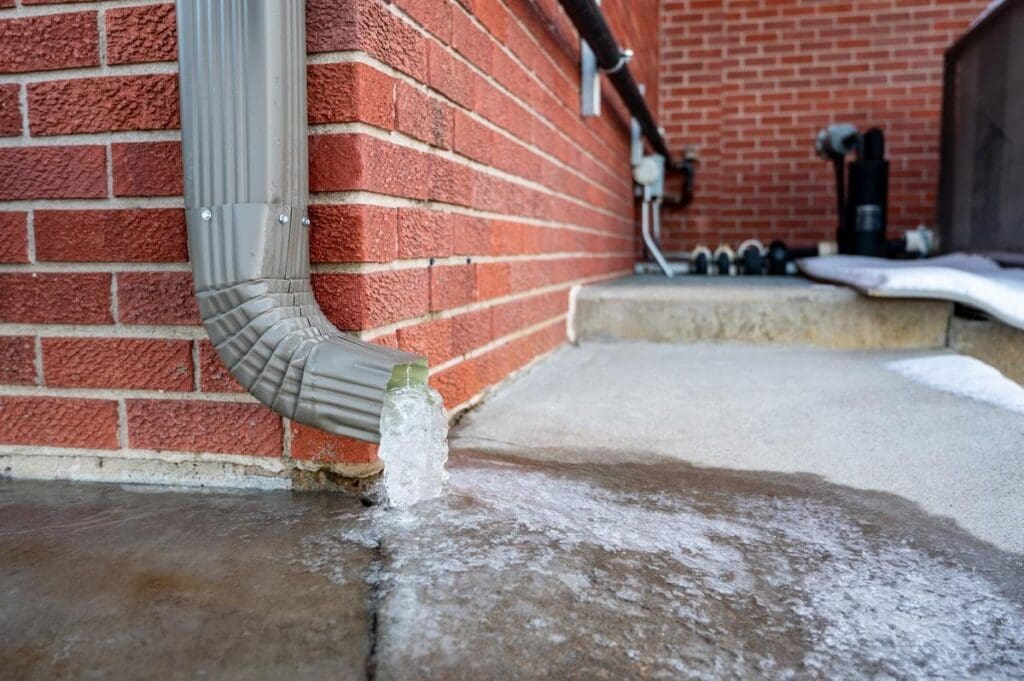
A downspout discharging directly onto a concrete surface with water running toward the foundation — a scenario common on Tulsa-area homes where the original downspout configuration was never updated after construction. Water running along concrete toward the foundation creates exactly the wetting cycle that causes clay soil expansion, pressure on foundation walls, and eventual structural movement. Redirecting this discharge 10 or more feet from the house is among the most cost-effective foundation protection measures available.
The Splash Block Limitation: What It Does and Does Not Do
Splash blocks are not worthless — they serve a genuine purpose by breaking the concentrated force of water exiting the downspout, preventing a scour hole from forming in the soil directly below the discharge point, and redirecting water a short distance away from the foundation wall. They are better than an unprotected discharge opening directly against the foundation.
What they do not do: move water far enough from the foundation to prevent the foundation-adjacent soil from repeatedly saturating on Oklahoma clay. A splash block typically deposits water one to two feet from the foundation. On sandy soil with good infiltration, this may be adequate. On Tulsa’s clay, that water has nowhere to go quickly and simply saturates the soil next to the house on every rain event.
Splash blocks are the appropriate solution for situations where a proper extender or underground system is in place and the splash block is used simply to protect the soil surface at the connection point. As the primary discharge management solution on a clay soil property, they are not sufficient.
What Happens If You Ignore Downspout Management
The consequences of inadequate downspout discharge management accumulate slowly but are genuinely expensive when they arrive:
- Foundation movement and cracking. Oklahoma’s expansive clay is the primary driver of foundation repair costs in the Tulsa area. Repeated saturation and drying cycles adjacent to the foundation cause the clay to swell and contract, eventually cracking foundation walls and causing differential settlement. Pier underpinning to correct foundation settlement costs $5,000 to $20,000 or more on a typical residential property.
- Wet basement or crawl space. For Tulsa-area homes with basements or crawl spaces, downspout discharge against the foundation is one of the most direct pathways for water intrusion. The hydrostatic pressure of saturated soil against a foundation wall will find any crack or penetration point.
- Persistent wet areas in the foundation-adjacent lawn. The strip of lawn directly in the discharge path of an unextended downspout frequently develops persistent wet areas, moss growth, fungal problems, and thin turf due to overwatering relative to the surrounding lawn. These areas also tend to develop low spots as the repeatedly saturated clay soil settles unevenly.
- Lawn care program effectiveness. Chronically wet areas near the foundation affect the effectiveness of fertilization and weed control applications in those zones. Waterlogged soil has different nutrient availability characteristics than well-drained soil, and pre-emergent and post-emergent applications perform differently in saturated conditions. The wet zone from an unextended downspout can create a persistent problem area that limits the results of an otherwise effective lawn care program.
Downspout Solutions at a Glance
Comparing the primary options for Tulsa-area homes:
| Solution | Cost Level | DIY or Pro | Notes for Tulsa-Area Homes |
| Splash block | Basic | DIY | Slows erosion at discharge point; does not move water far enough in most cases |
| Surface downspout extender | Basic to moderate | DIY | Affordable, easy install; must be long enough (6-10 ft minimum on clay soils) |
| Roll-out / accordion extender | Basic | DIY | Convenient but frequently disconnected by mowers; not a permanent solution |
| Underground downspout drain | Moderate | DIY or pro | Best permanent surface solution; keeps lawn clear; requires proper slope and outlet |
| Pop-up emitter | Moderate | DIY or pro | Used with underground drain; releases water when flow is present, closes when dry |
| Downspout to rain barrel | Moderate | DIY | Captures water for reuse; limited capacity; needs overflow routing plan |
| Downspout to rain garden | Higher | Pro recommended | Natural filtration; supports Oklahoma native plants; best for consistent large volumes |
Special Situations: Downspouts Near HVAC Equipment, Meters, and Utilities
Many Tulsa-area homes have downspouts located near HVAC condensing units, gas meters, electric meters, and irrigation backflow preventers. Routing an underground drain in these areas requires extra care. The water must still be redirected — parking a downspout discharge against an HVAC unit causes premature equipment corrosion and can affect efficiency — but the routing needs to work around utilities that cannot be disturbed.
In tight situations near utilities, running a longer surface extender to clear the equipment footprint before connecting to an underground system is often the most practical approach. If the downspout is directly adjacent to a gas meter or electrical service entrance, involving a professional who can locate all underground utilities before trenching is worth the additional investment.
How Downspout Management Connects to Your Lawn Health
For homeowners in Tulsa, Broken Arrow, Bixby, Jenks, Owasso, and Sand Springs who invest in a science-based lawn care program, properly managed downspouts contribute to that program’s effectiveness in ways that are easy to overlook. The foundation-adjacent areas of a lawn that receive repeated concentrated downspout discharge typically show measurably different soil characteristics than the rest of the lawn — higher moisture retention, different pH patterns, and root depth limitations in the saturated zone.
Complete Lawn Care recommends annual soil testing as part of every lawn program, and soil samples from chronically wet areas near downspouts frequently show conditions that require different treatment than the surrounding turf. Getting those areas properly drained is a precondition for getting them to respond normally to a lawn care program.
Irrigation and Drainage Service from Complete Lawn Care
With over 25 years of experience serving the Tulsa metro area, Complete Lawn Care’s irrigation service team diagnoses and corrects drainage problems related to irrigation systems, downspout discharge, and persistent wet areas throughout our service territory. We understand Oklahoma’s clay soils, the specific challenges they create for foundation drainage, and the practical solutions that hold up in our climate.
Our approach is the same one we apply to every service: understand the actual cause, recommend what will genuinely fix it, and do the work with the intention and attention to detail that produces lasting results. If a drainage issue affecting your lawn is also affecting your foundation, we will tell you that — and point you toward the right path forward, whether that is something we handle directly or something that needs a foundation specialist’s involvement.
Experience tells us what to do. Science tells us when and why. Every application — and every repair — is intentional.
Ready to Stop Downspout Water from Damaging Your Foundation and Lawn?
Contact Complete Lawn Care at completelawncaretulsa.com or call (918) 605-4646. We serve Tulsa, Broken Arrow, Bixby, Jenks, Owasso, and Sand Springs — and we’ll give you an honest assessment of what’s actually happening and what will fix it.
Experience. Science. Intentional Lawn Care — That’s the Complete Lawn Care Difference.