
By the lawn care experts at Complete Lawn Care | Serving Tulsa, Broken Arrow, Bixby, Jenks, Owasso, and Sand Springs
Mowing in circles occasionally will not damage your lawn, but doing it as your only mowing pattern week after week will. The real problem is not the circular path itself — it is the repetition. When your mower wheels travel the same route every time, soil compacts in those tracks, grass develops a lean (called grain) in one direction, and certain areas get scalped consistently on curved turns. Rotating your mowing pattern regularly is one of the simplest things you can do to keep your Tulsa-area lawn looking healthy and even all season long.
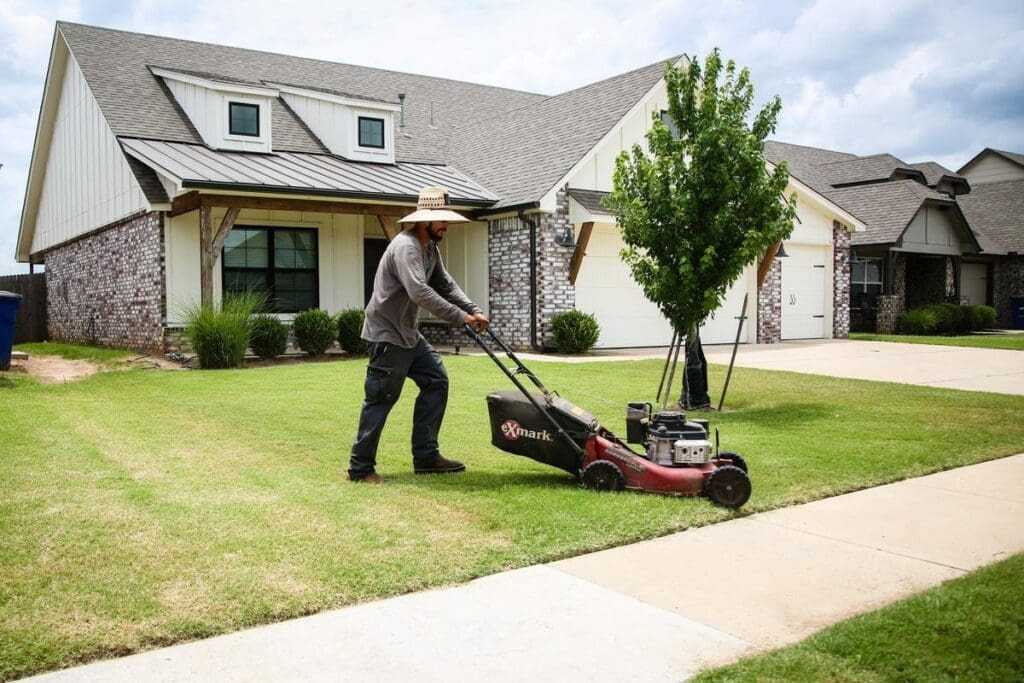
A Complete Lawn Care crew member mowing a Tulsa-area front lawn — note the clean, consistent lines that come from intentional pattern rotation each visit.
Why Repeating the Same Mowing Pattern Causes Problems
Think about what happens when a mower follows the exact same circular or straight path every single week. The wheels press into the soil in the same spots over and over. On Oklahoma’s clay-heavy soils — which compact more easily than sandier ground — those repeated wheel paths can create shallow ruts and hard, airless soil underneath. Compacted soil makes it harder for roots to penetrate, reduces water infiltration, and creates the conditions that weeds love.
There is also the issue of grain. Grass blades naturally bend in the direction they are repeatedly pushed. Mow the same direction every week and your turf starts to lay over in that direction rather than standing upright. This creates an uneven, sometimes matted appearance and can make the lawn look lighter or darker from different angles depending on how light reflects off the angled blades.
Tight circular turns are another concern. When a mower pivots repeatedly on the same spot, the inside wheel barely moves while the outside wheel pulls hard. That friction and torque can tear at the turf, especially during dry Oklahoma summers when the grass is already stressed. Over time you can end up with worn, thin patches right where those pivot points occur.
What Is the Right Way to Mow a Lawn for Pattern Variety?
The goal is simple: change your mowing direction each time you mow. If you mowed north to south last week, go east to west this week. If you did straight rows last time, try diagonal rows this time. That rotation ensures no single strip of soil bears the brunt of the mower wheels consistently, and it encourages grass blades to stand upright rather than lean in one direction.
For homeowners who prefer a circular approach — especially on irregular-shaped lawns where straight rows are harder to manage — the pattern still works fine as long as you shift where you start and which direction you circle. Alternating clockwise one week and counterclockwise the next helps distribute the traffic and turf stress more evenly.
At Complete Lawn Care, our crews are trained to rotate mowing patterns deliberately on every visit. It is one of those small details that makes a noticeable difference in turf quality over a full season — and it is something a lot of homeowners do not think about until they start seeing ruts or worn lines in their lawn.
Complete Lawn Care mowing a residential lawn in the Tulsa metro — professional mowing means more than just cutting grass, it means protecting the long-term health of your turf.
Does Mowing Height Matter When It Comes to Pattern Damage?
It does, and this is where many Tulsa homeowners unknowingly cause more damage than the mowing pattern itself. Cutting too short on curved turns is a common issue. When a mower follows a tight curve, the deck can tilt slightly, causing the blade to cut lower on the inside of the curve than it does on a straight pass. If you are already mowing at a low height, that slight tilt can scalp the grass — cutting below the green leaf tissue into the brown crown or thatch layer.
For Bermuda grass, which is the dominant turf type in most Tulsa-area lawns, a mowing height of 1.5 to 2.5 inches is generally recommended during the growing season. Zoysia grass does well at 1.5 to 2 inches. Tall fescue lawns, which you will find in shadier or cooler microclimates around the Tulsa metro, should be kept at 3 to 4 inches to maintain root depth and drought tolerance.
Keeping your blade sharp is equally important. A dull mower blade tears grass rather than cutting it cleanly. Torn blade tips turn brown, create entry points for disease, and give the lawn a ragged, faded look even when the pattern and height are correct. Blades should be sharpened at the start of each season and checked again mid-summer.
Does Mowing When the Grass Is Wet Make Pattern Damage Worse?
Yes, significantly. Wet soil is far more vulnerable to compaction than dry soil. Mowing after a heavy Oklahoma rain — or right after your irrigation system has run — puts mower weight on softened ground, which presses down more easily and recovers more slowly. Wet grass also clumps and clogs the deck, leaving heavy mats of clippings on the surface that can smother turf if not dispersed.
Whenever possible, mow when the grass has had time to dry following rain or irrigation. Early morning is usually fine if dew has dried off. Afternoon mowing during Oklahoma summers also works, though you want to be mindful of mowing during the absolute peak heat when grass is already under stress.
When Should I Consider a Professional Weekly Mowing Service?
If you are spending your weekends chasing a mowing schedule, dealing with ruts, worn spots, or uneven cuts, or simply want the consistency that comes from a trained crew with commercial equipment, a weekly mowing service is worth considering.
Complete Lawn Care’s weekly lawn mowing service is built around doing the job right every time — proper height for your specific grass type, pattern rotation on every visit, edging along driveways and sidewalks, and cleanup of clippings from hard surfaces. Our crews serve homeowners throughout Tulsa, Broken Arrow, Bixby, Jenks, Owasso, and Sand Springs, and they bring the same attention to detail whether they are mowing a small front yard or a large residential property.
With over 25 years of experience, Complete Lawn Care combines proven results with science-based lawn care. We invest in leadership training, research, and agronomy expertise to ensure every visit is intentional, effective, and continually improving — because your lawn deserves more than guesswork.
Quick Answers: Mowing Pattern FAQs
Is it bad to always mow the same direction? Yes. Repeating the same direction causes soil compaction in wheel tracks, promotes grass grain, and can create worn or scalped areas over time. Change your pattern every mow.
Can mowing in circles cause ruts? Over time, yes — especially in Oklahoma’s clay soils. Wheel tracks on repeated paths compact the soil and can eventually create shallow ruts. Rotating patterns prevents this.
How often should I change my mowing pattern? Every time you mow. That does not mean a dramatic change — simply shifting from north-south to east-west rows, or alternating diagonal directions, is enough to make a meaningful difference.
Does the type of mower affect pattern damage? Heavier riding mowers create more compaction pressure per wheel than walk-behind mowers, so pattern rotation matters even more with riding equipment. Zero-turn mowers are particularly hard on turf at pivot points if the operator is not careful.
What is the best mowing height for Tulsa lawns? Bermuda grass: 1.5 to 2.5 inches. Zoysia: 1.5 to 2 inches. Tall fescue: 3 to 4 inches. Cutting below these ranges increases scalping risk and stress on the turf.
Let Complete Lawn Care Handle It for You
If keeping up with a consistent mowing schedule — the right height, the right pattern, the right timing — sounds like more than you want to manage, we are here to help. Complete Lawn Care offers reliable weekly lawn mowing service throughout the Tulsa metro area, handled by trained crews who understand what Tulsa-area turf actually needs through every season.
And if your lawn needs more than just mowing, ask us about our science-based 7-step lawn care program — guided by agronomic expertise and built specifically for the challenges Oklahoma lawns face, from summer heat and clay soils to weed pressure and drought stress.
Call us at (918) 605-4646, email [email protected], or visit completelawncaretulsa.com to get a quote. We serve Tulsa, Broken Arrow, Bixby, Jenks, Owasso, and Sand Springs.
Experience. Science. Intentional Lawn Care — That’s the Complete Lawn Care Difference.