
Lawn stripes are created by bending grass blades in alternating directions so that adjacent mowing passes reflect light differently — one pass appears lighter, the next darker — producing the striped effect you see on baseball fields, golf courses, and high-end residential lawns. The stripes are not painted, dyed, or cut at different heights. They are entirely a light-reflection phenomenon produced by blade direction. Whether you achieve them with a dedicated striping mower, a stripe kit attachment, or simply consistent mowing technique, the principle is the same: adjacent rows of grass blades bent in opposite directions create the contrast that makes stripes visible.
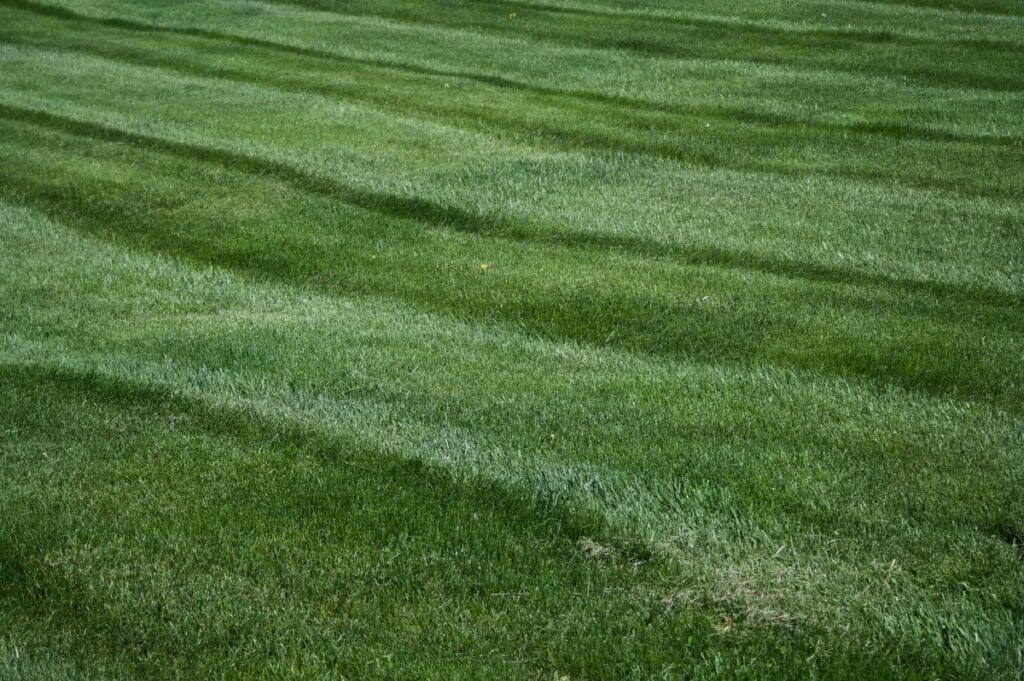
Lawn stripes are created entirely by light reflection — grass blades bent toward the viewer reflect less light and appear darker, while blades bent away reflect more light and appear lighter. No special dye, paint, or height variation is involved. The pattern is pure mowing technique.
The Science Behind the Stripe: Why It’s Just Light
Understanding how stripes work demystifies them considerably and helps explain both why they look impressive and why they fade within a few days on most lawns. Grass blades are flexible and reflective. When a mower passes over them and pushes them in a direction, the blades bend that way and stay bent until they grow upright again or are pushed by a subsequent mow.
When you look across a striped lawn, the blades in one row are bent toward you and the blades in the adjacent row are bent away from you. Blades bending toward you are presenting their underside or side profile to your eyes — less reflective. Blades bending away from you are presenting their flat upper surface — more reflective. The difference in reflectivity between adjacent rows is what creates the contrast you see as light and dark stripes.
The stripe is not visible from every angle. If you walk 90 degrees around the lawn and look at it from a perpendicular direction, the stripes largely disappear or reverse. This is also why stripe patterns look most dramatic in photographs taken from an end-on perspective, looking down the length of the stripes, rather than from a side angle.
Stripes also fade over time as grass blades grow back toward their natural upright position, typically within three to five days on actively growing warm-season grass and five to seven days on cooler-season grasses with longer, more flexible blades. This is why achieving consistent stripe patterns on fast-growing Bermuda grass in an Oklahoma July is genuinely challenging.
How Lawn Companies Actually Create Stripes
There are three primary methods lawn care professionals use to create stripe patterns, ranging from the most basic to the most specialized:
Method 1: Mowing technique alone. The simplest stripe is created by any mower through straight, parallel passes in opposite directions. When a mower travels north and then turns around to travel south on the adjacent pass, the grass in the northbound pass bends south and the grass in the southbound pass bends north. The contrast between these rows creates a basic stripe that is visible on any lawn with sufficient blade length. The stripe is subtle because standard mowers do not actively push blades down — they primarily cut. Still, technique-based striping produces a noticeable light-and-dark pattern on well-maintained lawns with adequately long grass.
Method 2: Stripe kit or roller attachment. A stripe kit is a brush, rubber flap, or weighted roller mounted behind the mower deck that bends grass blades more aggressively in the direction of travel after the cutting blade has passed. Rollers are the most effective — they press the grass blades flat against the ground, creating much more pronounced light-dark contrast than technique alone. Stripe kits are available as aftermarket attachments for most walk-behind and zero-turn mowers, typically ranging from $75 to $300 depending on the mower size and kit quality.
Method 3: Dedicated striping mowers. High-end commercial mowers — particularly certain zero-turn models — are designed with built-in roller or flap systems optimized for stripe production. These machines bend blades more aggressively, can produce sharper patterns at higher mowing speeds, and are purpose-built for the high-visibility properties, athletic fields, and golf courses where dramatic stripes are a priority. They represent a meaningful equipment investment and are not standard on most residential mowing fleets.
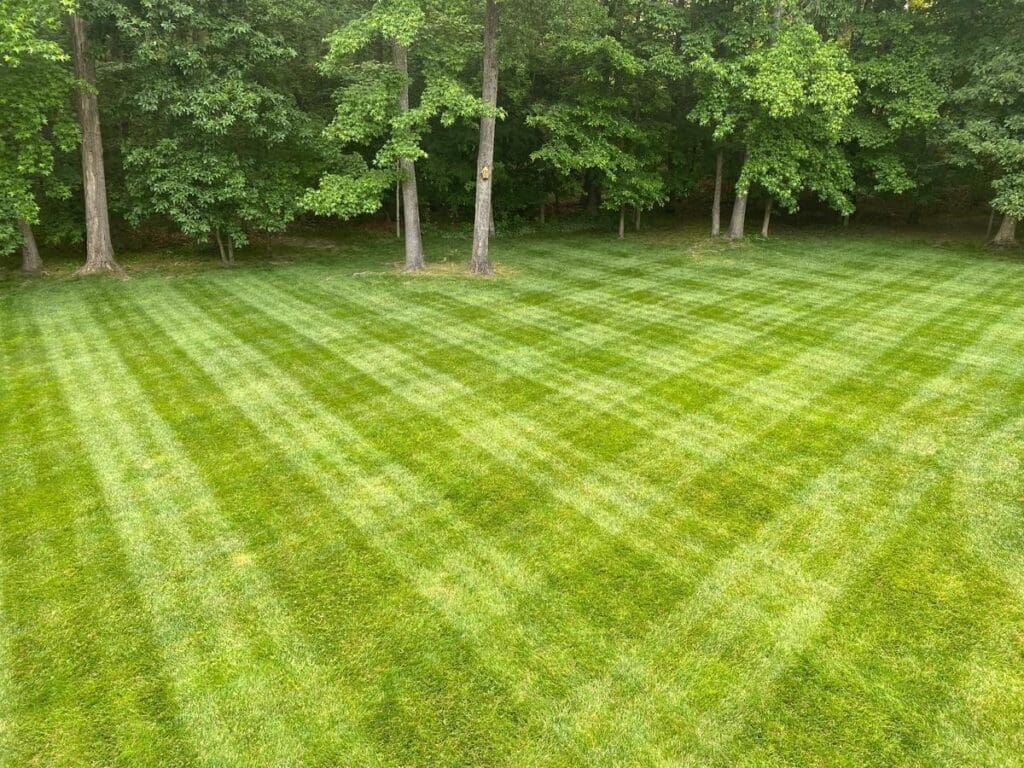
Bold stripe patterns on a well-maintained lawn. The checker-board effect here is created by mowing perpendicular patterns on consecutive visits — north-south one visit, east-west the next — which bends blades in two crossing directions and creates the grid-like contrast. Achieving this level of definition on warm-season Oklahoma grasses requires dedicated equipment and specific grass conditions.
Why Dramatic Stripes Are Less Practical in Tulsa
Here is what most lawn striping content does not tell you: the dramatic stripes you see in showcase photographs are almost always created on cool-season grasses in cooler climates — Kentucky bluegrass in Ohio, tall fescue in Virginia, ryegrass in the Pacific Northwest. These grasses have longer, broader, more flexible blades that bend readily and hold the bend for days.
In the Tulsa area, the dominant lawn grasses are warm-season types — primarily Bermuda and Zoysia. Bermuda grass is short, tight, and fine-textured. It grows aggressively in summer heat and bounces back toward upright almost immediately after being bent. Getting Bermuda to hold a dramatic stripe pattern requires dedicated roller equipment, and even then the effect tends to fade noticeably within a day or two in peak summer growing conditions.
Zoysia holds stripes somewhat better than Bermuda thanks to its denser, slightly broader blade structure, but it is still a warm-season grass operating in conditions that work against blade-bend retention. The lawns you see in beautiful striping photographs — baseball field stripes, golf course patterns, dramatic residential checkerboards — are typically not Bermuda or Zoysia. They are fescue or bluegrass maintained under conditions that favor long blade length and good blade flexibility.
This does not mean stripes are impossible on Tulsa-area lawns. It means setting realistic expectations about what is achievable with warm-season grass versus what you see in national lawn care marketing images.
| The Tulsa Grass Stripe RealityBermuda: Short, dense, fast-growing. Basic directional contrast is achievable with good technique. Bold stripe patterns fade within 24-48 hours without a roller attachment.Zoysia: Slightly better blade length and density. Holds patterns modestly better than Bermuda.Tall fescue: The best candidate for visible stripes in Oklahoma — longer blades, cooler-season growth. Fescue is primarily used in shaded or cooler areas of Tulsa-area lawns and thins in full summer heat.Bottom line: A clean, professional mowing pattern matters far more than stripe chasing on Tulsa turf. |
How Complete Lawn Care Creates a Professional Appearance
Complete Lawn Care does not use striping mowers as standard equipment on residential properties — and we want to be transparent about why, because we think it is the honest answer rather than the marketing one.
On Tulsa-area warm-season grasses like Bermuda and Zoysia, the practical value of a dedicated striping mower on a typical residential property is limited. The stripe fades quickly, the equipment cost is higher, and the turf health benefit of the stripe itself is zero — stripes are entirely cosmetic. The equipment investment makes sense for high-visibility commercial properties, athletic fields, and clients who specifically prioritize the aesthetic and understand the grass conditions required.
That said, we do have one mower in our fleet with a dedicated striping capability for clients and properties where that appearance is a priority. It is available as a premium service option. If that matters to you, we can talk through whether it makes sense for your specific lawn, grass type, and property.
What every Complete Lawn Care mowing visit does deliver — on every property, every week — is the professional directional contrast that comes from rotating mowing patterns. Our crews mow diagonally and change direction on every visit, cycling through multiple pattern angles across consecutive mows. This produces a clean, dimensional appearance with visible light-and-dark directional contrast that makes a well-maintained Tulsa lawn look noticeably better than one that just gets cut in the same direction every time. It is achievable on any grass type, including Bermuda and Zoysia, and it also prevents the lawn lean, compaction ruts, and scalping problems that same-direction mowing causes over time.
The honest summary: dramatic striping is more of a showroom concept on most Tulsa-area warm-season lawns. A clean directional pattern with consistent direction rotation is the practical path to a professional appearance — and it is what we focus on delivering.
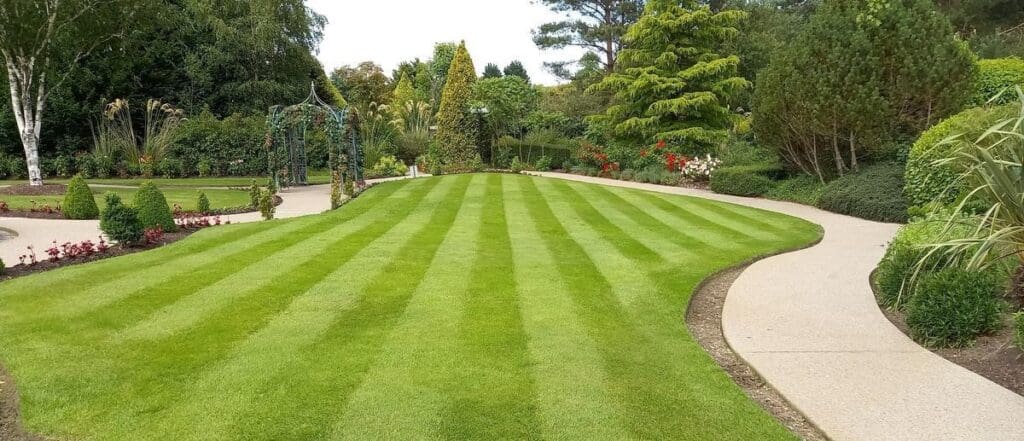
Formal garden lawn with crisp stripe lines created by a roller-equipped mower. Patterns like this are achievable on longer-bladed cool-season grasses or very dense Zoysia, but represent specialty lawn care rather than standard residential mowing practice in the Tulsa area.
Stripe Patterns by Grass Type: What to Expect in Oklahoma
Use this table as a realistic guide to what is achievable on your specific turf type in the Tulsa metro area:
| Grass Type | Stripe Ability | Practical in Tulsa? | Notes |
| Tall fescue | Excellent | Yes | Longer blades hold bend well; ideal for strong stripes |
| Bermuda grass | Fair | Possible | Short, tight growth limits stripe visibility; fades quickly |
| Zoysia | Good | Yes | Denser than Bermuda; holds patterns better than most warm-season |
| Buffalo grass | Fair | Possible | Low growing; limited blade length reduces contrast |
| St. Augustine | Good | Yes | Wider blades create decent contrast in shaded/cooler spots |
| Kentucky bluegrass | Excellent | Yes | Classic stripe grass; not common in Tulsa climate |
Pattern Styles: From Basic Stripes to More Complex Designs
For those who want to pursue lawn patterning beyond basic directional contrast, here are the common styles and what they require:
Straight stripes: The simplest pattern — straight parallel lines produced by adjacent north-south or east-west passes. Achievable with any mower using technique alone; enhanced significantly by a roller kit.
Checkerboard: Produced by mowing north-south on one visit and east-west on the next, creating a grid pattern where each square has blades bent in one of two crossing directions. More visually complex but requires two consecutive mowing sessions to achieve and only holds for a short time on warm-season grasses.
Diagonal stripes: Mowing at 45 degrees to the yard’s primary axis. Diagonal patterns often look more dynamic than straight stripes on rectangular lawns and are less expected, which tends to make them read as more professional. Complete Lawn Care uses diagonal and rotating diagonal patterns as standard practice on residential properties.
Diamond pattern: Two sets of diagonal stripes crossing each other, produced by mowing at opposing 45-degree angles on consecutive visits. Creates a diamond grid effect. More subtle on warm-season grasses but very effective on fescue.
Wave or circular patterns: Curved and freeform patterns used on large properties or for specialty applications. Requires significant operator skill and is most common on high-visibility commercial and municipal properties.
DIY Tips for Better Lawn Pattern Appearance
If you mow your own lawn and want to improve the visual result without investing in specialty equipment, these practices will make a meaningful difference:
- Mow straight. This sounds obvious but is the most impactful technique change most homeowners can make. Pick a fixed reference point at the far end of the lawn and drive toward it rather than looking down at the mower. Straight lines make pattern contrast far more visible than slightly wandering ones.
- Rotate your pattern every mow. This is the most important practice for both appearance and turf health. Changing direction between north-south, east-west, and diagonal prevents lawn lean and compaction while creating varying directional contrast that gives the lawn a crisper, more dimensional look.
- Mow at the right height for your grass and season. Longer blades show stripe contrast better than very short blades. Bermuda mowed at 2 inches will show more directional contrast than Bermuda mowed at 1 inch. In summer, the height that protects turf health also happens to be the height that shows the best pattern.
- Use sharp blades. Clean cuts reflect light more uniformly and create crisper pattern edges than torn cuts. Sharpen or replace blades at least twice per growing season.
- Mow when grass is dry. Wet grass mats and clumps, reducing the clean separation between adjacent passes that makes pattern contrast visible.
Professional Mowing in Tulsa: What Actually Makes the Difference
With over 25 years of serving the Tulsa metro area, Complete Lawn Care knows that what homeowners actually want is a lawn that looks consistently well-maintained and stands out from the neighbors — not just on mowing day, but throughout the week. Dramatic stripe patterns on Bermuda grass are not the path to that result. Consistent technique, correct seasonal height, direction rotation, sharp blades, and clean edges are.
Our crews bring science-based decision making to every visit. Mowing height adjusts as the season progresses. Patterns rotate every single visit as a standard practice. Equipment is maintained to perform correctly on every property. These are the details that produce a lawn that looks genuinely maintained rather than just cut.
If dedicated striping is something you specifically want for your property, we have the equipment to do it and can discuss whether it makes sense for your grass type and property. We would rather have that honest conversation than oversell something that will fade by the next morning on a Bermuda lawn in July.
Ready for Professional Mowing That Delivers a Real Difference?
Contact Complete Lawn Care at completelawncaretulsa.com or call (918) 605-4646 to learn about our weekly mowing service throughout Tulsa, Broken Arrow, Bixby, Jenks, Owasso, and Sand Springs. We will give you a straight answer about what your specific lawn can achieve — and then we will deliver it, every week.
Experience. Science. Intentional Lawn Care — That’s the Complete Lawn Care Difference.