
Keeping gophers out of your yard in Broken Arrow requires a two-part approach: eliminating the gophers currently active in your lawn through trapping, and then preventing new gophers from moving in by reducing the food sources and habitat conditions that attract them. Trapping is the most reliably effective control method for an active infestation — far more effective than repellents, vibration stakes, or castor oil products that are heavily marketed but produce inconsistent results in Oklahoma clay soil conditions. Underground wire mesh barriers are the most effective permanent prevention for garden beds and landscape borders. Gopher control is one of those yard problems where the methods that look easiest rarely work, and the method that actually works — trapping — requires a little patience and the willingness to identify and work in active tunnels.
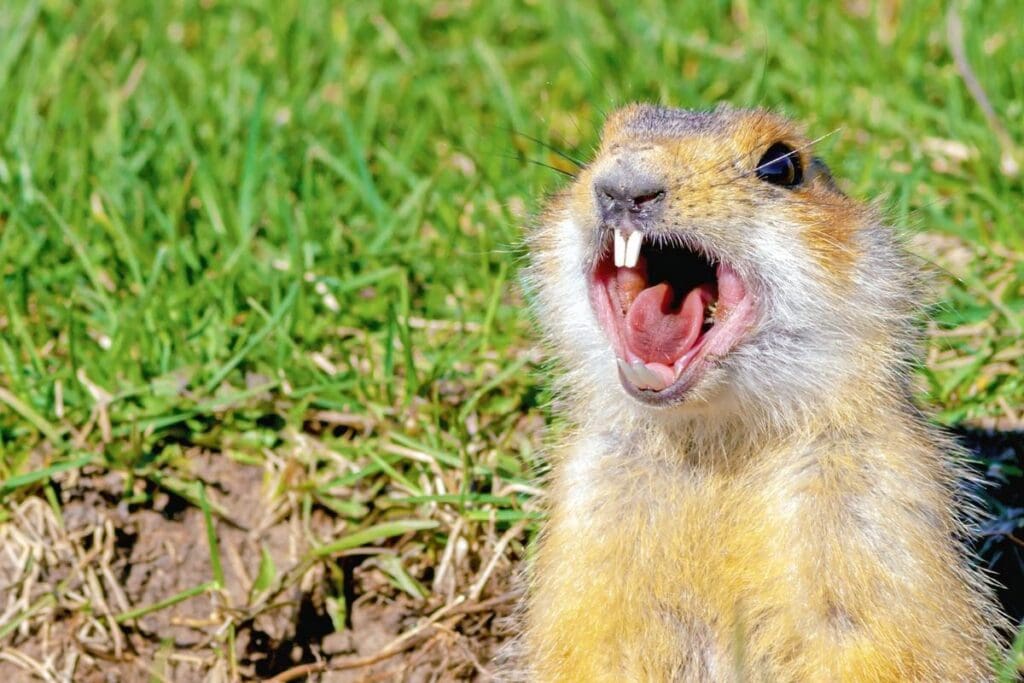
A plains pocket gopher (Geomys bursarius) — the primary gopher species found in eastern Oklahoma including Broken Arrow, Bixby, Jenks, and the greater Tulsa metro. The large, protruding incisors and external fur-lined cheek pouches are characteristic of this species. Plains pocket gophers are solitary, highly territorial animals; each individual maintains and defends its own burrow system. This is important context for control: you are typically dealing with one to three individuals per property, not a large colony. Removing the active individuals resolves the damage rather than requiring a broad population reduction effort.
First: Make Sure You Actually Have Gophers (Not Moles)
Gophers and moles are frequently confused in Broken Arrow and throughout the Tulsa metro, and the distinction matters because the control approach is different. Identifying which animal is present before spending money on control products saves significant time and frustration.
Gopher mounds: Fan-shaped or horseshoe-shaped piles of loose soil pushed to one side, with a visible plug hole sealed with loose soil on the edge of the fan. Gopher mounds are asymmetric — the soil is piled on one side of the hole rather than symmetrically around it. The plug hole is often barely visible but distinguishes gopher mounds definitively from mole mounds. On Broken Arrow’s sandy-clay transition soils (the Broken Arrow area sits at the edge of the Verdigris River floodplain where soil texture varies significantly by neighborhood and street), gopher mounds tend to be crumbly and loose rather than the denser, darker mounds you see on heavier clay soils.
Mole mounds: Symmetrical, volcano-shaped piles of soil pushed up from directly below, with no visible hole on the surface. Moles also create raised ridge tunnels just below the surface — visible as a linear raised seam across the lawn. Gophers do not create surface ridge tunnels; their tunnel systems are deeper (typically 6 to 18 inches below grade) and do not push up the surface in a linear pattern.
Gopher burrow system depth: Gopher tunnels run 6 to 18 inches below the soil surface in most Broken Arrow residential properties. This depth is important because it means gophers are operating below the root zone of most turf grasses but within the root zone of ornamental shrubs, vegetables, and perennial plants — which is why gopher damage often shows up as plants dying or collapsing from below rather than surface turf disruption.
| Quick Identification: Gopher vs. Mole vs. ArmadilloGopher: Fan-shaped mound with sealed plug hole on one side. No surface ridge tunnels. Plants die or wilt from below. Deep tunnels (6-18 inches). Active year-round in Oklahoma. Mole: Volcano-shaped symmetric mound. Raised surface ridge tunnels. Does not kill plants. Shallow tunnels (2-6 inches). Peak activity spring and fall in Oklahoma. Armadillo: Open excavated holes, lifted turf sections, soil pushed aside. No mounds. Nocturnal. Almost exclusively eats grubs. Increasingly common in Broken Arrow. |
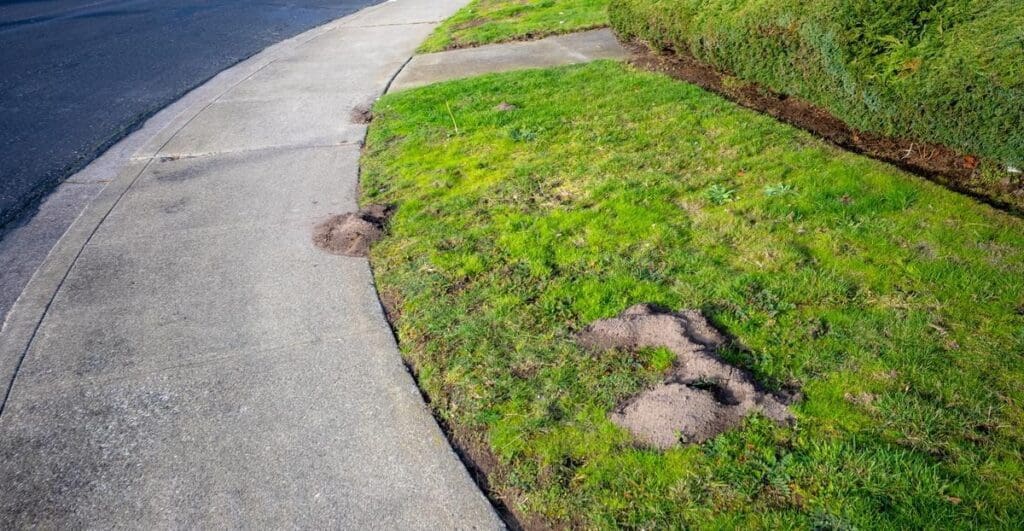
Gopher mounds along a lawn edge adjacent to sidewalk in a residential neighborhood — note the fan-shaped soil deposits pushed to one side, which distinguishes gopher mounds from the symmetric volcano-shaped mounds left by moles. The location near the sidewalk edge is typical of gopher activity in Broken Arrow-area properties: gophers follow the soil transition zones along hardscape edges where root systems concentrate and food is accessible. Fresh mounds appearing overnight indicate active tunnel use; mounds that have crusted over and do not expand indicate the gopher has moved its activity to another section of the tunnel system.
Why Broken Arrow Properties Are Particularly Attractive to Gophers
Gophers are most active in areas with loose, well-aerated soil that is easy to tunnel through and rich in the plant roots, bulbs, and underground plant material they eat. Broken Arrow sits at a soil transition zone that creates highly variable conditions across the city — sandy loam soils in neighborhoods north and east of the BA Expressway (74012 and 74014 zip codes particularly) are significantly easier for gophers to tunnel through than the heavier clay soils further west toward Tulsa. Established residential neighborhoods with mature trees, ornamental beds, and vegetable gardens provide concentrated root food sources that sustain active gopher populations through the year.
Oklahoma’s climate is favorable for gopher activity year-round. Unlike northern states where frozen soil limits winter tunneling, gophers in eastern Oklahoma remain active through winter and can increase tunneling activity during warm winter spells. This means there is no seasonal window when gopher pressure naturally stops — an active gopher on a Broken Arrow property in January will still be there in May unless actively controlled.
New construction and recently disturbed soil are particularly attractive to gophers because loosened backfill is significantly easier to tunnel through than compacted native soil. New home construction across eastern Broken Arrow and the 74014 zip code has brought gopher pressure into neighborhoods where the species was previously absent — the disturbed soil from foundation and utility work creates ideal tunneling conditions that persist for several years while the soil settles and recompacts.
The Most Effective Method: Trapping
Trapping is the single most effective control method for active gopher infestations in Broken Arrow residential properties. It works quickly when done correctly — most active infestations show results within three to five days — and it does not rely on the gopher choosing to interact with a bait or repellent. The two trap types most effective for plains pocket gophers in eastern Oklahoma are the Macabee trap (a scissor-jaw design) and the Cinch trap (a pincer design). Both are widely available and neither requires bait — gophers trigger them by encountering them while moving through their tunnels.
Step-by-step trapping process:
- Locate an active tunnel. Look for fresh mounds (loose, crumbly soil that has not crusted over) or areas of the lawn where the soil surface feels soft and spongy underfoot — indicating a tunnel just below. Use a metal rod or a stiff screwdriver to probe the soil 8 to 12 inches from the edge of a fresh mound in the direction the fan shape points. When the probe drops suddenly into an open space, you have found the main lateral tunnel.
- Expose the tunnel. Use a hand trowel to carefully open the tunnel at the probe point. Dig straight down until you reach the tunnel, then widen the opening enough to place two traps side by side facing in both directions in the tunnel. Remove loose soil that has fallen into the tunnel — the traps need to sit at tunnel floor level.
- Set and place two traps facing opposite directions. Gophers can approach from either direction in the tunnel; two traps facing both ways eliminates the chance of the gopher backing away from a single trap. Wire or stake the traps to prevent the gopher from dragging them deeper into the system if triggered.
- Cover the opening loosely. Cover the exposed tunnel opening with a piece of sod, cardboard, or dirt clod to block light from entering the tunnel. Gophers are sensitive to light in their tunnels and may avoid a brightly lit opening. Do not seal the opening so tightly that you cannot check and remove the traps.
- Check every 24 to 48 hours. If no activity within 48 hours, the gopher has likely moved its activity to a different section of the tunnel system. Relocate the traps to a fresh mound or a different area of soft turf. If the trap is triggered but no gopher is caught, reset in the same location — gophers sometimes trigger traps without being caught and then return through the same tunnel section.
- After catching, check for continued activity. A single gopher can produce 1 to 3 mounds per day during active tunneling. If no new mounds appear within 5 to 7 days after trapping, the infestation has been resolved. If new mounds appear, a second individual may be present or a neighboring gopher has moved into the vacated territory.
A common trapping mistake is placing traps in old, crusted mounds rather than fresh ones. Crusted mounds indicate the gopher has moved its primary activity to a different section of the burrow. Always target fresh mounds with soft, loose soil for best results.
Prevention: Underground Wire Mesh Barriers
Once active gophers are removed, preventing re-infestation through underground barriers is the most effective long-term solution for garden beds, ornamental borders, raised vegetable beds, and newly installed landscape areas. This is particularly valuable for Broken Arrow properties with established ornamental beds where replanting after gopher damage is expensive — installing a permanent barrier is almost always less costly than replacing damaged plants repeatedly.
The barrier specification that works: 3/4-inch galvanized hardware cloth (not chicken wire, which degrades quickly in Oklahoma soil conditions and has gaps large enough for juvenile gophers to pass through). The barrier should be buried 18 to 24 inches deep to go below the primary gopher tunnel zone, with a 6-inch outward bend at the bottom directed away from the protected area — this bend prevents gophers from tunneling under the bottom edge of the barrier. The hardware cloth should extend 6 inches above grade around bed borders to prevent gophers from emerging and entering from above the soil surface along the edge.
For new sod or lawn installations in areas with a history of gopher activity, hardware cloth laid flat below the sod installation at 4 to 6 inches depth provides root zone protection for the new turf while allowing root development above the barrier. This approach is used in golf course construction and is increasingly practical for residential installations in high-pressure Broken Arrow neighborhoods.
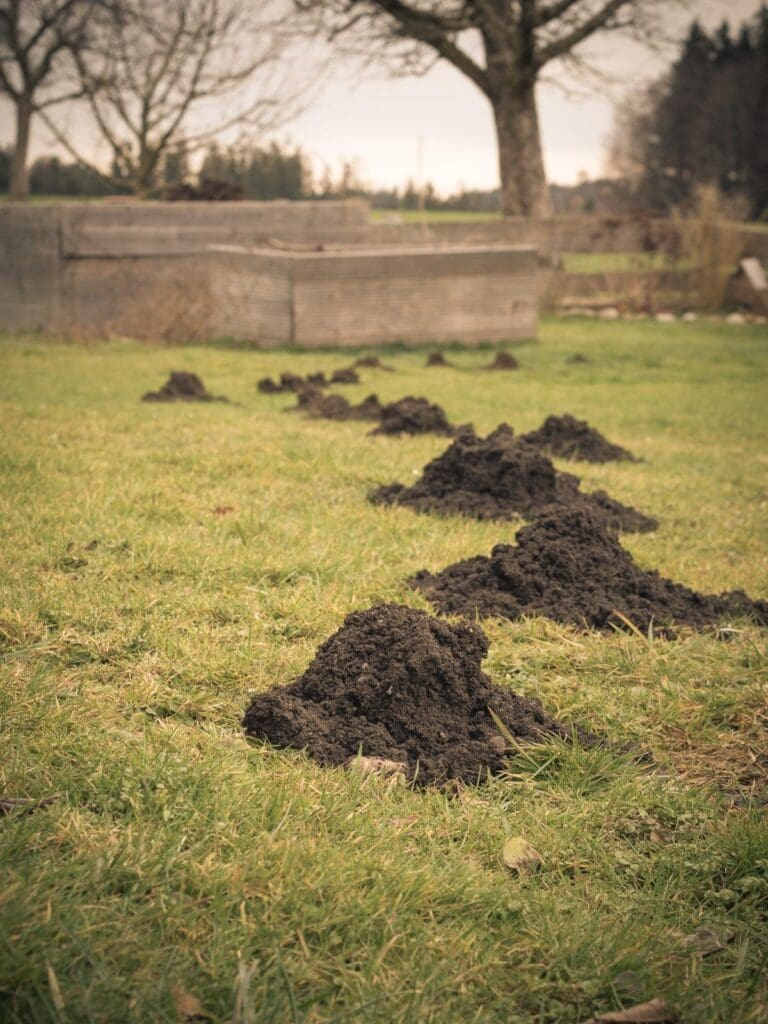
A series of fresh gopher mounds across a residential lawn — the characteristic rounded soil pushes running in a line reflect the path of the gopher’s primary lateral tunnel below. When mounds appear in a line or arc pattern across a lawn, they typically follow the edge of the tunnel system’s main run, which connects the deeper sleeping and food-storage chambers. Trapping should be placed in the main lateral tunnel connecting these mounds rather than at the individual mound locations themselves, where the tunnel typically branches into a dead-end lateral leading to the mound surface. Finding and targeting the main run is the step that separates successful trapping from repeated failed attempts.
What About Repellents, Vibration Stakes, and Castor Oil Products?
The honest answer on these products: most of them produce inconsistent results in Oklahoma conditions, and the marketing claims for some of them significantly outpace the scientific evidence for their effectiveness. Knowing this before spending money on products that are unlikely to work saves frustration.
Castor oil granules and liquid repellents. Castor oil products work on the theory that gophers dislike the scent and taste of castor oil on plant roots and will relocate to avoid treated areas. In practice, results are highly inconsistent — some homeowners report success, and controlled studies show variable outcomes. The most significant limitation in the Broken Arrow area is that castor oil repellents require regular reapplication after rain, and eastern Oklahoma’s spring and early summer rainfall creates a challenging maintenance cycle. On clay-dominant soils, the product may not penetrate deeply enough to reach the active tunnel zone where gophers are feeding. Castor oil products are most useful as a supplemental deterrent after trapping has removed active gophers, not as a standalone control.
Vibration stakes and sonic repellents. These devices create vibration in the soil intended to disturb gophers and encourage them to relocate. Independent research and broad field experience consistently show that gophers habituate to vibration stakes within days to weeks and resume normal activity. They are not recommended as a primary control method. The Oklahoma clay soil environment is also less conducive to vibration propagation than sandy soils, reducing the effective radius of these devices even before habituation occurs.
Gopher repellent plants (gopher spurge, castor bean). Some plants are marketed as natural gopher deterrents. The evidence for effectiveness in established infestations is weak. These plants may have some deterrent effect on gophers selecting a new area to colonize but are not reliable for removing gophers that have already established a burrow system on the property.
What about natural predators? Owls, red-tailed hawks, and gopher snakes all prey on plains pocket gophers in eastern Oklahoma. Installing owl boxes in large open areas can provide supplemental population pressure over time. In established suburban neighborhoods with extensive tree cover (like much of west Broken Arrow along the Kenosha corridor or south Broken Arrow toward Lynn Lane), raptors have limited hunting visibility and predation pressure is naturally lower. Predators are a background factor in long-term population management but are not reliable primary control for an active infestation on a residential property.
Protecting Your Lawn Care Investment
Gophers are a direct threat to the turf health investment that Complete Lawn Care’s 7-step program builds over the course of a season. Gopher tunnel systems disrupt root-to-soil contact in the areas above active tunnels — the same mechanism that causes mole tunnel sponginess — and the root feeding that occurs when gophers pull plants down from below can create dead patches that appear similar to drought stress, fungal disease, or fertilizer burn. Correctly identifying gopher damage before attributing turf dieback to other causes prevents misdiagnosis and misdirected treatment.
Annual soil testing, which Complete Lawn Care recommends for every property in our service area, provides baseline data that helps distinguish turf decline caused by soil chemistry issues from decline caused by root zone disruption from subterranean pests. When turf health is declining in a pattern that does not respond to fertilization adjustments or irrigation changes, subsurface pest activity is always worth considering as an explanation.
With over 25 years of experience in the Broken Arrow and Tulsa market, Complete Lawn Care has worked through every variation of the pest-and-turf interaction that eastern Oklahoma produces. Our programs are continually refined based on real-world results and agronomic science — and part of that experience is knowing when a turf health issue is agronomic and when it is animal-related. We apply what does work. Your lawn deserves the best.
Gopher Control Methods Compared
| Method | Effectiveness | Effort Level | Notes for Broken Arrow / Tulsa Area |
| Trapping (scissor or pincer traps) | High — most reliable | Moderate (requires identifying active tunnels) | Most effective single method for active infestations; works within days when placed correctly; requires checking traps every 24-48 hours |
| Underground wire mesh barrier | High — permanent prevention | High (requires installation) | Most effective for garden beds, landscape borders, and new sod installations; 3/4-inch galvanized hardware cloth buried 18-24 inches deep with 6-inch outward bend at bottom |
| Castor oil granules or repellent | Low to moderate | Low (broadcast application) | May redirect gophers to adjacent areas rather than eliminating them; requires reapplication after rain; more effective as supplemental measure than primary control |
| Vibration stakes (sonic) | Low — inconsistent results | Very low | Studies and field experience show limited effectiveness; gophers habituate quickly; not recommended as primary control on Oklahoma clay soil |
| Bait (strychnine or zinc phosphide) | Moderate to high | Moderate (must be placed in active tunnels) | Regulated products in Oklahoma; must follow label exactly; secondary poisoning risk to owls and raptors that prey on gophers; best used by pest professionals |
| Exclusion fencing above grade | Low for gophers | Low | Above-grade fencing does not stop subterranean animals; ineffective against gophers specifically |
| Natural predators (owls, snakes) | Low to moderate | Very low (passive) | Owl boxes in large open areas can provide supplemental population pressure; not reliable as primary control in established suburban yards |
Repairing Gopher Damage to Your Broken Arrow Lawn
After active gophers are removed, the turf repair process for Bermuda and Zoysia lawns (the dominant grass types in Broken Arrow residential properties) is straightforward but needs to be timed correctly:
- Fill tunnel depressions. Surface depressions above collapsed or abandoned tunnels should be filled with topsoil and tamped firmly. Oklahoma’s clay soils tend to settle significantly after tunnel systems collapse, and mowing over unfilled depressions damages mower decks and creates an uneven surface that persists for months.
- Repair dead patches above feeding areas. Areas where gopher root feeding killed the turf will need either sodding (for patches larger than a square foot) or will recover naturally from surrounding Bermuda or Zoysia runners if the dead area is small. Bermuda is particularly aggressive at filling small bare patches during the May through August growing window. Larger bare areas that are left without sodding will typically fill with weeds before Bermuda runners can cover them — sodding is generally the better choice for patches above 6 by 6 inches.
- Time repairs to the growing season. Bermuda and Zoysia sod installations for repair patches performed in June through August establish fastest with Broken Arrow’s summer heat and have the best chance of knitting into the surrounding turf before fall dormancy. Repairs made in September through November establish more slowly and may show seam lines or thin areas through winter.
Lawn Care and Pest Management in Broken Arrow
For more than 25 years, Complete Lawn Care has served homeowners throughout Broken Arrow, Tulsa, Bixby, Jenks, Owasso, and Sand Springs. We invest in leadership training, research, and agronomy expertise to ensure every recommendation — from grub control timing to turf repair approaches after pest damage — is based on proven science and local experience, not guesswork.
Our 7-step agronomy-supported program is one of the few in the Tulsa area guided by direct agronomy expertise, which means when turf health issues arise that have a pest management dimension, we approach them with the same intentional, science-based framework that guides every fertilization and weed control decision we make. Every application is intentional. Every recommendation is earned.
Contact Complete Lawn Care at completelawncaretulsa.com or call (918) 605-4646 to get your Broken Arrow lawn on the right program — and to get real answers about what is happening below the surface.
Experience. Science. Intentional Lawn Care — That’s the Complete Lawn Care Difference.