
When applied correctly by a trained technician and when you follow simple drying time guidelines, professional yard flea treatments are safe for dogs and cats. The products used in professional flea control are EPA-registered for residential use, applied at low concentrations to specific areas of your property, and are the same general class of active ingredients found in many veterinary flea and tick products that go directly on your pet’s skin. The risk to pets from a properly applied yard treatment is very low. The risk to pets from an untreated yard full of fleas is much higher.
This is a question that every responsible pet owner in Broken Arrow should ask before having their yard treated. Your pets are family, and wanting to make sure a pest control treatment will not hurt them is exactly the right instinct. The short answer is that professional flea treatments are safe for pets when the application is done correctly. But “done correctly” involves specific practices that matter, and not every provider approaches pet safety with the same level of care.
Let us walk through what is in the products, how they interact with dogs and cats differently, what precautions to take, and what to look for in a provider to make sure the treatment on your Broken Arrow property is being done responsibly.
What Is in Professional Yard Flea Treatments
Most professional yard flea treatments use synthetic pyrethroids as the active ingredient. Common pyrethroids used in residential pest control include bifenthrin, permethrin, lambda-cyhalothrin, and deltamethrin. These are synthetic versions of pyrethrins, natural insecticides derived from chrysanthemum flowers. Pyrethroids work by disrupting the nervous system of insects, causing rapid knockdown and death. They are effective at very low concentrations, which is one reason they have been the standard in residential pest control for decades.
Many professional treatments also include an insect growth regulator (IGR). IGRs like methoprene or pyriproxyfen prevent flea eggs and larvae from developing into adults. They mimic natural insect hormones and are extremely specific to insects. IGRs have an excellent safety profile for mammals because they target biological processes that do not exist in dogs, cats, or humans. The addition of an IGR is actually one of the advantages of professional treatment over many retail products, and it does not increase the risk to your pets.
The concentrations used are very low. To put the concentration in perspective, the active ingredients in a professional yard flea treatment are applied at fractions of a percent. The same active ingredients are used in many common veterinary flea and tick products at significantly higher concentrations applied directly to your pet’s skin and fur. Frontline (fipronil), Advantix (permethrin for dogs), and many flea collars use pyrethroids or similar chemistry at concentrations far exceeding what is present on a treated lawn surface after a professional application.
These products are EPA-registered, meaning they have undergone extensive testing for toxicity, environmental impact, and safety when used according to label directions. The product label is a legal document, and licensed applicators in Oklahoma are required to follow it.
How Yard Flea Treatments Affect Dogs
Dogs are generally very tolerant of the pyrethroids used in yard flea treatments. This should not be surprising when you consider that many popular veterinary flea and tick products apply these same active ingredients directly to your dog’s skin at much higher concentrations than what would be present on treated yard surfaces. Products like K9 Advantix use permethrin applied directly to the dog. Seresto collars release a continuous low dose of a pyrethroid-class compound around the dog’s neck for months. The dried residue on treated vegetation after a yard treatment represents a fraction of the exposure your dog gets from their own flea prevention product.
The main precaution for dogs is drying time. Keep your dog off treated areas until the product has dried, which typically takes 30 minutes to one hour depending on temperature, humidity, and airflow. On a warm, sunny Broken Arrow afternoon, the product dries quickly. On a cool, overcast morning, allow more time. Once dry, the product is bound to the surfaces it was applied to and is not readily transferable to your dog’s paws or fur in meaningful amounts.
Dogs that roll in treated vegetation are still at very low risk. Once the treatment has dried, a dog rolling in treated grass or brushing against treated shrubs picks up an extremely small amount of product residue. This amount is well below the threshold for any adverse reaction in dogs. If you have a dog that loves to roll in every patch of vegetation in the yard, the dried residue from a properly applied treatment is not a concern.
Water bowls and food dishes need to be protected. This is an area where technician care makes a real difference. Outdoor water bowls, food dishes, and any other container your dog drinks or eats from should never be sprayed during a yard treatment. At Complete Lawn Care, our technicians are trained to identify pet water sources before beginning treatment and to work around them completely. If you want to be extra cautious, bring pet dishes inside before a scheduled treatment and put them back out after the product has dried.
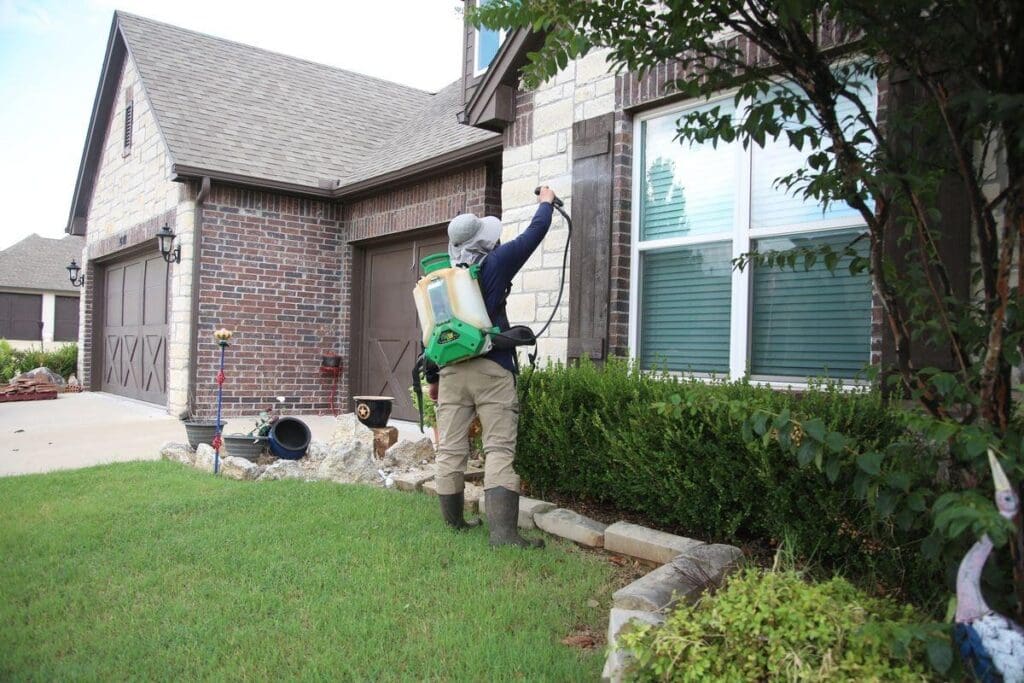
Image: A Complete Lawn Care pest control technician treating foundation and landscape areas at a Broken Arrow home. Professional treatments target specific pest harborage zones while avoiding pet water sources and high-contact areas.
Why Cats Require Extra Attention
Cats are more sensitive to certain pyrethroids than dogs, and this is an important distinction that your pest control provider should be aware of. The reason is biological: cats lack a specific liver enzyme (glucuronyl transferase) that dogs and humans use to metabolize and eliminate pyrethroids from the body. Without this enzyme, cats process these compounds much more slowly, which means the same exposure that a dog handles easily can potentially cause problems for a cat.
The risk from dried yard treatment residue is still very low for cats. The amount of pyrethroid a cat would encounter from walking through treated vegetation after the product has dried is orders of magnitude lower than what causes toxicity. Pyrethroid toxicity in cats is primarily associated with direct application of concentrated dog flea products to cats (a well-known veterinary emergency) or cats coming into contact with very freshly applied, still-wet concentrated product. The dried residue on a treated leaf surface is a fundamentally different level of exposure.
Cats groom themselves, which increases their exposure compared to dogs. When a cat walks through treated vegetation, product residue can transfer to their paws and fur. Because cats groom frequently and thoroughly, they ingest whatever is on their coat. This ingestion route means cats have slightly higher effective exposure than dogs from the same environmental residue. This is why drying time is even more important for cat owners. Once the product is fully dry and bound to surfaces, the amount that transfers to a cat’s paws is minimal.
What to do if you have outdoor cats: Keep cats inside during treatment and for at least one to two hours afterward to ensure complete drying. Mention to your pest control provider that you have outdoor cats so they can factor this into their product selection and application approach. Some professional products are more cat-friendly than others, and an experienced provider can make adjustments. At Complete Lawn Care, we ask about pets on the property before the first treatment specifically so we can plan the application with your household in mind.
Other Pets and Animals to Consider
Fish and aquatic animals are highly sensitive to pyrethroids. If you have a koi pond, fish pond, outdoor aquarium, or any water feature with aquatic life, this is the most important safety consideration during a yard flea treatment. Pyrethroids are extremely toxic to fish and aquatic invertebrates at very low concentrations. Your pest control provider must know about any aquatic features on your property and create an appropriate buffer zone. A responsible provider will ask about this before the first treatment. If they do not ask, tell them.
Rabbits, guinea pigs, and other small mammals. If you have outdoor rabbit hutches, guinea pig enclosures, or other small animal housing, these should be covered or moved away from treatment areas during application. Small mammals are generally more sensitive to pesticide exposure than dogs due to their smaller body mass. Once the treatment has dried, the risk is very low, but keeping small pet enclosures out of the direct treatment zone is a reasonable precaution.
Chickens and backyard poultry. Backyard chickens are increasingly common in Broken Arrow, and their coops and runs should be excluded from treatment zones. Chickens peck at the ground constantly, which means they could ingest treated material if their area is sprayed directly. The treatment area should avoid the coop, run, and any area where chickens free-range. Let your provider know about backyard poultry so they can plan accordingly.
Reptiles and amphibians. Outdoor enclosures for turtles, tortoises, or other reptiles should be covered or moved during treatment. Amphibians (frogs, toads) are particularly sensitive to pesticides due to their permeable skin. If you have a habitat that supports frogs or toads, mention this to your provider.
What a Responsible Provider Does to Protect Your Pets
The safety of a yard flea treatment depends as much on the technician applying it as it does on the product itself. Here is what to expect from a provider that takes pet safety seriously.
They ask about pets before the first treatment. A responsible provider wants to know what animals are on your property, where they spend time, where their water sources are, and whether there are any special considerations (outdoor cats, fish ponds, chicken coops). If a company shows up for the first treatment without asking about pets, that is a red flag.
They identify and avoid pet water sources every visit. This is not a one-time conversation. Every time a technician treats your property, they should be scanning for pet water bowls, dishes, and any other sources before they begin spraying. Water bowls get moved, new ones appear, and conditions change. A good technician checks every time. At Complete Lawn Care, our technicians are specifically trained to identify and avoid pet water sources on every visit. It is part of the standard process, not an afterthought.
They apply product to harborage areas, not everywhere. A professional flea treatment is not a broadcast application that coats every surface on your property. It is a targeted treatment applied to the specific areas where fleas breed and harbor: shaded areas under decks, along fence lines, in shrub beds, in ground cover, and under structures. The sunny open lawn, the play area, the patio, and the spaces where pets eat and drink are not treatment targets. If a provider is spraying everything indiscriminately, they are not providing responsible pest control.
They communicate clearly about drying time. After treatment, you should know when it is safe to let your pets back outside. A good provider tells you explicitly. At Complete Lawn Care, we communicate clearly about what was applied and when the treatment will be dry so you do not have to guess.
They are licensed and follow label directions. In Oklahoma, commercial pesticide applicators must be licensed through the Oklahoma Department of Agriculture, Food and Forestry. Licensed applicators are required to follow product label directions, which include safety precautions for pets and wildlife. Ask your provider about their licensing and be wary of anyone who seems unfamiliar with label requirements.
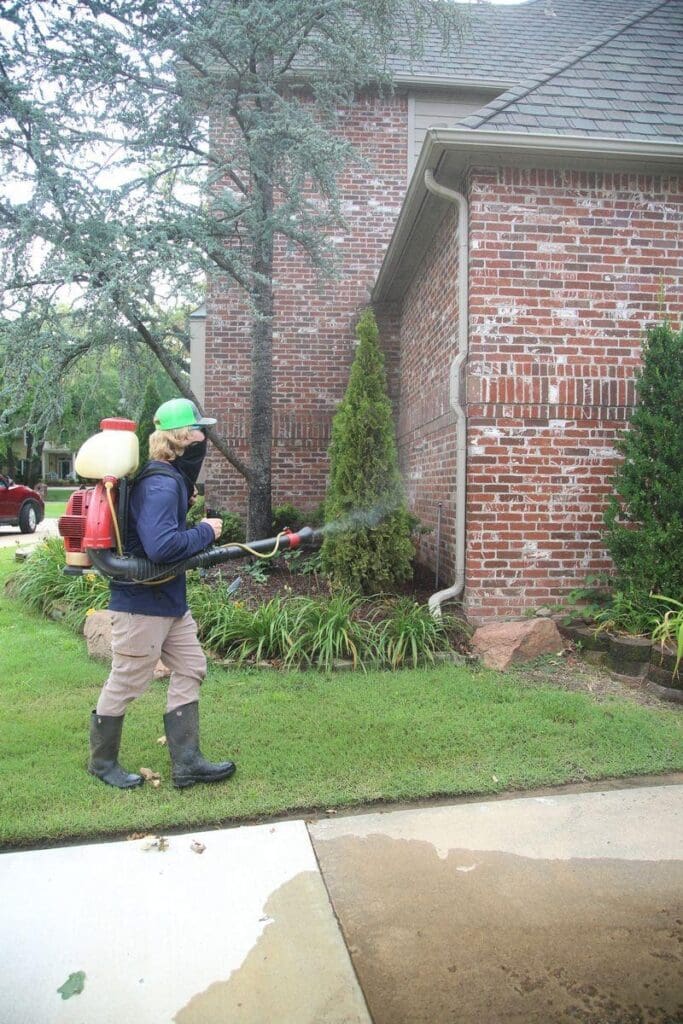
Image: A Complete Lawn Care technician applying a targeted pest control treatment to a foundation and landscape area. Treatments are applied to specific harborage zones, avoiding pet water sources, food dishes, and high-contact areas.
The Bigger Picture: Treatment Risk vs. Flea Risk
When weighing whether to treat your yard for fleas, it helps to consider what happens if you do not treat.
Fleas cause real harm to pets. Beyond the obvious itching and discomfort, fleas cause flea allergy dermatitis (the most common skin disease in dogs and cats), secondary skin infections from scratching, hot spots, hair loss, and anemia in severe infestations, particularly in puppies, kittens, and small or elderly pets. A heavy flea burden can remove enough blood to cause life-threatening anemia in a young puppy or kitten.
Fleas transmit diseases and parasites to pets. Fleas are the primary vector for tapeworms in dogs and cats. When a pet ingests a flea during grooming (which happens constantly), they can become infected with tapeworm larvae. Fleas also transmit Bartonella (cat scratch disease bacteria), murine typhus, and in rare cases, plague. These are real health risks to your pets, not theoretical ones.
An untreated flea infestation affects your pet’s quality of life. A dog or cat covered in fleas is uncomfortable all the time. They scratch, bite at their skin, lose sleep, become agitated, and can develop behavioral changes from chronic discomfort. If you have ever had a flea bite, you know how maddening a single bite is. Imagine dozens of bites continuously throughout the day. That is what your pet experiences during an untreated infestation.
The treatment risk is far lower than the flea risk. A professional yard flea treatment applied correctly with appropriate drying time poses minimal risk to your pets. An untreated yard with an active flea population poses definite harm to your pets through biting, disease transmission, allergic reactions, and chronic discomfort. The safer choice for your pets is treating the yard, not leaving it untreated.
Simple Precautions That Make Yard Flea Treatment Safe for Your Pets
Protecting your pets during and after a yard flea treatment comes down to a handful of simple practices.
Keep pets inside during treatment and for 30 minutes to one hour after. This is the single most important precaution. Once the product has dried on treated surfaces, the risk to pets drops to effectively zero for dogs and extremely low for cats.
Bring pet water bowls and food dishes inside before treatment. Put them back out after the treatment has dried. This eliminates any possibility of product contaminating your pet’s water or food.
Tell your provider about all pets on the property. Dogs, cats, fish, rabbits, chickens, turtles. Let them know everything. A good provider adjusts their approach based on what is on the property.
If you have outdoor cats, allow extra drying time. One to two hours instead of 30 minutes. Cats’ grooming behavior and sensitivity to pyrethroids warrant the additional caution.
Schedule treatments when pets can be inside. If your dog has separation anxiety and cannot be kept inside, coordinate with your provider to find a time when you can be home to keep pets contained during and just after treatment.
For more than 25 years, Complete Lawn Care has been a trusted lawn care provider in the Broken Arrow and Tulsa area. We treat every property as if our own pets were in the yard. That means asking about animals before the first visit, identifying and avoiding pet water sources every time, applying product to harborage areas rather than broadcasting it everywhere, and communicating clearly about drying time. Our programs are continually refined based on real-world results, and our team invests in training so that every application is intentional, effective, and safe for the families and pets we serve.
Pet-Safe Flea Control in Broken Arrow
Complete Lawn Care’s pest control program provides targeted flea treatments that protect your yard and your pets. We treat harborage areas where fleas breed, avoid pet water sources and food dishes, and communicate clearly about drying time. Combined with our 7-step lawn care program, weekly mowing, mosquito control, landscape maintenance, and irrigation service, we manage the full picture. No contracts. No subscriptions. Serving Broken Arrow, Tulsa, Bixby, Jenks, Owasso, and Sand Springs.
Call us today: (918) 605-4646
Get a Free Quote at completelawncaretulsa.com
Experience. Science. Intentional Lawn Care. That’s the Complete Lawn Care Difference.