
Seeing some mosquitoes after a professional treatment does not mean the treatment failed. No mosquito control program eliminates 100% of mosquitoes from your property. What a good program does is reduce the population dramatically, often by 75% to 90%, so that your outdoor living space goes from unusable to enjoyable. If you are seeing a few mosquitoes after treatment, that may be completely normal. If you are seeing just as many as before, something may need to be addressed.
This is one of the most common questions we hear from Tulsa-area homeowners, especially those who are new to professional mosquito control. The frustration is understandable. You paid for a treatment, and you still got bitten. But understanding why some mosquitoes persist after treatment helps you evaluate whether the program is working as expected or whether there is a genuine problem that needs attention.
Let us walk through the most common reasons you may still see mosquitoes after treatment and what can be done about each one.
New Mosquitoes Are Constantly Being Produced
A barrier treatment kills mosquitoes that are on your property when it is applied and those that land on treated surfaces afterward. But it does not prevent new mosquitoes from being born. If there are active breeding sites on or near your property, new mosquitoes are hatching continuously throughout the season. During peak summer conditions in the Tulsa area, a mosquito can go from egg to biting adult in as little as 7 to 10 days. That means a rain event on Monday can produce a new generation of mosquitoes by the following week.
This is the most common reason homeowners still see mosquitoes after treatment. The barrier is working, killing adults that land on treated surfaces, but new mosquitoes are emerging from breeding sites faster than the barrier can eliminate them.
What to do about it: Walk your property after every rain and eliminate standing water. Check flower pot saucers, clogged gutters, kids’ toys, low spots in the yard, grill covers, bird baths, and any container that holds water for more than a couple of days. This is the single most impactful thing you can do to improve the effectiveness of professional treatments. The barrier handles the adults. You handle the breeding sites. Together, the results are dramatically better than either approach alone.
Mosquitoes Are Coming from Neighboring Properties
Mosquito barrier treatments protect your property by killing mosquitoes that land on treated surfaces. But mosquitoes do not respect property lines, and if your neighbors are not treating their yards, their mosquitoes will occasionally fly onto your property.
The good news is that most common backyard mosquito species in Oklahoma are weak fliers and typically stay within a few hundred feet of where they hatched. The mosquitoes biting you in your backyard most likely came from your property or very close to it, not from across the neighborhood. But some migration from untreated adjacent properties is inevitable, especially if those properties have standing water, dense vegetation, or other favorable conditions.
What to do about it: You cannot control what your neighbors do, but a consistent treatment schedule on your property means that migrating mosquitoes encounter treated surfaces when they land in your shrubs, on your fence line, or under your deck. They do not survive long. Over the course of a season with regular treatments, the population on your property stays suppressed even with some neighborhood migration. If you have a neighbor who would also benefit from treatment, a referral can help both of your yards.
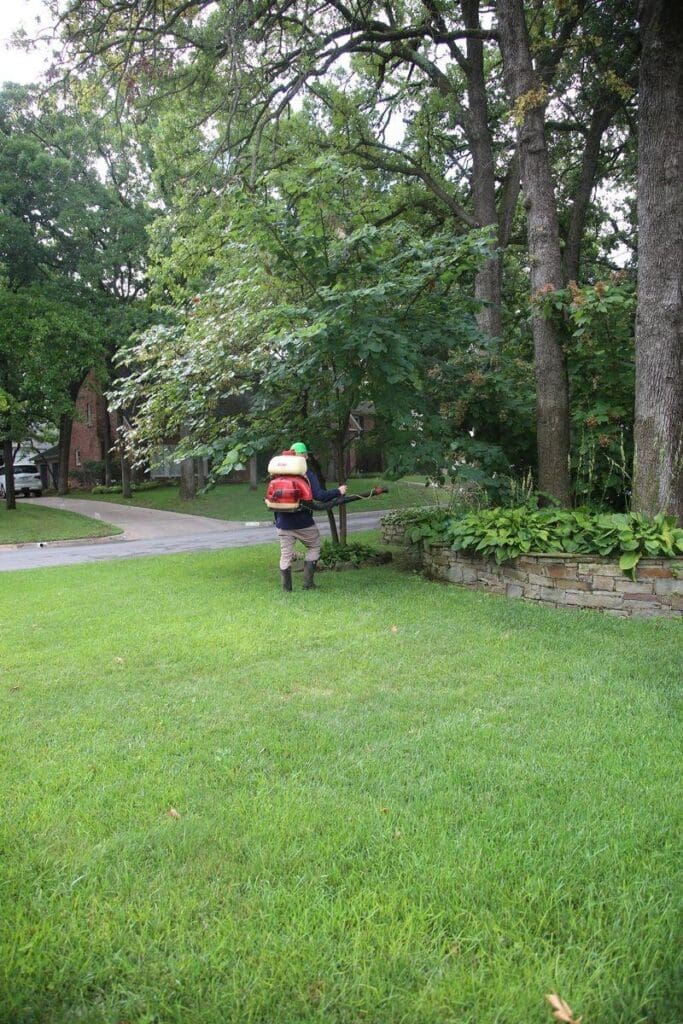
Image: A Complete Lawn Care technician treating mature landscaping and ground cover beds. Barrier treatments kill mosquitoes that land on treated surfaces, including those migrating from neighboring properties.
Heavy Rain Reduced the Treatment’s Effectiveness
Oklahoma does not do gentle rain. Our spring and summer storms are intense, often dumping an inch or more in a short period. Heavy, sustained rain can wash some product off of treated leaf surfaces and reduce the barrier’s effectiveness before the next scheduled treatment.
A normal rain typically does not significantly affect a properly applied barrier treatment. Professional-grade products are formulated to adhere to vegetation and resist moderate rainfall. But a severe storm, particularly one with high winds that physically strip leaves and shake vegetation, can reduce coverage enough that you notice an increase in mosquito activity in the days following the storm.
On top of reducing the barrier, heavy rain also creates fresh standing water across your property, which immediately becomes a new breeding site. So a big storm hits your mosquito situation from both directions: it weakens the existing barrier and produces new mosquitoes at the same time.
What to do about it: After a major storm, dump any standing water on your property as soon as possible. If you notice a significant increase in mosquito activity following heavy rain, contact your provider. At Complete Lawn Care, we can move your next treatment up if conditions warrant it. We monitor weather patterns throughout the season and adjust scheduling based on what is actually happening, not just what the calendar says.
You Are in the Middle of Peak Mosquito Season
June through August is peak mosquito season in the Tulsa area. During these months, mosquito populations are at their highest, breeding cycles are at their fastest, and environmental conditions are as favorable for mosquitoes as they get. Even a property on a consistent treatment program will see more mosquito activity during peak season than in May or September.
The comparison that matters is not “do I see any mosquitoes” but “how does my yard compare to an untreated yard right now.” If your neighbor without mosquito control cannot sit on their patio for five minutes in July and you are hosting an hour-long dinner outside with only an occasional mosquito, the treatment is working. It may not feel like it when that one mosquito bites you, but the difference between treated and untreated during peak season is substantial.
What to do about it: Stay on your treatment schedule through the entire peak season. This is the time when consistency matters most. Skipping a treatment in July because “there are still some mosquitoes” is counterproductive. The treatment is suppressing a population that would otherwise be dramatically worse. Removing the treatment during peak season allows a rapid rebound.
You Are Outside During Peak Mosquito Hours
Mosquitoes are most active at dawn and dusk. If you are spending time in your yard during these transition hours, you are in the window when mosquitoes are most aggressive about finding a host. Even on a treated property, mosquitoes that are actively flying and seeking a blood meal during their peak feeding window are harder to avoid than during the middle of the day when they are resting on treated surfaces.
What to do about it: If you are planning an evening event or spending time outside at dusk, consider using a personal repellent as an additional layer of protection. An outdoor fan on the patio also helps significantly because mosquitoes are weak fliers and struggle to navigate even a moderate breeze. These strategies combined with your barrier treatment provide excellent protection during the hours when mosquitoes are most active.
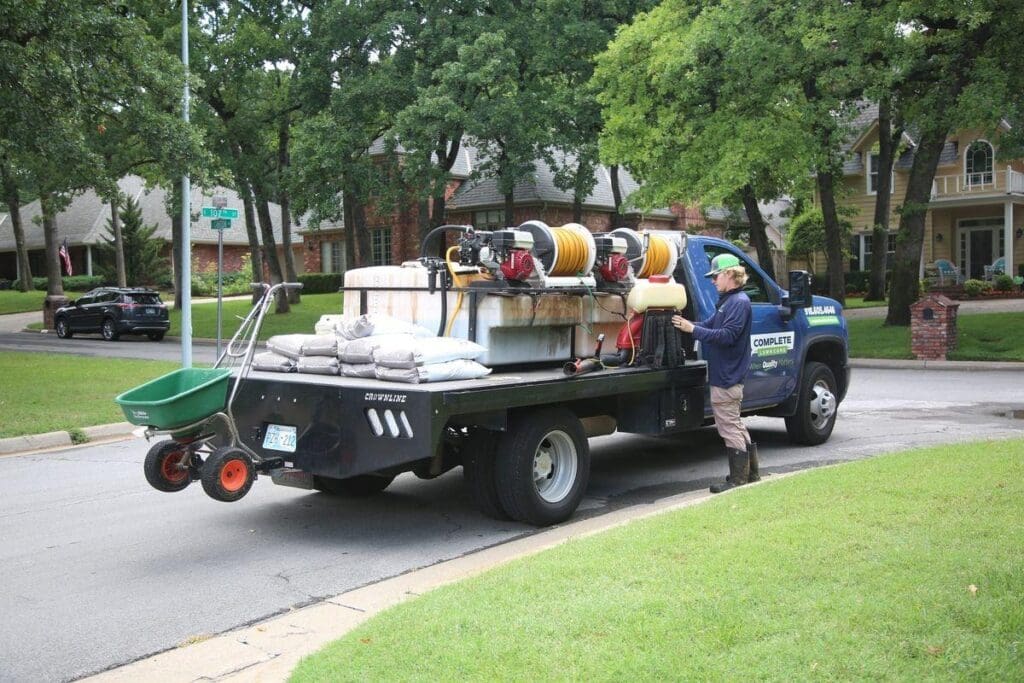
Image: A Complete Lawn Care service truck equipped with professional spray rigs, granular spreader, and treatment products in a Tulsa-area neighborhood. Consistent professional service throughout the season is what keeps mosquito populations suppressed.
The Treatment May Not Have Been Thorough Enough
This is the hardest one to address, but it is important to be honest about it. The effectiveness of any mosquito treatment depends heavily on how well it was applied. A thorough application and a rushed application use the same products but produce very different results.
A thorough treatment covers all harborage areas on your property. That means the undersides of leaves on shrubs, not just the tops. It means fence lines on both sides if accessible. It means under the deck, around the porch, along the foundation, through landscape beds, into ground cover, and around the base of trees. A technician who walks the perimeter once and skips the backyard did not deliver a complete treatment.
The time spent on your property is a reasonable indicator. A typical residential property in the Tulsa area with normal landscaping should take 15 to 30 minutes to treat thoroughly, depending on size and vegetation density. If your technician was on the property for five minutes, they did not treat everything that needed treatment. If areas of your yard that have dense vegetation were not treated, mosquitoes are resting in those untreated zones and emerging to bite you.
What to do about it: If you suspect your treatment was not thorough, talk to your provider. A reputable company wants to know if you are not seeing results because it gives them the opportunity to improve. At Complete Lawn Care, our technicians are trained to treat every harborage area on the property, and we encourage homeowners to walk the property with the technician on the first visit to identify any areas of concern. If you are switching from another provider because results were poor, that is something we hear regularly, and the solution is often simply a more thorough application.
Your Property Has Conditions That Create Higher Mosquito Pressure
Some properties are simply harder to control than others. If your property has one or more of the following conditions, you may need additional attention beyond a standard treatment program.
Proximity to creeks, ponds, or drainage areas. Properties that back up to Crow Creek, Haikey Creek, the Arkansas River, retention ponds, or municipal drainage channels face a continuous supply of mosquitoes from breeding sources you cannot eliminate. The barrier treatment handles mosquitoes on your property, but the supply from nearby water sources is essentially unlimited. These properties often benefit from more frequent treatments during peak season.
Heavily wooded or densely landscaped lots. The more vegetation on your property, the more surface area mosquitoes have to rest on, and the more area that needs treatment. A half-acre lot with mature trees, extensive shrub beds, and dense ground cover requires significantly more treatment time and product than a quarter-acre lot with minimal landscaping. If you have a heavily vegetated property and your technician spends the same amount of time as they would on a small lot, that is a coverage gap.
Standing water you cannot eliminate. Some properties have persistent standing water from poor grading, natural springs, French drain outlets, or HOA-managed retention features. If you have a standing water source that cannot be drained, mosquito dunks (Bti larvicide) placed in the water will kill larvae before they become adults. This complements the barrier treatment, which handles the adults.
Irrigation issues creating standing water. An irrigation system that is overwatering certain zones, has broken heads creating puddles, or has poor drainage around spray patterns can produce standing water that breeds mosquitoes between every watering cycle. At Complete Lawn Care, our irrigation team can identify and correct these problems, which directly improves both your turf health and your mosquito situation.
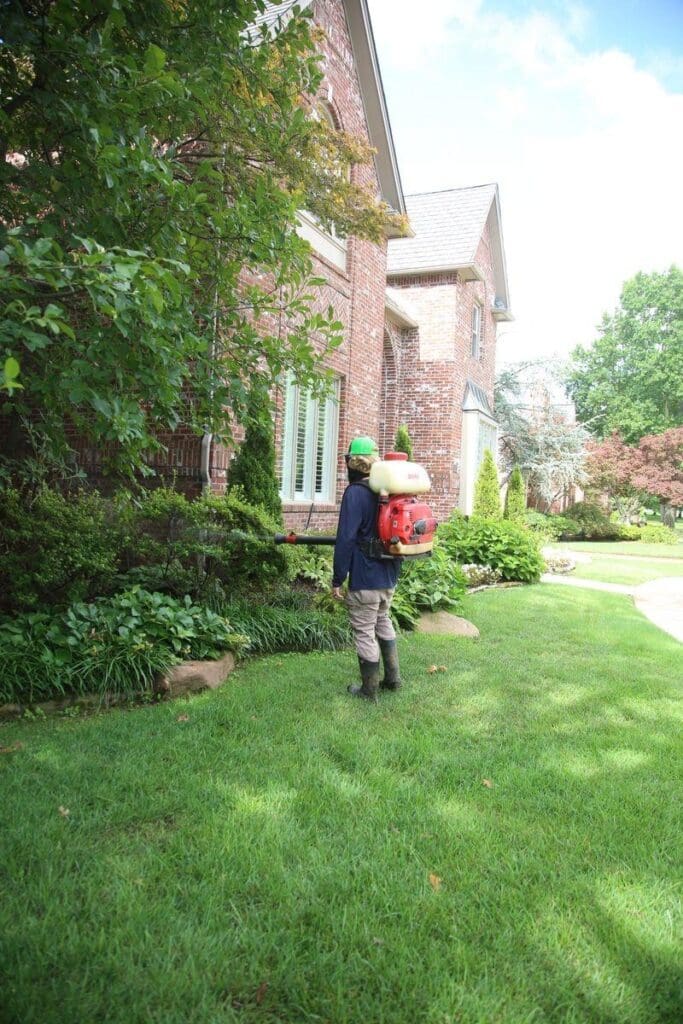
Image: A Complete Lawn Care technician treating dense foundation landscaping. Properties with heavy vegetation require thorough treatment of every harborage area to achieve effective mosquito control.
When to Call Your Provider vs. When to Be Patient
Here is a simple framework for deciding whether what you are experiencing is normal or whether it is time to make a call.
Normal and expected: Seeing a few mosquitoes during dusk and dawn. Noticing a temporary increase after heavy rain. Seeing slightly more activity during the peak of summer (July and August) than in the shoulder months. Getting an occasional bite during extended outdoor time in the evening. Seeing mosquitoes near your property line where it borders untreated areas.
Worth a call to your provider: Seeing no meaningful improvement after two or more treatments. Noticing that mosquito activity is just as bad as it was before treatment started. Finding significant new standing water sources on your property that were not addressed. Suspecting that areas of your yard were not treated. Experiencing a major increase in mosquitoes after a severe storm that may have washed the barrier.
A sign you may need to switch providers: If you have been on a program for several treatments, have eliminated standing water on your property, and still see no improvement, the application quality may be the issue. Some providers rush treatments, skip areas, or use lower-quality products. If your current provider cannot explain why you are still seeing high mosquito activity and is not willing to adjust their approach, it may be time to look for a provider who takes the application more seriously.
For more than 25 years, Complete Lawn Care has been a trusted lawn care provider in the Tulsa area. We believe great results do not come from guessing. They come from experience, science, and continual improvement. When a homeowner tells us they are still seeing mosquitoes, we do not dismiss the concern. We investigate. We check for standing water. We review the treatment coverage. We ask about timing and conditions. And if something needs to change, we change it. Our agronomy support allows us to make smarter corrections, faster, and that principle applies to our mosquito program just as much as our turf care.
Results You Can See. A Team That Listens.
Complete Lawn Care’s mosquito control program is built on thorough applications, consistent scheduling, and direct communication with homeowners. If something is not working, we want to know about it. Combined with our 7-step lawn care program, weekly mowing, pest control, landscape maintenance, and irrigation service, we manage the conditions that affect mosquito populations on your property. No contracts. No subscriptions. Serving Tulsa, Broken Arrow, Bixby, Jenks, Owasso, and Sand Springs.
Call us today: (918) 605-4646
Get a Free Quote at completelawncaretulsa.com
Experience. Science. Intentional Lawn Care. That’s the Complete Lawn Care Difference.