
For Bermuda and Zoysia lawns — which make up the majority of residential turf in the Tulsa area — the right time to start regular irrigation in spring is mid-April to early May, after the final frost risk has passed and soil temperatures have reached 60 degrees Fahrenheit consistently. Starting your irrigation system earlier than this is one of the most common and least recognized lawn care mistakes in Oklahoma: cool, wet soil from premature spring watering keeps soil temperatures suppressed, encourages cool-season weed germination, and promotes fungal disease conditions before warm-season grasses have broken dormancy and developed the active root system needed to benefit from the water. The system startup date and the irrigation schedule date are also two different things — you can perform your spring startup inspection in late March to catch and fix any winter damage, while holding off on running regular irrigation schedules until the turf genuinely needs supplemental water in April or May.
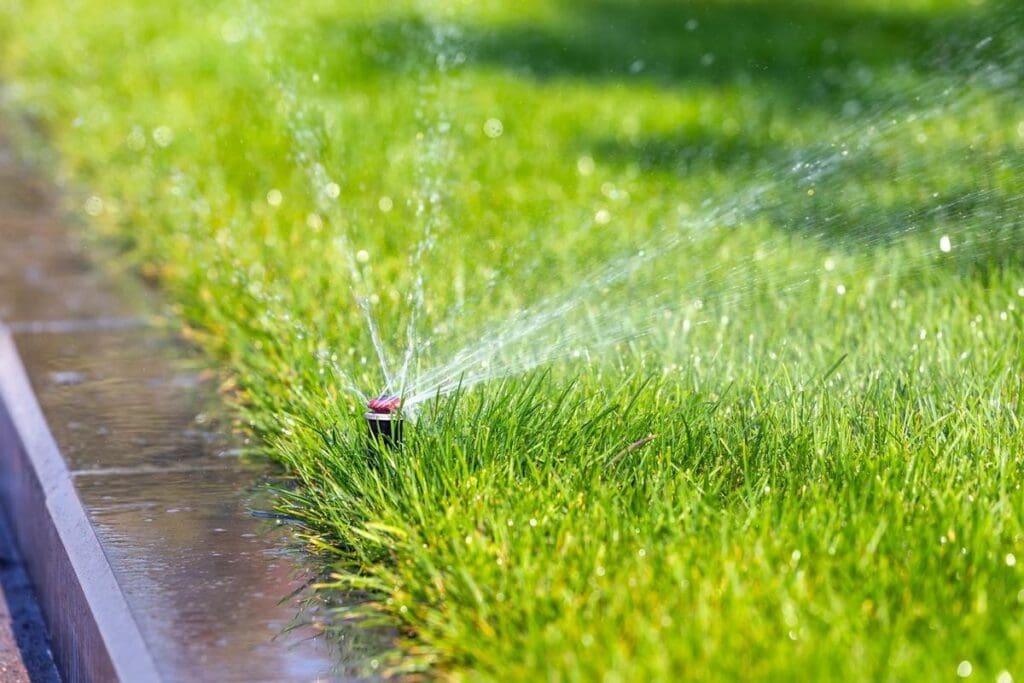
A rotor head delivering coverage along a lawn edge in active spring growth — the lush green turf visible here is the condition that should guide irrigation startup timing in Oklahoma. If your Bermuda or Zoysia lawn looks like this in spring, it does not need supplemental irrigation yet; spring rainfall and soil moisture are meeting its needs. Irrigation startup becomes appropriate when the lawn shows active growth, soil temperatures are consistently at or above 60°F, and a dry period extends beyond 5 to 7 days without rainfall. Starting the system before this point wastes water and can work against the lawn.
Why Timing Matters More Than Most Homeowners Realize
Oklahoma’s spring is one of the most variable periods of the year for lawn care decisions. Tulsa-area average last freeze dates fall between March 20 and April 5, but late cold snaps extend into April some years. Spring rainfall in Oklahoma is typically above average — March and April bring the first of the severe weather season’s moisture — meaning Bermuda and Zoysia lawns that are still dormant in March and early April are often sitting in adequately or even excessively moist soil without any supplemental irrigation.
The single most important reason to wait on spring irrigation for warm-season grasses: Bermuda and Zoysia are cool-dormant grasses that do not begin significant water uptake until their root systems are actively growing. Before soil temperatures reach 55 to 60 degrees consistently, Bermuda roots are essentially inactive. Irrigation applied to a dormant lawn moves through the surface zone, pools in Tulsa-area clay, and creates the exact conditions that cool-season weeds — henbit, chickweed, annual bluegrass — thrive in. You are watering weeds, not grass, in the early spring period when warm-season lawns have not yet broken dormancy.
The counterintuitive truth: Bermuda and Zoysia lawns that go into spring with adequate soil moisture from winter rainfall and are left alone until the turf shows visible green-up typically green up faster and more uniformly than lawns that received premature spring irrigation. The soil warms faster when it is not being continuously wetted by irrigation; faster soil warming leads to faster and more complete green-up for warm-season grasses.
The Right Trigger: Soil Temperature, Not Calendar Date
The most reliable signal that regular irrigation should begin for Bermuda and Zoysia lawns is soil temperature consistently at or above 60 degrees Fahrenheit at the two-inch depth — not a calendar date. Soil temperature correlates directly with root activity: below 55 degrees, warm-season grass roots are largely inactive and cannot use supplemental water efficiently. Above 60 degrees, root activity is increasing and the grass begins to emerge from dormancy with growing water needs.
Tulsa-area soil temperatures typically reach and hold the 60-degree threshold in mid-April to early May in normal years. In an early warm spring, this may happen in early April. In a late cold spring, it may not arrive until mid-May. The year-to-year variability makes any fixed date guidance unreliable — using soil temperature as the trigger is more accurate.
You do not need a specialized instrument to check soil temperature. A simple digital thermometer — the kind used for cooking — pushed two inches into the soil in a shaded location (not in direct sun, which will read higher than actual soil temperature) gives a usable reading. Check it at the same time of day for several consecutive days. When readings are consistently at or above 60 degrees in the morning, it is appropriate to begin an irrigation schedule for warm-season grasses.
Oklahoma State University Cooperative Extension and the Oklahoma Mesonet both publish soil temperature data for monitoring stations across the state, including stations in the Tulsa metro area. The Mesonet soil temperature data (available online at no cost) is one of the most useful resources for precise spring startup timing in this region.

A fixed-spray head irrigating an ornamental bed in active growing conditions — landscape beds with established shrubs, perennials, and ornamental plantings have earlier spring water needs than warm-season turf. Ornamentals emerging from dormancy in late March and April benefit from supplemental irrigation if spring rainfall is below average, making a two-phase spring startup approach practical: bring the landscape bed zones online in late March for ornamentals, while holding the turf zones until mid-April or soil temperature confirmation. This approach is easy to implement on systems with dedicated landscape versus turf zones.
Spring Startup vs. First Regular Irrigation: Two Separate Steps
A point that saves both time and potential repair costs: your spring system startup inspection and your first regular irrigation cycle are not the same thing, and they do not need to happen on the same day.
Spring startup inspection — typically late March through early April after the final frost risk has passed — is the right time to pressurize the system, run each zone manually, walk every head, check the backflow preventer, and identify any winter damage that needs to be repaired before the irrigation season begins. This inspection can be done in late March without running a full irrigation schedule, and it gives you time to address any repairs before the lawn needs consistent watering in May.
Regular scheduled irrigation — activating the controller to run zones on an automatic schedule — should wait until the lawn actually needs supplemental water. For Bermuda and Zoysia in a normal Oklahoma spring, that is typically late April to early May. Turning the controller to auto-run in March and then leaving it means the system will run on schedule regardless of whether the turf needs water, regardless of spring rainfall, and regardless of whether a late freeze is forecast.
| Two-Step Spring Approach for Tulsa-Area HomeownersStep 1 — System Inspection (Late March to Early April): Open the main irrigation supply slowly. Inspect the backflow preventer for freeze damage (weeping, cracks, or failed test cocks). Run each zone manually one at a time and walk every head. Note heads that are not rising, leaking at the base, or spraying incorrectly. Schedule repairs before regular irrigation season begins. Leave controller in Off or Rain mode — do not activate automatic scheduling yet. Step 2 — Activate Regular Irrigation (Mid-April to Early May): Confirm soil temperature is consistently at or above 60°F. Confirm visible green-up in Bermuda or Zoysia turf is underway. Check 7-10 day rainfall forecast before setting first schedule. Start with a conservative schedule (1-2x per week) and adjust based on lawn response. Set the controller to rain sensor / freeze sensor mode, not pure auto. |
Starting Too Early: What Actually Goes Wrong
The practical consequences of turning the irrigation system on too early in spring are specific and worth understanding:
Pre-emergent dilution and washoff. Spring pre-emergent applications — one of the most important applications in Complete Lawn Care’s 7-step program — depend on the product staying in the upper soil layer where germinating weed seeds contact it. Irrigation applied too heavily after pre-emergent application moves the product below the germination zone before it can work. Spring irrigation schedules that begin before the turf needs water often coincide with pre-emergent applications and undermine their effectiveness by leaching the product deeper than it needs to be.
Cool-season weed encouragement. Henbit, chickweed, annual bluegrass, and hairy bittercress all germinate and thrive in cool, moist soil. A dormant Bermuda lawn that is being irrigated in March provides exactly the conditions these weeds need. By the time the Bermuda breaks dormancy in April, the cool-season weeds have had four to six weeks of ideal growing conditions at the expense of your water bill and pre-emergent application.
Fungal disease setup. Spring fungal diseases — particularly brown patch in Zoysia and large patch in Bermuda — are encouraged by cool, wet conditions that persist into the warming period of late spring. Prolonged soil saturation from unnecessary early spring irrigation, combined with rising temperatures in April and May, creates ideal conditions for these diseases to establish before the turf is growing vigorously enough to outpace them. Brown patch and large patch are both treated by Complete Lawn Care as part of our program, but preventing the conditions that allow them to establish is more effective than correcting an established infestation.
Suppressed soil warming. Wet soil warms more slowly than dry soil — this is basic thermal physics. A Tulsa-area clay lawn that is being irrigated in March when soil temperatures are in the 45 to 55 degree range may take two to three weeks longer to reach the 60-degree threshold needed for Bermuda green-up than the same lawn left to warm naturally. Homeowners who start irrigation early in spring often wonder why their neighbor’s Bermuda is greening up faster; slower soil warming from premature irrigation is frequently the reason.
Tall Fescue: Different Timing Rules
Tall Fescue lawns in the Tulsa area follow a completely different irrigation timing logic than Bermuda and Zoysia. Fescue is a cool-season grass that is actively growing through the fall, winter, and early spring. It does not go fully dormant in normal Oklahoma winters and resumes active growth earlier in spring than warm-season grasses.
For Fescue lawns, spring irrigation startup timing depends less on soil temperature and more on actual soil moisture and rainfall. Fescue that is actively growing in March and April may need supplemental water during dry stretches — particularly in years when March and April are drier than average. The appropriate trigger for Fescue irrigation startup is not soil temperature but soil moisture: if rainfall has been below average and the soil at the two-to-four-inch depth is dry to the touch, supplemental irrigation is appropriate regardless of calendar date.
The caution for Fescue in spring is on the opposite end: do not overwater during the April through June period when temperatures are rising. Fescue under chronic moisture stress from both underwatering and overwatering is more vulnerable to summer decline. Fungal diseases — particularly brown patch in Fescue — are promoted by overwatering in the April through June warm-up period. Light, infrequent watering that promotes deep rooting is more appropriate for Fescue entering the Oklahoma summer than frequent shallow watering that keeps the surface perpetually moist.

An irrigation technician completing a riser and head installation during a repair — the spring startup inspection is the ideal time to catch and address winter damage before the irrigation season begins. Heads that settled below grade over winter, flex risers that cracked from freeze events, and solenoid failures from cold weather all show up during a thorough startup inspection. Finding and addressing these issues in late March means they are repaired and ready before the lawn needs consistent irrigation in May.
Spring Irrigation Schedule: Starting Conservatively
When it is time to activate regular irrigation scheduling — mid-April to early May for Bermuda and Zoysia in the Tulsa area — starting with a conservative schedule and adjusting based on lawn response is more effective than running the same schedule that worked in July. Spring conditions are fundamentally different from summer:
- Spring rainfall in Oklahoma is typically higher than summer rainfall, meaning the irrigation system needs to supplement natural moisture rather than replace it entirely. A schedule appropriate for a dry July will overwater the same lawn in a normal April or May.
- Evapotranspiration rates are lower in spring than in summer. Bermuda and Zoysia need roughly half the water per week in April compared to July, because temperatures are lower and the grass is not under peak heat stress.
- Warm-season grasses in the green-up phase (April and early May) benefit from irrigation that encourages deep rooting rather than frequent shallow watering. One to two cycles per week applying 0.5 to 0.75 inches per cycle promotes deeper rooting going into summer than three or four shallow cycles per week.
A practical spring starting schedule for Bermuda and Zoysia in the Tulsa area: one to two irrigation cycles per week, with each cycle running long enough to apply approximately 0.5 inches of water across the zone. For rotor heads covering larger turf areas, this is typically 25 to 40 minutes per zone depending on head type and spacing. Adjust the frequency up or down based on the 7 to 10 day rainfall forecast and visible lawn response — if the lawn shows no stress symptoms and rainfall has been adequate, skip cycles rather than running them by default.
Spring Startup and Irrigation Schedule by Grass and Plant Type
Tulsa-area properties often have a mix of warm-season turf, ornamental landscape beds, and potentially Fescue or mixed turf in shaded areas. Startup timing by zone type:
| Turf or Plant Type | Startup Window | Initial Schedule | Oklahoma-Specific Notes |
| Bermuda grass | Mid-April to early May | 1-2x per week, 20-30 min rotors | Wait until soil temps reach 60°F and active growth is visible. Starting too early encourages cool-season weeds and keeps soil cold. |
| Zoysia grass | Mid-April to early May | 1-2x per week, 20-30 min rotors | Same as Bermuda — Zoysia is slow to green up. Irrigation before active growth is usually unnecessary if spring rainfall is average. |
| Tall Fescue | Late March to early April | 2-3x per week, shorter cycles | Fescue is actively growing in spring and dries out faster. Earlier startup appropriate if soil is dry; do not overwater as fungal pressure rises in warm wet conditions. |
| Landscape beds (ornamentals, shrubs) | Late March | 1x per week, 15-20 min | Established ornamentals need less water than turf. New plantings from March onward need supplemental irrigation immediately. |
| New sod or seeded areas | Immediately at installation | Light and frequent — 2-3x daily initially | New turf installations require irrigation from day one regardless of season. Frequency tapers as roots establish over 3-4 weeks. |
How Irrigation Startup Timing Connects to Your Lawn Care Program
Complete Lawn Care’s 7-step agronomy-supported program is timed around Oklahoma’s climate calendar — and the timing of irrigation activation directly affects how well those applications perform. Pre-emergent herbicide applications in early spring depend on the product staying positioned in the upper soil layer where germinating crabgrass, goosegrass, and weed seeds contact it; premature heavy irrigation washes it below the effective zone. Early spring fertilization applications in late March and April require soil moisture for activation and uptake, but not saturation — proper irrigation timing in the weeks after application determines how efficiently the product reaches the root zone.
Our agronomy support guides the timing and product selection for every application in our program — which means when you call us for a spring startup inspection, we are not just checking that the heads are working. We are looking at whether the irrigation schedule makes sense for where the lawn is in its spring development, what applications are coming up in the program calendar, and whether any irrigation patterns are creating conditions that would work against the treatments. Every application is intentional. Every irrigation recommendation connects to the broader picture of what the turf needs through the season.
We recommend annual soil testing for every property we serve in Tulsa, Broken Arrow, Bixby, Jenks, Owasso, and Sand Springs. Spring startup is an ideal time to collect soil samples — results inform both the fertilization program for the coming season and the irrigation approach based on actual soil moisture retention and structure.
Spring Startup and Lawn Care Services in the Tulsa Area
For more than 25 years, Complete Lawn Care has served homeowners across the Tulsa metro with irrigation service, spring startup inspections, and science-based 7-step lawn care programs. We invest in leadership training, research, and agronomy expertise to ensure every recommendation — including when and how to irrigate in spring — is based on proven science, not guesswork or one-size-fits-all advice.
Our agronomy-supported approach means we adjust throughout the season because turf conditions, weather, and soil biology are always changing. Experience tells us what to do. Science tells us when and why.
Whether you need a spring startup inspection to catch winter damage before irrigation season begins, help setting the right controller schedule for Oklahoma’s spring conditions, or a lawn care program that coordinates fertilization, weed control, and irrigation for the best possible results through the season, we are the Tulsa-area team that gets it done intentionally.
Ready to Start Your Sprinkler System This Spring?
Contact Complete Lawn Care at completelawncaretulsa.com or call (918) 605-4646. We serve Tulsa, Broken Arrow, Bixby, Jenks, Owasso, and Sand Springs — and we will help you start the season the right way.
Experience. Science. Intentional Lawn Care — That’s the Complete Lawn Care Difference.