
The most reliable way to locate buried sprinkler valve boxes is to trace the low-voltage wiring from the irrigation controller back to each valve. Every zone valve is connected by a two-wire circuit — a common wire and a zone wire — that runs from the controller terminal strip out to the valve location underground. By running each zone from the controller and following the wiring path, or by using a wire tracer tool that sends an audible signal through the wire, you can pinpoint valve box locations even when they have been buried under years of soil buildup, overgrown grass, or landscape material. Other methods — running each zone and observing where heads are absent in a region (indicating a valve without nearby spray), walking the typical wiring routes from the controller, or using a metal probe to physically search suspect areas — can all work in combination when wire tracing is not feasible.
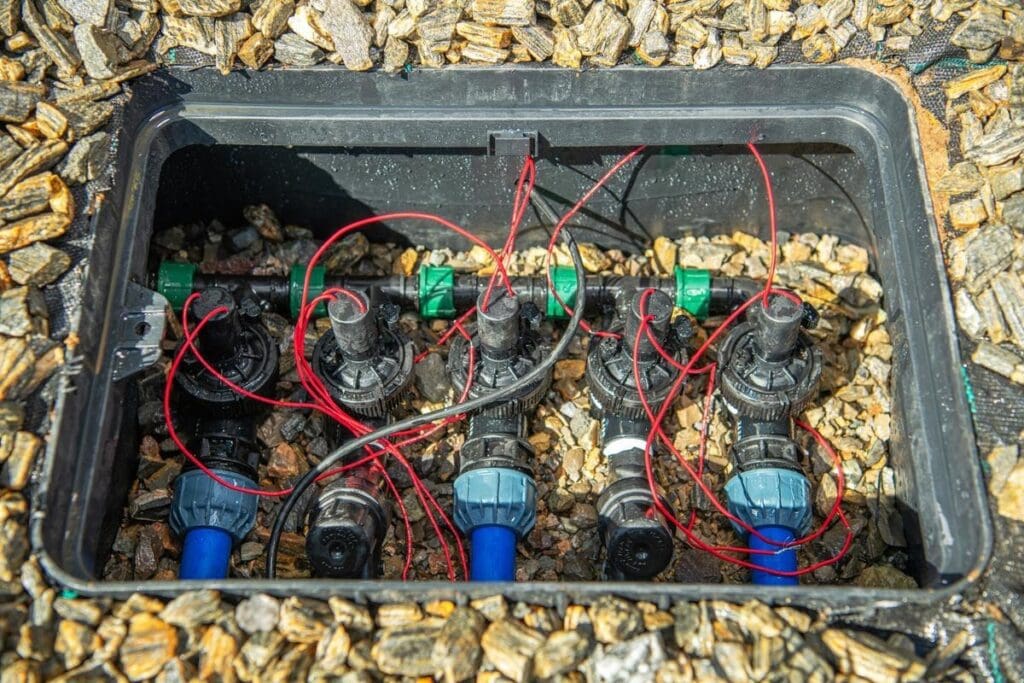
A residential irrigation valve manifold inside an open valve box — four zone valves with red zone wires and blue outlet pipes serving individual irrigation zones. Each solenoid (the cylindrical component on top of each valve body) connects to the irrigation controller via two wires: a shared common wire and a zone-specific wire. Tracing these wires from the controller to the valve box is the most reliable method for locating buried boxes on Tulsa-area residential properties.
Why Valve Boxes Get Lost
Valve boxes on Tulsa-area residential properties get buried and lost for predictable reasons. The green or black plastic lids of standard residential valve boxes sit flush with the turf surface when installed correctly — and over seasons of lawn mowing, thatch buildup, top dressing, and soil settlement, that surface rises by a quarter inch per year in many yards. After five or ten years without active maintenance of the box location, it is not unusual for a valve box to be covered by an inch or two of accumulated organic matter and soil that has completely obscured it.
Landscape renovation also buries boxes: fresh sod installation, bed expansion, mulch application, and hardscape additions all cover valve boxes that were previously accessible. In the Tulsa metro area, where many neighborhoods have homes built in the early 2000s through 2010s now undergoing their first major landscape updates, uncovering original valve boxes is a routine part of irrigation service and renovation work.
Previous owners or landscapers sometimes relocate boxes to more convenient locations during other work and do not document the change. Irrigation contractors occasionally install individual valves without standard boxes — particularly on add-on zones — that were never properly accessible to begin with. And in some cases, particularly on properties with aggressive Bermuda grass, the turf has simply grown over a box that was accessible as recently as the prior season.
Method 1: Wire Trace from the Irrigation Controller
The irrigation controller is the logical starting point because every zone valve in the system is wired back to it. Opening the controller and identifying the wiring terminals shows you how many zones the system has and gives you physical access to the zone wires — which run underground directly from the controller to each valve location.
The approach:
- Open the irrigation controller and locate the terminal strip — the row of screw terminals where zone wires connect. Count the occupied terminals to confirm how many zones the system has. Each terminal (labeled Zone 1, Zone 2, etc.) has one colored wire connected to it, plus a common wire (usually white) that is shared across all valves.
- Note where the wiring exits the controller. The wire bundle typically exits through a conduit or hole at the bottom or side of the controller housing and runs underground from there. The direction this conduit points gives you the initial bearing for the wiring run.
- Run each zone individually from the controller and walk the property to observe where water appears. Heads that run during Zone 1 are on the Zone 1 circuit; their approximate location tells you which area of the yard Zone 1 serves. The valve box for Zone 1 is somewhere between the controller and those heads.
- Look for the wiring trench path. On many properties, the wiring was buried in a shallow trench that follows logical routes — along fence lines, along the edge of beds, along the house foundation, or across open lawn areas in straight runs. In areas where the grass grows differently (slightly greener, slightly different texture, or a subtle line in the lawn surface), you may be seeing the trench where the wire was buried. Following this line leads to the valve.
- Probe suspect areas. Once you have identified a likely zone on the property, use a thin metal probe (a long screwdriver, a wire flag probe, or a dedicated lawn probe tool) to systematically probe the area in a grid pattern at 6-inch intervals. Valve boxes produce a hollow sound and reduced resistance compared to solid soil. When the probe encounters a hollow area or the plastic lid of a buried box, dig carefully to expose it.

An irrigation controller and valve assembly — the controller terminal strip connects to zone valves via low-voltage wiring, with one wire per zone plus a shared common wire. Identifying which terminal a zone wire connects to and tracing it to the valve box is the most reliable starting point for locating buried valves. On Tulsa-area residential systems, the controller is typically mounted on the exterior wall of the garage, in the utility room, or near the backflow preventer on the exterior of the house.
Method 2: Valve Locator or Wire Tracer Tool
A valve locator or wire tracer is the fastest and most precise method for locating buried valve boxes, particularly on properties where the box has been under ground for many years or is located in a densely planted area where probing is impractical. These tools send a low-frequency signal through the zone wire from the controller end and use a handheld receiver to detect the signal path underground.
How the tool works: the transmitter connects to the zone wire at the controller terminal (no disassembly required — it clips to the wire or connects to the terminal). When activated, it sends a signal through the wire circuit to the valve. The handheld receiver, walked across the property, produces an audible tone or visual display that strengthens as you approach the wire path and peaks directly over the valve location. On a typical residential lot, this narrows a search from the entire property to a specific square foot in a few minutes.
Valve locator tools are available for rent at some equipment rental companies and irrigation supply stores in the Tulsa area. Professional irrigation technicians carry these tools as standard equipment — if you have multiple missing valve boxes or a large property, a professional service call that includes valve location as part of the diagnostic may be more cost-effective than purchasing or renting the tool for a single use.
One important note: the valve locator works on the zone wires. If a zone wire has been cut or is damaged between the controller and the valve, the signal will not reach the valve. In this case, the tool is useful for identifying where the wire break occurred, which is its own valuable diagnostic.
Method 3: Following Irrigation System Logic
On properties where the original system was installed by a professional irrigation contractor following standard practices, the valve box locations follow logical patterns that can be worked out from first principles:
Near the backflow preventer or water supply point. The backflow preventer is typically the highest-visibility component of a residential irrigation system — it is the above-ground assembly of valves and check valves on the exterior of the house or near the meter. On many residential systems, the first or primary valve manifold is located in a box within 10 to 20 feet of the backflow preventer, where the main supply line splits into individual zone lines. Start your search in a radius around the backflow preventer before expanding.
Along the house foundation near the controller. When the controller is mounted on the house, the wiring exit point is typically near the controller location. Valve boxes are often placed in beds along the foundation within 20 to 40 feet of the controller to minimize wire run length. On many Broken Arrow and Bixby new-construction homes, the valve manifold is in the same bed as the backflow preventer or in an adjacent foundation bed.
In or near landscape beds. Valve boxes placed in turf areas are more easily lost than those in beds, so installers often — though not always — place valve boxes in foundation beds, side yard beds, or areas with established ground cover where the box lid remains accessible. Check under mulch in beds near the zone areas the valve serves.
Along fence lines on corner lots. On larger residential lots, secondary valve boxes serving back yard or side yard zones are frequently placed along fence lines where they are out of the main lawn area. Check along the base of fences, particularly at corners, for boxes that may have been covered by grass growing over the lid.
| Common Valve Box Locations in Tulsa-Area Residential SystemsFoundation bed adjacent to the backflow preventer or within 20 feet along the foundation.Near or at the meter connection point for systems with manifold installed close to supply.Corner of the house where front yard zones meet back yard zones in the wiring run.Along fence lines — particularly in areas where a zone serves the back yard exclusively.At the base of large trees or in established shrub beds where the box lid has not been disturbed.Wherever you see a small mound, a hollow-sounding spot when walked on, or a slight depression in turf.Check under ground cover and mulch in beds throughout the property — not just in grass areas. |

An irrigation technician working inside an open valve box to service zone valves — a common scenario during spring startup inspections in the Tulsa area when valves that have been inaccessible over winter are opened, tested, and serviced. Once located, the box should be raised to grade if buried, marked on a property diagram, and checked annually during spring startup to confirm the lid is clear and accessible before irrigation season begins.
Method 4: Systematic Probe Search
When wire tracing is not available and the wiring path cannot be identified, a systematic physical search of likely areas using a probe tool is the fallback method. This is slower but reliable in open lawn areas:
- Identify the search area based on which zone the missing valve serves. Run that zone and observe which heads activate — the valve is upstream of all of them, somewhere between the controller and the nearest active head.
- Mark the search boundary. Place flags at the corners of a search grid approximately 10 feet on a side in the most likely area. If the first search grid produces nothing, expand the boundary.
- Probe at 6-inch intervals across the grid in parallel rows. Use a thin metal probe (a steel rod, long screwdriver, or commercial lawn probe) pushed straight down with moderate force. Solid soil produces resistance; a valve box produces a hollow feel and reduced resistance as the probe hits the plastic lid. A sharp metal probe will click against the lid distinctly.
- When you feel a hollow resistance, probe around the perimeter of the hollow area to define the box footprint before digging. Standard residential valve boxes are roughly 10 by 14 inches for manifold boxes and 6 by 6 to 9 by 9 inches for single-valve boxes. Mapping the perimeter before digging prevents damaging the box lid or the valves inside.
- Dig carefully. Once the box location is confirmed, remove soil carefully — valve wire connections inside the box are fragile, and valve bodies are plastic components that can crack under aggressive tool contact. Hand tools or a trowel are appropriate for the final excavation.
Once You Find the Box: What to Do Next
Locating a buried valve box is only half the work — the other half is making sure it does not get lost again. After exposing the box:
- Check and clean the box interior. Soil, insects, and moisture accumulate inside buried boxes. Shake out debris, inspect wire connections (look for bare wires, corroded connections, and tape that has failed), and confirm each valve is intact and undamaged.
- Raise the box to current grade. If the box was buried under accumulated soil or landscape material, excavate the sides of the box and raise it so the lid sits at or just above the current surface grade. This prevents it from being re-buried by the next season of mowing and turf buildup.
- Mark the location on a site map. Draw a simple sketch of the property showing the valve box locations relative to fixed landmarks — the house corners, the backflow preventer, the driveway edge. Even a rough hand-drawn sketch with measurements stored with the controller or in a home file saves hours of searching in future seasons.
- Consider installing a permanent marker. Some homeowners install a small landscape marker, a distinctive rock, or a specific plant near valve box locations as a visual cue. On turf areas, a small colored flag stake near the box is visible but unobtrusive.
- Label your valves. Once you have confirmed which zone each valve controls (run each zone from the controller and confirm which valve activates), label the valve bodies or the inside of the box lid with waterproof marker or a weatherproof label. Zone 1 = Front right lawn, Zone 2 = Front left lawn, etc. This information is invaluable for any future service work.
Valve Box Location Methods at a Glance
Comparing the primary search methods:
| Method | Reliability | Cost | Best Used When |
| Wire trace from controller | Best | Free / low cost | Requires controller access and basic continuity tester; most reliable method for locating all valves |
| Flag wire from zone run observation | Very good | Free | Works well for visible spray zones; less reliable for drip or buried-head zones |
| Walk the wiring path | Good | Free | Follows logical installation patterns; most useful on new-build properties with predictable routing |
| Probe and flag grid method | Good | Low cost (probe tool) | Systematic physical search; works well in open lawn areas; slow but thorough |
| Valve locator / wire tracer tool | Excellent | Tool rental or pro | Sends signal through valve wire; pinpoints exact location; fastest method for deep or overgrown boxes |
| Original irrigation as-built map | Excellent | Free if available | Check builder records, previous owner documents, or the installing company; rarely available but invaluable |
When to Call for Professional Help
Most valve box location work is DIY-capable given enough time and the right approach. These situations benefit from professional involvement:
- Multiple missing boxes across a large property — a professional with a valve locator tool can find all boxes in a fraction of the time a manual search requires.
- The system has been extensively modified or added to and the current zone count or wiring configuration does not match any available documentation, making manual tracing unreliable.
- Wiring damage is suspected — if a zone is not responding to the controller at all (not just a weak zone but completely non-functional), the valve locator is also used to find wire breaks, and this diagnostic work is best performed by someone with the proper test equipment.
- The property has recently been landscaped and no one has a record of where the original valve boxes were, whether they were relocated, or whether new zones were added during the renovation.
- You find the box but the valves inside are not functioning correctly — valve solenoid replacement, diaphragm replacement, and zone valve troubleshooting are straightforward professional repairs that take less time with proper experience and parts inventory.
Irrigation Service and System Repair in the Tulsa Area
With over 25 years serving homeowners throughout Tulsa, Broken Arrow, Bixby, Jenks, Owasso, and Sand Springs, Complete Lawn Care provides full-service irrigation repair, maintenance, and seasonal inspection services. Our irrigation team locates buried valve boxes, services and replaces zone valves, repairs wiring, and performs comprehensive spring startup inspections that identify problems before they affect your lawn through the heat of an Oklahoma summer.
We bring the same intentional, science-based approach to irrigation service that we apply to every aspect of lawn care. Our programs are continually refined based on real-world results — because an irrigation system that cannot be properly serviced due to missing valve box access is one that accumulates deferred maintenance season after season. We see this regularly on Tulsa-area properties and know how to address it efficiently.
Experience tells us what to do. Science tells us when and why. Every service call is intentional.
Need Help Locating Valve Boxes or Servicing Your Irrigation System?
Contact Complete Lawn Care at completelawncaretulsa.com or call (918) 605-4646. We serve Tulsa, Broken Arrow, Bixby, Jenks, Owasso, and Sand Springs — and we will find your valve boxes and get your system back in proper working order.
Experience. Science. Intentional Lawn Care — That’s the Complete Lawn Care Difference.