
When a single irrigation zone fails to run while the rest of the system works normally, the problem is almost always in one of three places: the solenoid on the zone valve, the low-voltage wiring between the controller and that valve, or the controller terminal for that specific zone. Because all other zones are functioning, the controller itself, the water supply, and the main system components are confirmed working — the fault is isolated to the circuit for the one dead zone. The fastest diagnostic is the manual bleed test: locate the zone valve and open the manual bleed screw by hand. If the zone runs with the manual bleed open, the valve itself is functional and the problem is in the solenoid or wiring. If the zone does not run even with the manual bleed open, the valve diaphragm has failed and needs replacement regardless of the wiring situation.
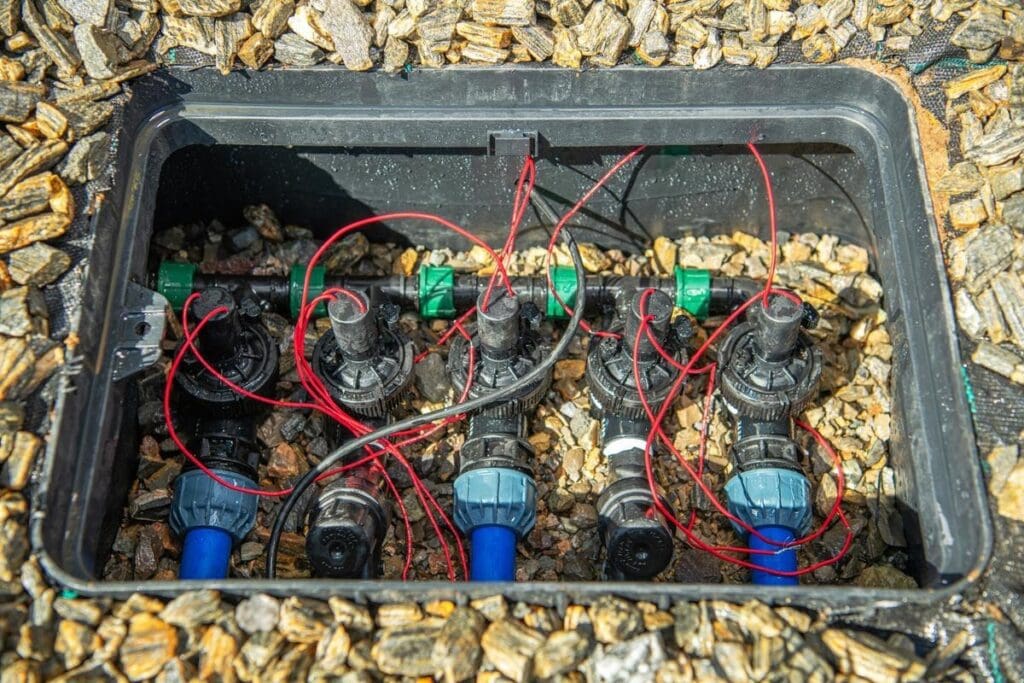
A residential irrigation valve manifold inside an open valve box — four zone valves with solenoids and red zone wires. When one zone fails to respond to the controller while others run normally, this is the starting point for diagnosis: the solenoid on the non-functioning valve and the wiring connections at this manifold are the first things to check. On Tulsa-area systems, spring startup often reveals solenoids or wiring splices that were damaged during winter and now prevent one or more zones from opening.
The Manual Bleed Test: Your First Diagnostic Step
Every zone valve in a residential irrigation system has a manual bleed mechanism — a screw or solenoid that can be opened by hand to let water flow through the valve without any electrical signal from the controller. This test takes less than one minute and immediately tells you whether the valve body itself is the problem or whether the fault is electrical.
How to perform the manual bleed test:
- Locate the valve box for the non-functioning zone. If you do not know where the valve boxes are, see our blog post on locating buried sprinkler valve boxes for the search method.
- Open the valve box and identify the correct valve. On a multi-valve manifold, run the other zones from the controller to confirm which valves activate — the remaining valve that never opens is the one for your dead zone.
- Find the manual bleed on the problem valve. Most residential solenoid valves have a manual bleed screw on the side of the valve body, or the solenoid itself can be manually opened by turning it counterclockwise one quarter to one half turn. Check your valve brand: Rainbird valves typically have a small bleed screw on the side; Hunter valves are typically bled by turning the solenoid; Toro valves vary by model.
- Open the manual bleed slowly with the irrigation water supply on. The zone should activate and heads should rise and spray. If they do, the valve diaphragm and valve body are functional — the problem is electrical (solenoid or wiring). If the zone does not run with the manual bleed open, the valve diaphragm or valve body has failed and needs replacement independent of the electrical issue.
- Close the manual bleed after confirming the result. An open manual bleed left unattended will run the zone continuously.
Cause 1: Failed Solenoid
The solenoid is the electromagnetic component that sits on top of the zone valve body and opens the valve when it receives a 24-volt AC signal from the controller. When the controller activates a zone, it sends this signal through the zone wire to the solenoid, which pulls a plunger open to release the valve diaphragm and allow water flow. A failed solenoid either does not respond to the signal at all (complete failure) or responds intermittently (partial failure that may cause the zone to work sometimes but not reliably).
Solenoid failure is the most common cause of a single non-functioning zone in Tulsa-area residential irrigation systems, particularly at spring startup. Oklahoma’s winters produce hard freezes that can damage solenoid components — particularly water that has accumulated inside the solenoid housing and expands as it freezes. A solenoid that appeared functional at the end of last irrigation season may fail when the system is pressurized in spring because internal freeze damage was not immediately apparent.
Testing the solenoid:
- Resistance test with a multimeter: A functional solenoid should measure 20 to 60 ohms of resistance between its two wire terminals (check your valve brand’s spec sheet for the exact range). A reading outside this range indicates a failed solenoid. A reading near zero (short circuit) or infinite ohms (open circuit) confirms failure.
- Swap test: If you do not have a multimeter, swap the solenoid from a working valve onto the non-functioning valve. If the previously dead zone now works, the original solenoid was the failure. This test works if your system uses the same valve brand and model throughout — Rainbird and Hunter solenoids are not interchangeable.
- Replacement cost: Replacement solenoids for common residential valve brands (Rainbird, Hunter, Toro) cost $10 to $25 at hardware stores and irrigation supply companies throughout the Tulsa area. Solenoid replacement involves unscrewing the old solenoid from the valve body and threading on the new one — typically a two to three minute repair that requires no tools.
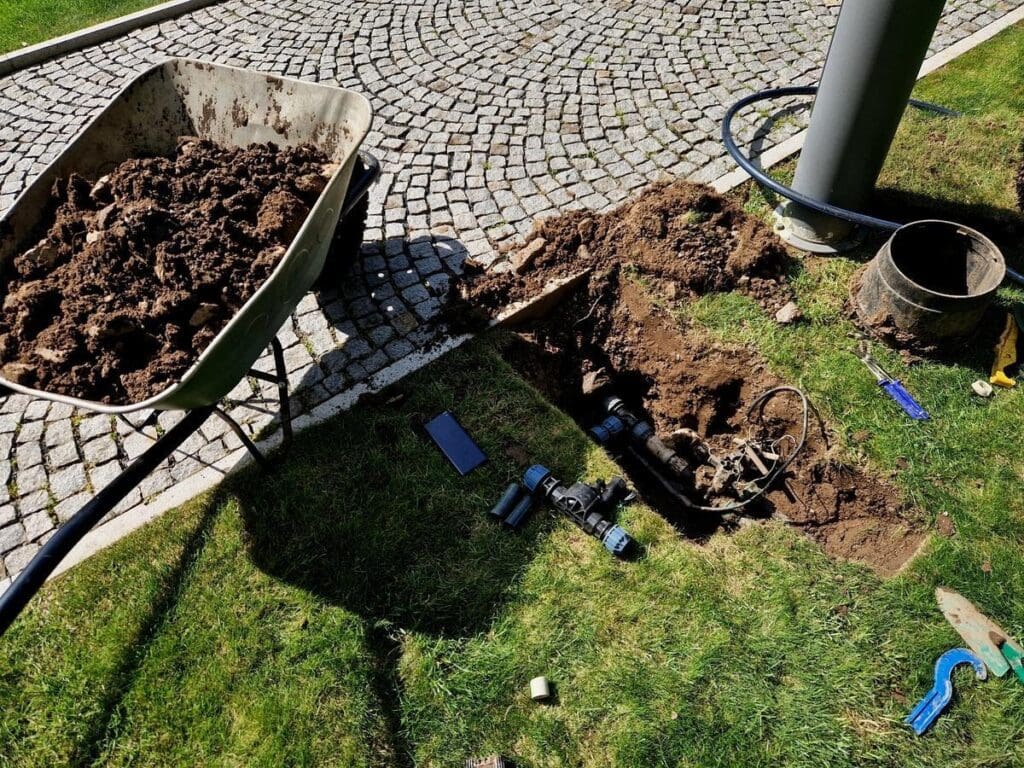
An irrigation zone valve excavated for replacement — the wheelbarrow of Oklahoma clay soil is typical of what is required to access buried irrigation infrastructure. For solenoid replacement, this level of excavation is not required: the solenoid sits on top of the valve body and is accessible inside the valve box without any digging. Full valve body replacement (required when the manual bleed test confirms the diaphragm has failed) does require excavation to access the valve connections on the supply and zone lines.
Cause 2: Wiring Break or Faulty Connection
Every zone valve is connected to the irrigation controller by two wires: a zone-specific wire (typically a color-coded wire — red, blue, green, yellow, or white depending on the installation) and a common wire (typically white or bare copper) that is shared among all valves. A break in either wire, or a failed connection at either the controller terminal or the valve splice, will prevent the zone from receiving the electrical signal needed to open the valve.
Wire faults are the second most common cause of a single non-functioning zone in Tulsa-area systems. The most common points of failure:
Wire splices in the valve box. Most residential irrigation systems use wire connector nuts or waterproof wire connectors (direct-burial connectors filled with gel) to splice the controller wire to the solenoid pigtail wires inside the valve box. These connections can fail over time — particularly when the connector was not properly waterproofed, when corrosion develops in the connection, or when freeze events crack connector nuts that have become brittle. Open the valve box and inspect all wire connections for the affected zone. Look for bare wire ends that have separated, corroded connectors, or cracked connector nuts. Reconnect with a fresh direct-burial waterproof connector.
Wire cuts from landscaping or edging work. Irrigation wiring is typically buried at 6 to 8 inches in Tulsa-area residential systems — shallow enough that edgers, spades, or landscape maintenance work can cut through it. A zone that worked until recent landscaping activity was performed is a strong indicator of a cut wire. Locate the approximate path of the zone wire and probe the area where digging occurred. A wire locator or continuity tester can pinpoint where the break is.
Controller terminal failure. The controller terminal for the dead zone may be damaged or loose. Open the controller and visually inspect the zone wire connection at the terminal strip. Confirm the wire is firmly seated. If the wire is secure and the solenoid tests good, the terminal itself may have failed. Test this by temporarily moving the zone wire to an unused terminal and reprogramming that terminal in the controller — if the zone now works from the new terminal, the original terminal has failed and the controller may need replacement or professional service.
Freeze damage to above-grade wiring. In Oklahoma, irrigation wiring that runs above grade — near the backflow preventer, along the house foundation, or where a previous repair left wire exposed — is vulnerable to freeze damage. Wiring insulation becomes brittle in extreme cold and can crack, creating an intermittent connection or a short to ground. Inspect any above-grade wiring segments on the system.
| Wiring Test Without a MultimeterIf you do not have a multimeter, this field test can confirm a wiring break vs. a solenoid failure:1. At the controller, remove the zone wire and the common wire for the dead zone.2. Twist the two wire ends together (zone wire + common wire) at the controller.3. Go to the valve box and test continuity between the solenoid pigtail wires with a cheap battery-powered continuity tester ($5-10 at hardware stores).4. Continuity present: the wiring is intact, the solenoid is the likely failure.5. No continuity: there is a break in the wire between the controller and the valve.6. Untwist the wires at the controller when done and reconnect each to its proper terminal. |
Cause 3: Controller Programming Error or Zone Skip
Before assuming a mechanical or electrical failure, verify the controller is actually sending a signal to the problem zone. This may sound obvious, but controller programming issues account for a meaningful number of service calls — particularly after power outages, battery replacement, or seasonal programming changes.
Things to check in the controller settings:
- Zone run time set to zero. On many controller models, a zone with a run time of zero minutes will be skipped entirely during auto operation without any error indication. Open the zone programming and confirm the dead zone has a non-zero run time assigned.
- Zone turned off or disabled. Most modern controllers allow individual zones to be disabled without deleting their programming. Check whether the zone is toggled off in the seasonal adjustment, zone enable, or skip settings. This setting is sometimes changed accidentally when programming other zones.
- Start time conflict. If the controller has multiple programs (Program A, Program B, Program C on most residential controllers), a zone may be programmed in one program but that program may have been inadvertently disabled or have no start time set.
- Rain sensor lockout. A rain sensor that has been triggered — either by actual rain or by a sensor malfunction — bypasses all irrigation zones until the sensor dries out and resets. On controllers with rain sensor bypass switches, confirm the bypass switch is in the correct position. On controllers without a manual bypass, a malfunctioning rain sensor that never resets can lock out a single zone or the entire system depending on wiring.
- Recent power interruption. Power outages reset some controller models to factory defaults, erasing all zone programming. If other zones are functioning, a complete reset is unlikely — but individual zone settings may have been altered. Verify the dead zone’s programming matches the other zones in terms of how it was set up.
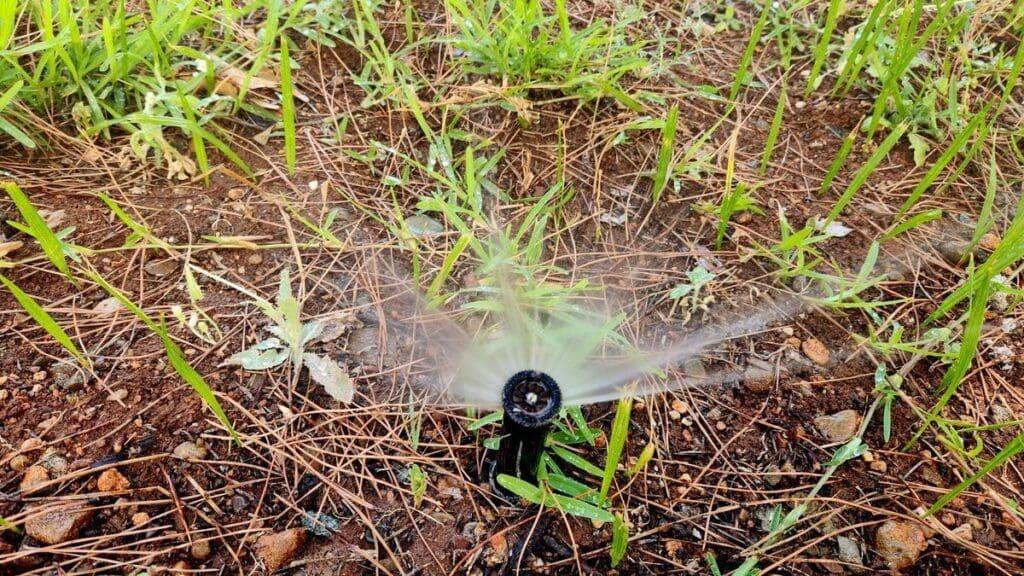
A fixed-spray head delivering coverage in a sparse turf area — when this head and every other head on a zone fail to respond while all other zones work, the problem is upstream of the heads: solenoid, wiring, or controller programming. The heads and nozzles themselves are not at fault when an entire zone is non-functional. Confirming this with the manual bleed test before pursuing any head-level repairs saves time and unnecessary expense.
Cause 4: Failed Valve Diaphragm
If the manual bleed test showed that the zone does not run even when the bleed is manually opened, the valve body itself has failed — specifically the rubber diaphragm inside the valve that controls water flow. The solenoid and wiring may be completely functional; the valve simply cannot open regardless of the signal it receives.
Valve diaphragm failures are less common than solenoid or wiring failures but occur in Tulsa-area systems that have been in service for 15 or more years, on valves that were exposed to freeze damage, or on valves where debris from the supply line has damaged the diaphragm seat. Symptoms beyond the manual bleed test include valves that make a buzzing or humming sound when the controller activates them (the solenoid is energized and working, but the diaphragm is not lifting) and valves that have had chronic leak or drip issues.
Diaphragm replacement on most residential valve brands is a serviceable repair — the top cap of the valve body unscrews, the diaphragm can be lifted out and replaced with a brand-specific replacement part. Replacement diaphragms for common brands (Rainbird, Hunter, Toro) are available at irrigation supply companies in the Tulsa area for $5 to $15. The repair requires shutting off the irrigation water supply before disassembling the valve. Full valve replacement — replacing the entire valve body — is the alternative when the diaphragm housing or valve seat is damaged and a diaphragm replacement alone will not restore function.
Spring Startup in Tulsa: Why One Zone Often Fails After Winter
In the Tulsa metro area, the most common timing for a single zone failure is spring startup — when the system is pressurized and run for the first time after winter. This timing pattern is not coincidental. Oklahoma winters produce freeze events that damage irrigation components in specific ways:
Solenoid freeze damage is the leading cause. Water retained inside the solenoid housing freezes and expands, cracking the internal components. The solenoid may still appear intact externally but will fail to energize when the system is started in spring.
Wire connector failures follow the same pattern. Connector nuts that held through several seasons become brittle and crack under freeze pressure. The connection appears intact when the box is opened but has failed internally. Replacing all exposed or suspect wire connectors in the valve box with fresh direct-burial waterproof connectors during spring startup is inexpensive insurance.
Valve diaphragm hardening occurs in valves that were not fully drained before freeze events. Rubber diaphragms that have been frozen in place and then dried out over winter lose flexibility and may not seat properly when the system restarts in spring.
For Tulsa-area homeowners: if a zone that worked at the end of last season fails at spring startup, the most cost-effective first repair is solenoid replacement ($10 to $25) before pursuing valve body or wiring repairs. Solenoid failure after winter is overwhelmingly the most common cause of this specific failure pattern in our service area.
Single Zone Failure Diagnosis at a Glance
Matching the symptom to the most likely cause:
| Symptom | Most Likely Cause | DIY or Pro? | First Step |
| Controller shows zone running but no heads appear | Failed solenoid or wiring break | DIY-capable | Manual bleed test confirms valve is receiving signal; solenoid replacement is straightforward |
| Manual bleed opens valve but controller cannot | Wiring break or bad controller terminal | DIY or pro | Confirms valve itself is fine; test wiring continuity and controller terminal output |
| Zone ran fine last season, fails at spring startup | Freeze-damaged wiring splice or failed solenoid from freeze | DIY-capable | Most common Tulsa-area spring startup failure; check splice connections in valve box first |
| All other zones work; only one is dead | Solenoid failure or single zone wire break | DIY-capable | Solenoid replacement ($10-25) is the most cost-effective first repair attempt |
| Zone worked, then rain sensor was installed | Rain sensor bypassing zone or wired incorrectly | DIY or pro | Check that rain sensor is wired to sensor terminals, not zone terminals |
| Zone worked until landscaping was done | Wire cut during digging or edging | DIY or pro | Locate wire break using continuity tester; splice and waterproof properly |
| Controller display shows error for that zone | Short circuit in wiring (wires touching ground) | Professional | Short circuit can damage controller; do not repeatedly attempt to run the zone until diagnosed |
When to Call a Professional
Most single-zone failures are DIY-capable repairs. These situations benefit from professional service:
- The controller displays an error code or fault message for the zone — a short circuit in the wiring can damage the controller if the zone is repeatedly run. Stop attempting to activate the zone and have the wiring diagnosed with proper test equipment before running the zone again.
- Multiple zones have failed simultaneously after a freeze event — widespread wiring or solenoid damage from a hard freeze is more efficiently diagnosed and repaired by a professional with a wire locator and proper test equipment than zone-by-zone trial and error.
- The wiring break is located and requires splicing in the middle of a buried run — a proper direct-burial splice using the correct waterproof connector materials and burial depth is important for long-term reliability. A splice that is not properly waterproofed will fail within one to two seasons.
- The valve body requires replacement and the fitting access requires excavation — digging in Tulsa-area clay to access a buried valve fitting and make PVC connections correctly is straightforward work but requires the right tools and materials.
Irrigation Repair and Service Throughout Tulsa and Surrounding Areas
With over 25 years serving homeowners in Tulsa, Broken Arrow, Bixby, Jenks, Owasso, and Sand Springs, Complete Lawn Care provides irrigation diagnosis, repair, and seasonal service for all major residential system brands. Our team diagnoses zone failures systematically — solenoid, wiring, valve, and controller — rather than replacing parts at random until something works.
We bring the same science-based, intentional approach to irrigation service that we apply to every aspect of lawn and turf care. Our agronomy support allows us to make smarter corrections, faster — because understanding the cause before recommending the fix is how we operate, whether we are diagnosing a fertilization problem or a zone that will not turn on.
With over 25 years of experience, we have seen every irrigation failure pattern common to Oklahoma’s climate, soil, and freeze cycles. When your irrigation system is not performing right, we will find the actual cause and fix it.
One Zone Not Working on Your Tulsa-Area Irrigation System?
Contact Complete Lawn Care at completelawncaretulsa.com or call (918) 605-4646. We serve Tulsa, Broken Arrow, Bixby, Jenks, Owasso, and Sand Springs and will diagnose your irrigation problem accurately before recommending any repair.
Experience. Science. Intentional Lawn Care — That’s the Complete Lawn Care Difference.