

What Is the Difference Between Program A, B, and C on My Sprinkler Timer?
By the irrigation experts at Complete Lawn Care | Serving Tulsa, Broken Arrow, Bixby, Jenks, Owasso, and Sand Springs
Programs A, B, and C on your sprinkler timer are three separate, independent watering schedules that can each run different zones on different days at different times. They do not communicate with each other — they simply take turns running in sequence on any given day if more than one is scheduled. Most homeowners only need Program A and leave B and C unused, but understanding what all three do — and when using more than one actually makes sense — can help you water your lawn more efficiently and avoid the most common irrigation programming mistakes.
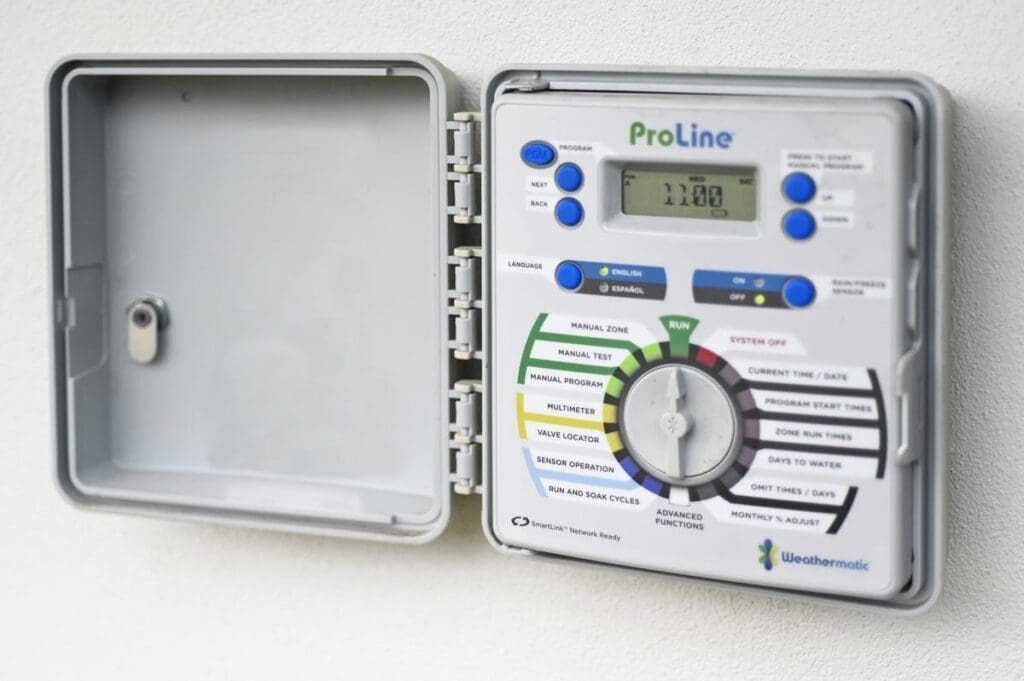
A Weathermatic ProLine irrigation controller — most residential timers use the same A, B, C program structure regardless of brand. Understanding what each program does helps you water smarter and avoid overwatering.
What Exactly Is a Program on a Sprinkler Timer?
Before getting into the differences between A, B, and C, it helps to understand what a program actually is. On most residential irrigation controllers — whether you have a Rain Bird, Hunter, Toro, Weathermatic, or another brand — a program is a complete set of watering instructions that includes three things: which zones run, how long each zone runs, and when the whole cycle starts.
Every program contains those same three elements. Program A has its own start time, its own zone run times, and its own schedule for which days it waters. Program B has its own completely separate version of all three. Program C does the same. They are essentially three independent timers living inside the same box.
When a day arrives where both Program A and Program B are scheduled to run, the controller runs A first from start to finish, then runs B from start to finish. They do not overlap — they queue up and run back to back. This is important to understand because it means stacking multiple programs on the same days can result in much longer total run times than you intended, and in some cases it can cause overwatering or contribute to the kind of runoff and pooling problems that are common in Tulsa-area clay soils.
Why Do Sprinkler Timers Have Three Programs at All?
The multi-program design exists because different areas of a lawn or landscape often have legitimately different watering needs that cannot be served well by a single schedule.
The clearest example is a lawn that includes both a turfgrass area and a drip irrigation zone for flower beds or shrubs. Grass and ornamental plants typically need water at different frequencies and for different durations. Turf may need to run twice a week for 10 to 15 minutes per zone, while drip zones for established shrubs may only need to run once a week for 30 to 45 minutes. Trying to fit those two completely different schedules onto one program creates compromises — you either overwater one area or underwater the other. Two separate programs solves that cleanly.
A similar situation arises with a lawn that has zones in very different sun exposures. A shaded back yard zone loses far less moisture to evaporation than a south-facing front yard zone baking in direct sun all afternoon. Separate programs let you run the sunny zones more frequently without running the shaded zones at the same rate, which would push them toward fungal disease territory.
The third common use case is a cycle-and-soak approach for clay soil — something especially relevant for Tulsa-area homeowners. Because Oklahoma clay absorbs water slowly, running a zone for 15 straight minutes often results in more runoff than infiltration. Instead, you can use Program A to run each zone for 5 minutes, then use Program B with the same zones set to start 30 minutes later for another 5 minutes, and Program C for a final 5-minute pass after another 30-minute gap. The total water delivered is the same 15 minutes, but spread across three short cycles with soak time in between — dramatically improving how much actually reaches the root zone versus running off the clay surface.
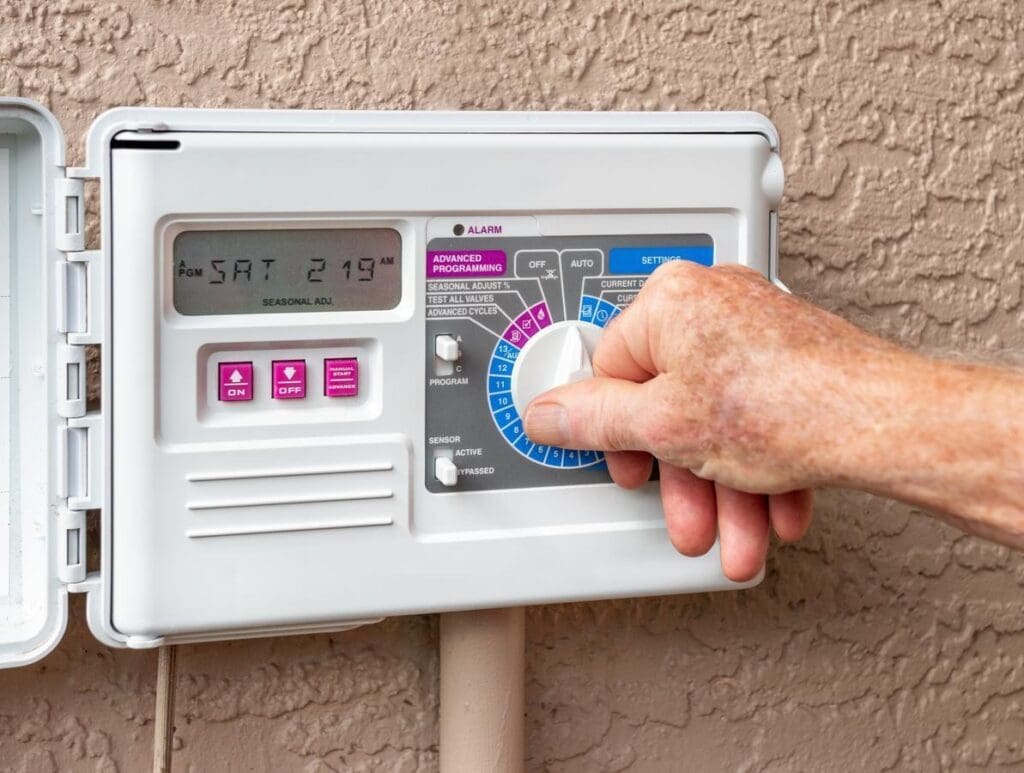
Adjusting a residential irrigation controller — the program dial controls which independent schedule you are editing. Most homeowners set Program A and never return to the controller until something stops working.
How Most Homeowners Actually Use Programs A, B, and C
The honest answer is that most homeowners use Program A for everything and leave B and C completely empty. That works fine if you have a straightforward lawn with similar zones and no drip irrigation. The multi-program capability exists for more complex situations, and there is nothing wrong with ignoring it if your setup does not need it.
Where things go wrong is when a homeowner — or an irrigation technician who rushed through a setup — accidentally programs the same zones into multiple programs and ends up running everything twice or three times without realizing it. If your water bill is higher than expected, your lawn seems perpetually wet, or you notice runoff consistently occurring after your system runs, checking whether multiple programs are active with overlapping zones is one of the first things to verify.
To check this, go through each program on your controller one at a time — not just A — and look at whether any zones are programmed with run times and active days. On most controllers, a program is inactive if its zones are set to zero minutes or if no start times are assigned. A program with zones set to run but no start time scheduled may still trigger in some controller firmware, so it is worth zeroing out any program you are not intentionally using.
How Should I Set Up Programs A, B, and C for a Tulsa-Area Lawn?
For a typical Bermuda grass lawn in Tulsa, Broken Arrow, Bixby, or the surrounding area, here is a practical starting framework — though the right settings for your specific yard depend on your soil, sun exposure, sprinkler head type, and system flow rate.
Turf zones (Program A): In peak summer (June through August), most Bermuda lawns in the Tulsa area need water two to three times per week. Typical run times per zone range from 10 to 20 minutes depending on head type — rotary heads generally need longer run times than fixed spray heads because they apply water more slowly. Program your turf zones here and schedule start times in the early morning, ideally between 4:00 and 6:00 AM, to minimize evaporation and give foliage time to dry before evening.
Drip or bed zones (Program B): If you have drip irrigation for shrubs, flower beds, or trees, give them their own program. Established shrubs in the Tulsa area typically need water once or twice a week at most during summer — less in spring and fall. Drip zones run much longer than spray zones because the delivery rate is slower, so mixing them into Program A creates scheduling complications.
Cycle-and-soak (Programs A, B, and C together): If you have clay soil and runoff is a consistent problem, divide your total zone run time across two or three short cycles using multiple programs staggered by 30 to 60 minutes. For example, Program A starts at 4:00 AM, Program B starts at 4:45 AM, and Program C starts at 5:30 AM — each running the same zones for one-third of the total time. The soil absorbs each short cycle before the next one begins.
Seasonal Adjustments: Don’t Set It and Forget It
One of the most common irrigation mistakes in Oklahoma is setting the controller in May for peak summer conditions and never touching it again. Your lawn’s water needs change significantly across the growing season, and a timer that was right in July can easily overwater in September — leading to disease, shallow roots, and wasted water.
As a general guideline for Bermuda grass in the Tulsa area: spring and fall typically require about half the water that peak summer demands. Reduce run times or watering frequency in April, May, September, and October. In October, transition to once-a-week watering or less as the grass begins going dormant. By mid to late October, most Bermuda lawns in the Tulsa metro need little to no supplemental irrigation if rainfall is occurring.
Many modern controllers include a seasonal adjustment percentage feature — often labeled as a dial or setting — that lets you reduce all zone run times by a set percentage without reprogramming every zone individually. If your controller has this feature, it is one of the most useful tools available for adapting to changing conditions without starting from scratch.
Signs Your Irrigation Programming Needs Attention
Your lawn and yard will tell you when something is off with the irrigation schedule. Knowing what to look for helps you catch problems before they damage your turf or drive up your water bill.
Runoff during or after irrigation cycles. Water sheeting off the lawn onto the driveway or sidewalk is a clear sign that your zones are running longer than the soil can absorb — especially common on Oklahoma clay. Shorten individual zone run times and consider a cycle-and-soak approach.
Dry spots that don’t respond to watering. Persistent dry areas in an otherwise irrigated lawn usually indicate a coverage gap, a clogged or misaligned head, or a zone that is not running at all. Dry spots that appear in a ring pattern may indicate a broken or partially blocked head in the center of a rotary zone.
Mushrooms, algae, or moss in irrigated areas. These are classic signs of overwatering. If you see them consistently in the same areas, reduce run times on the zones covering those spots and check whether multiple programs are running the same zones.
Higher-than-expected water bills. A significant jump in water usage during the irrigation season sometimes traces back to duplicate programming, a stuck valve that won’t close, or a broken head wasting water between scheduled cycles. If your bill is unexpectedly high, manually running each zone and walking the system is a worthwhile first step.
When to Call for Professional Irrigation Help
Programming questions are something most homeowners can work through with the controller manual and a little patience. Where professional help becomes genuinely valuable is when the system itself has problems — broken heads, leaking valves, zones that won’t run or won’t shut off, wiring faults, or backflow preventer issues — or when the existing system design is not covering the lawn evenly and no amount of programming adjustment will fully compensate for it.
At Complete Lawn Care, our irrigation repair and maintenance service covers the full range of residential system issues across Tulsa, Broken Arrow, Bixby, Jenks, Owasso, and Sand Springs. We can diagnose coverage problems, repair or replace damaged components, service backflow preventers, and help you set up a seasonal programming schedule that actually matches what your lawn needs — not just what was set up when the system was installed.
Our programs are continually refined based on real-world results and agronomic science. We adjust throughout the season — because turf conditions, weather, and soil biology are always changing. That same thinking applies to irrigation: what your system needs in June is not what it needs in September, and we help homeowners stay ahead of those changes rather than reacting after the damage is done.
Quick Answers: Sprinkler Timer Program FAQs
Do Programs A, B, and C run at the same time? No. They run sequentially, one after another. If A and B are both scheduled for the same day, A runs completely first, then B begins. They never overlap.
What happens if I accidentally program the same zones in A and B? Those zones will run twice on any day both programs are scheduled. This can result in overwatering, runoff, and higher water bills without any visible indication that something is wrong. Always review all active programs periodically, not just the one you most recently edited.
Can I use Program B for just one zone and leave all other zones in Program A? Yes. Each program can contain any combination of zones — including just one. This is useful when one zone needs a completely different schedule than the rest of the system.
Should I turn my sprinkler system off when it rains? Ideally, your system should have a rain sensor that does this automatically. If it does not, manually turning the controller to the off position (not unplugging it) skips the scheduled runs without erasing your programming. After rain, check soil moisture before resuming — in Oklahoma’s clay soil, a half inch of rain often provides several days of sufficient moisture for established turf.
How do I know if my controller is running the right amount of water? The best practical test is the tuna can method: place several empty cans around a zone, run it for the scheduled time, and measure how much water collected. Most turf in the Tulsa area needs about an inch of water per week during peak summer. If your system is delivering significantly more or less than that, adjust zone run times accordingly.
Is it better to water every day for a short time or less often for longer? Less often and longer is generally better for turf health. Frequent, shallow watering encourages shallow root development and increases disease pressure. Deep, less frequent watering pushes roots deeper into the soil profile, making the lawn more drought-tolerant and resilient. On clay soil, use cycle-and-soak to achieve deep watering without runoff.
Need Help Getting Your Irrigation System Running Right?
Whether you have a programming question, a zone that is not working, a head that needs replacing, or a system that has never been properly serviced, Complete Lawn Care offers irrigation repair and maintenance service throughout the Tulsa metro area. We also offer soil testing to help you understand exactly how much water your lawn’s soil actually needs — so your programming is based on data, not guesswork.
And if your lawn needs comprehensive year-round care beyond irrigation, ask about our agronomy-guided 7-step lawn care program — science-based fertilization and weed control built specifically for Oklahoma turf conditions.
Call us at (918) 605-4646, email [email protected], or visit completelawncaretulsa.com to get a quote. We serve Tulsa, Broken Arrow, Bixby, Jenks, Owasso, and Sand Springs.
Experience. Science. Intentional Lawn Care — That’s the Complete Lawn Care Difference.