
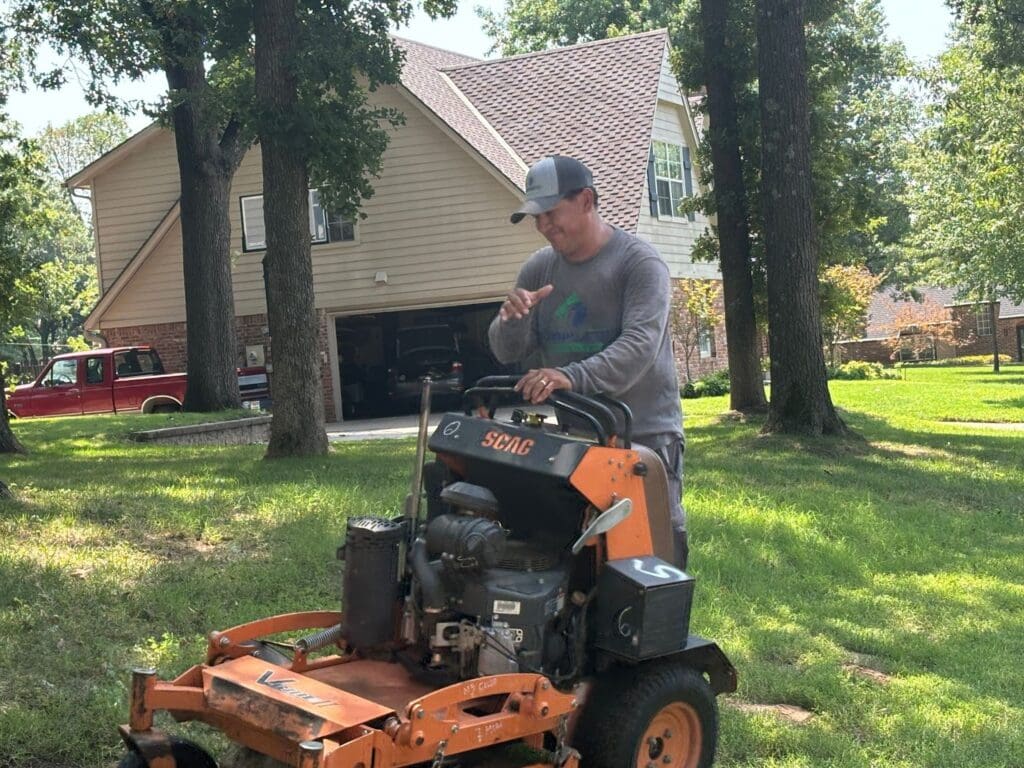
Professional Commercial Mowers vs. Homeowner Mowers: Why Your Lawn Can Tell the Difference
Here’s the honest truth: When you see Complete Lawn Care’s crews mowing with commercial-grade equipment and compare it to the $400 push mower you bought at Lowe’s, the difference isn’t just about speed or convenience—it’s about cut quality, turf health, and long-term lawn appearance. Commercial mowers use thick-gauge steel decks, industrial-strength engines, and professional-grade blade systems that deliver clean cuts instead of tearing grass. Homeowner mowers are designed to be affordable and “good enough” for weekend warriors, but they use thinner materials, less powerful engines, and blade designs that compromise cut quality to reduce cost. At Complete Lawn Care, we sharpen our blades weekly, maintain our equipment religiously, and replace mowers every few years because we know that equipment quality directly affects your lawn’s health. After 25+ years of mowing Tulsa lawns, we’ve seen the data: lawns mowed with sharp, commercial-grade equipment have fewer disease issues, better color, and thicker growth than lawns cut with dull homeowner mowers.
If you’re in Tulsa, Broken Arrow, or Owasso and you’re wondering whether equipment quality actually matters (or if it’s just marketing hype), this guide breaks down the real differences and what they mean for your lawn.
The Cut Quality Difference: Clean Cut vs. Torn Grass
Let’s start with the most important difference—what actually happens to your grass when it’s cut.
How a Sharp Commercial Blade Cuts:
Clean, surgical cut:
- Blade slices through grass cleanly (like scissors cutting paper)
- Cut surface is smooth and sealed quickly
- Grass recovers fast
- Minimal moisture loss
- Low disease risk
What your lawn looks like:
- ✅ Clean, uniform appearance
- ✅ Deep green color (no browning at tips)
- ✅ Healthy growth
- ✅ Thick, vigorous turf
How a Dull or Low-Quality Homeowner Blade Cuts:
Torn, ragged cut:
- Blade tears through grass (like ripping paper with your hands)
- Cut surface is jagged and shredded
- Grass takes longer to recover
- Moisture loss through torn ends
- Higher disease risk (open wounds)
What your lawn looks like:
- ❌ Brown, frayed tips (especially visible 24-48 hours after mowing)
- ❌ Dull, grayish appearance overall
- ❌ Slower recovery and growth
- ❌ Increased disease susceptibility
The visual difference: If your lawn looks grayish-brown a day after mowing, you’re looking at torn grass from a dull or poor-quality blade.
Commercial Mowers: What We Actually Use (And Why)
Let’s break down what professional lawn care companies use—and what makes them different.
Complete Lawn Care’s Equipment:
Commercial Walk-Behind Mowers:
- Brands: Scag, Exmark, Toro Commercial (not Toro homeowner models)
- Deck: 10-gauge steel (vs. 14-16 gauge on homeowner models)
- Engine: Kawasaki or Kohler commercial-grade (17-25 HP)
- Blade Speed: 18,000+ FPM (feet per minute)
- Cost: $3,000-$6,000 each
Commercial Zero-Turn Mowers:
- Brands: Scag Turf Tiger, Exmark Lazer Z, Toro Z-Master
- Deck: 7-10 gauge steel
- Engine: 25-35 HP commercial engines
- Blade Speed: 18,000-19,000 FPM
- Cost: $10,000-$15,000 each
Why These Cost So Much More:
1. Deck Construction:
- Commercial: Thick-gauge steel (7-10 gauge = 0.179″-0.134″ thick)
- Homeowner: Thin-gauge steel or stamped metal (14-16 gauge = 0.075″-0.060″ thick)
- Difference: Commercial decks last 10+ years of daily use; homeowner decks rust and crack in 3-5 years.
2. Engine Quality:
- Commercial: Kawasaki or Kohler commercial engines (rated for 2,000-3,000 hours)
- Homeowner: Briggs & Stratton or Honda homeowner engines (rated for 500-1,000 hours)
- Difference: Commercial engines run 8-10 hours per day, 5-6 days per week without overheating.
3. Transmission/Hydrostatic Drive:
- Commercial: Heavy-duty hydrostatic transmissions (smooth operation, precise control)
- Homeowner: Basic gear drives or light-duty hydros (jerky, less durable)
- Difference: Commercial transmissions handle slopes, wet grass, and daily use without failure.
4. Blade System:
- Commercial: High-lift blades, optimized airflow, better discharge
- Homeowner: Basic blades, minimal lift, poor discharge
- Difference: Commercial systems cut cleaner and handle thick/wet grass better.
Homeowner Mowers: What Most DIYers Use
Let’s be fair about what homeowner mowers are designed for.
Typical Homeowner Push Mower:
Brands: Toro (homeowner models), Honda HRX, Craftsman, Troy-Bilt
- Deck: Stamped or thin-gauge steel
- Engine: 5-7 HP Briggs & Stratton or Honda
- Blade Speed: 15,000-17,000 FPM
- Cost: $300-$800
What they’re good for:
- ✅ Occasional use (1-2x per week max)
- ✅ Small to medium lawns (under 8,000 sq ft)
- ✅ Flat terrain
- ✅ Dry conditions
- ✅ Budget-conscious homeowners
What they struggle with:
- ❌ Daily or frequent use (overheat, break down)
- ❌ Large properties (too slow)
- ❌ Wet grass (clogs, bogs down)
- ❌ Thick or tall grass (tears instead of cuts)
- ❌ Longevity (3-7 years typical lifespan with regular use)
Typical Homeowner Riding Mower:
Brands: John Deere (homeowner X-series), Cub Cadet, Husqvarna, Craftsman
- Deck: Stamped steel, 42″-54″ width
- Engine: 18-25 HP single- or twin-cylinder
- Cost: $2,000-$4,000
What they’re good for:
- ✅ Homeowners with 1+ acre
- ✅ Once-per-week mowing
- ✅ Comfortable operation
- ✅ Flat to moderate terrain
What they struggle with:
- ❌ Professional-level cut quality
- ❌ Daily use (not built for it)
- ❌ Steep slopes (safety and cut quality issues)
- ❌ Durability under heavy use (spindle bearings, deck wear)
The Data: How Equipment Quality Affects Turf Health
Let’s talk about what actually happens to lawns over time based on mower quality.
Study Results (Turf Research from Oklahoma State University and Others):
Dull Blade vs. Sharp Blade Impact:
Factor
Sharp Blade
Dull Blade
Water Loss
10-15%
30-50%
Disease Incidence
Low
2-3x higher
Brown Tip Duration
< 24 hours
2-3 days
Growth Rate
Normal
15-20% slower
Color Quality
Deep green
Grayish-brown
Commercial vs. Homeowner Mower Comparison (Over 1 Season):
Factor
Commercial (Weekly Sharp)
Homeowner (Monthly/Never Sharp)
Cut Quality
Consistently clean
Degrades over time
Disease Issues
Minimal
Moderate to high
Turf Density
Thick, vigorous
Thinner, stressed
Color
Deep green
Dull, inconsistent
The bottom line: Equipment quality and maintenance directly affect turf health, not just appearance.
Why Complete Lawn Care Sharpens Blades Weekly (And Why It Matters)
Here’s something most homeowners don’t know: we sharpen our mower blades every single week.
Why?
How Quickly Blades Dull:
After 8 hours of mowing (1 day for the commercial crew):
- Blade edge begins to round
- Cut quality starts declining
- Grass begins tearing slightly
After 40 hours of mowing (1 week for the commercial crew):
- Blade is noticeably dull
- Visible tearing on grass
- Brown tips appear 24 hours after mowing.
After 100+ hours (3+ weeks for the commercial crew):
- Blade is severely dull
- Grass is shredded, not cut.
- Lawn looks terrible; disease risk is high.
For homeowners:
- You probably mow 1 hour per week (if a small lawn) or 2 hours per week (if a large one).
- Your blade needs sharpening every 10-20 mows, or every 2-5 months. minimum
Reality: Most homeowners sharpen once per year (or never). By mid-season, they’re tearing grass every single cut.
Complete Lawn Care’s Blade Maintenance:
Weekly (Every Friday):
- Remove all blades from all mowers
- Sharpen to proper angle and balance
- Inspect for cracks, damage, and wear
- Replace if needed
Result:
- ✅ Every lawn gets cut with a sharp blade (not just the lucky Monday lawns).
- ✅ Consistent cut quality across all properties
- ✅ Minimal disease issues
- ✅ Professional appearance
Cost to us: Time, equipment, replacement blades ($30-$50 each)
Benefit to you: Clean cuts that keep your lawn healthy
The Speed Difference (And Why It Actually Matters for Quality)
Commercial mowers are way faster than homeowner mowers—but it’s not just about efficiency.
Mowing Speed Comparison:
Homeowner Push Mower:
- Speed: 2-3 MPH
- 7,500 sq ft lawn: 45-60 minutes
Commercial Walk-Behind:
- Speed: 4-6 MPH
- 7,500 sq ft lawn: 20-30 minutes
Commercial Zero-Turn:
- Speed: 6-9 MPH
- 7,500 sq ft lawn: 15-20 minutes
Why speed matters for quality (not just efficiency):
Faster mowing = less stress on grass in hot weather:
- Less time with crew on property during peak heat
- Grass doesn’t wilt as much during cutting
- Reduced soil compaction (fewer passes)
Consistent speed = even cut quality:
- Commercial hydrostatic drives maintain steady speed
- Homeowner mowers slow down in thick grass (uneven cuts).
Durability and Reliability: What Happens Over Time
Let’s talk about longevity and maintenance costs.
Commercial Mowers:
Expected Lifespan with Proper Maintenance:
- 2,000-3,000 hours of operation
- For commercial use: 5-7 years
- For homeowner use: Would last 30-50 years (but why?)
Maintenance Costs:
- Oil changes: Every 50 hours ($30 each)
- Blade sharpening/replacement: Weekly ($5-10)
- Spindle bearings: Every 500-1,000 hours ($150-300)
- Hydrostatic fluid: Every 500 hours ($100)
- Engine rebuild: 1,500-2,000 hours ($800-1,500)
Total ownership cost over 5 years:
- Purchase: $12,000
- Maintenance: $3,000-4,000
- Total: $15,000-16,000 for 2,500+ hours of use
Homeowner Mowers:
Expected Lifespan with Typical Maintenance:
- 500-1,000 hours of operation
- For homeowner use: 5-10 years
- For commercial use: 1-2 years (would never survive)
Maintenance Costs:
- Oil changes: Once per year ($30)
- Blade sharpening: Once per year (if at all) ($15)
- Air filter: Once per year ($10)
- Spark plug: Every 2 years ($5)
Total ownership cost over 5 years:
- Purchase: $500
- Maintenance: $250-400
- Total: $750-900 for 250-500 hours of use
Cost per hour of operation:
- Commercial: $6-7 per hour
- Homeowner: $1.50-2 per hour
But here’s the catch: homeowner mowers can’t handle commercial workloads. They’d fail in months.
The Grass Discharge Difference: Why Clumping Matters
Here’s something most people don’t think about: how well mowers discharge grass clippings.
Commercial Mowers:
High-lift blade design:
- Creates strong airflow in deck
- Lifts grass for a clean cut
- Discharges clippings evenly and far from deck
- No clumping (even in wet conditions)
Result:
- ✅ Even clipping distribution
- ✅ No clumps that smother grass
- ✅ Clean appearance
- ✅ Can mow in morning dew without issues
Homeowner Mowers:
Standard or low-lift blade design:
- Weaker airflow
- Grass doesn’t lift as well
- Clippings discharge short and pile up
- Clumping in thick or wet grass
Result:
- ❌ Clumps left on lawn (look bad, smother grass)
- ❌ Have to mow when grass is completely dry
- ❌ Sometimes need to rake up clumps
- ❌ Can’t handle thick growth well
When Homeowner Mowers Make Sense (Being Fair)
Look, we’re not saying homeowner mowers are garbage. They serve a purpose.
Homeowner mowers make sense if:
✅ You have a small lawn (under 5,000 sq ft).
✅ You mow once per week max.
✅ You maintain equipment properly (sharpen blades, change oil).
✅ You enjoy mowing and have time.
✅ Budget is a primary concern.
✅ Your lawn is healthy and not overly thick.
Homeowner mowers DON’T make sense if:
❌ You have 10,000+ sq ft (too slow, too much wear).
❌ You never sharpen blades (damaging your lawn).
❌ You’re trying to start a side business (won’t hold up).
❌ You hate mowing and resent the time (hire it out).
❌ Your lawn is thick, dense, or wet often (wrong tool).
What About the “Prosumer” Category? (Halfway Between)
There’s a middle ground: high-end homeowner and prosumer mowers.
Examples:
- Toro TimeMaster (30″ homeowner commercial-style)
- Honda HRX (premium homeowner)
- Scag Liberty Z (entry-level commercial zero-turn)
These offer:
- Better build quality than basic homeowner models
- Commercial-style features at a lower price
- Good for serious DIYers or small side businesses
Cost: $800-$5,000 depending on model
Who they’re for:
- Homeowners with large properties
- Weekend warriors who want quality
- People starting lawn care side hustles
- Those willing to invest in better equipment
They’re better than basic homeowner models but still not full commercial quality.
The Complete Lawn Care Equipment Investment (What We Spend)
Let’s be transparent about what we invest in equipment:
Per Crew (2-Person Team):
- 1 commercial zero-turn: $12,000
- 1 commercial walk-behind: $4,000
- 2 commercial string trimmers: $800
- 2 commercial blowers: $1,200
- 1 commercial edger: $600
- Trailer: $3,000
- Truck: $40,000
- Total per crew: $61,600
Maintenance per crew per year:
- Blade sharpening: $500
- Oil changes, filters, plugs: $800
- Repairs and parts: $1,500
- Fuel: $4,000
- Total: $6,800/year
Why this matters to you:
- We’re investing heavily to deliver quality.
- Equipment is maintained religiously.
- You’re not paying for cheap shortcuts.
- Results are consistent and professional
The Bottom Line: Equipment Quality Affects Your Lawn’s Health
The difference between commercial and homeowner mowers isn’t just speed or convenience:
✅ Cut quality (clean cuts vs. torn grass)
✅ Turf health (less disease, better growth)
✅ Appearance (professional look vs. ragged)
✅ Longevity (equipment that lasts under daily use)
✅ Consistency (reliable performance, not breaking down)
At Complete Lawn Care:
- We use commercial-grade equipment ($10,000-15,000 per mower).
- We sharpen blades weekly (every lawn gets a sharp cut).
- We maintain equipment religiously (minimal breakdowns).
- We replace mowers every 5-7 years (before they decline).
The result: Your lawn gets cut with professional equipment maintained to professional standards—not a $400 homeowner mower with a blade that hasn’t been sharpened in 6 months.
Ready for Professional-Grade Mowing?
If you want your lawn mowed with commercial equipment, sharp blades, and experienced crews who actually care about cut quality, Complete Lawn Care has been delivering professional mowing services in Tulsa for 25+ years.
We invest in the equipment, maintenance, and training that homeowner setups simply can’t match. Your lawn will show the difference.
📞 Contact Complete Lawn Care today to experience what professional-grade equipment and weekly blade sharpening actually look like on your lawn.