How to Find Buried Sprinkler Valve Boxes
The most reliable way to locate buried sprinkler valve boxes is to trace the low-voltage wiring from the irrigation controller back to each valve. Learn the proven methods used by Tulsa-area irrigation professionals to find valve boxes buried under years of soil, sod, and landscape material.
Why Valve Boxes Get Lost
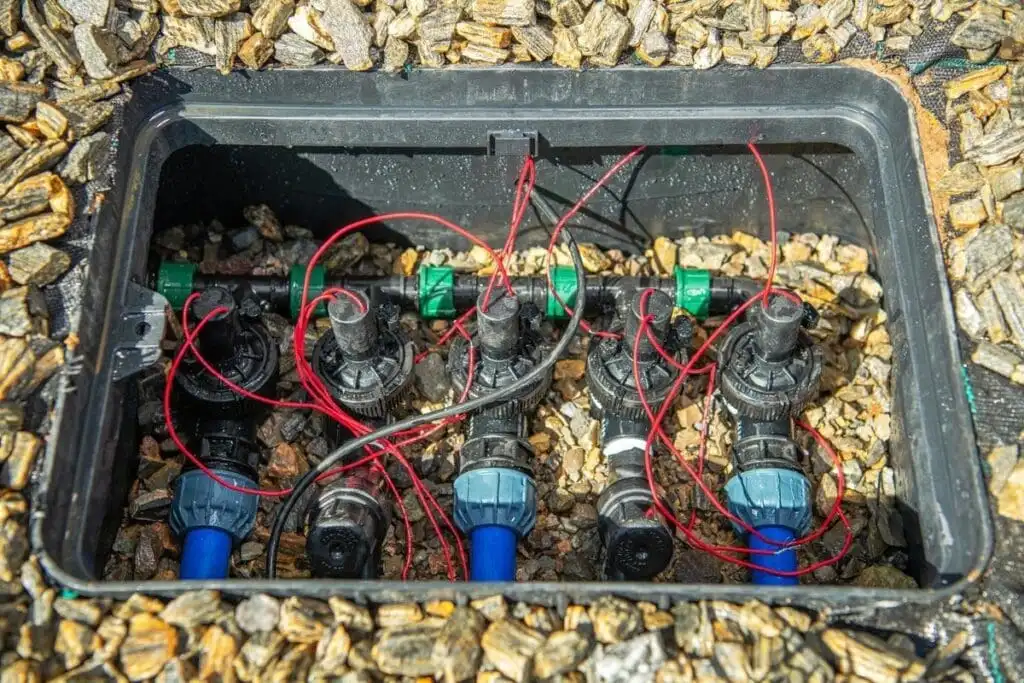
A residential irrigation valve manifold inside an open valve box — four zone valves with red zone wires and blue outlet pipes serving individual irrigation zones. Each solenoid connects to the irrigation controller via two wires: a shared common wire and a zone-specific wire. Tracing these wires from the controller to the valve box is the most reliable method for locating buried boxes on Tulsa-area residential properties.
Soil & Thatch Buildup
Valve box lids sit flush with the turf surface when installed correctly. Over seasons of mowing, thatch buildup, top dressing, and soil settlement, the surface rises by a quarter inch per year. After five to ten years, a valve box can be covered by an inch or two of accumulated organic matter and soil.
Landscape Renovation
Fresh sod installation, bed expansion, mulch application, and hardscape additions all cover valve boxes that were previously accessible. In the Tulsa metro area, many homes built in the early 2000s through 2010s are now undergoing first major landscape updates — uncovering original valve boxes is routine.
Undocumented Changes
Previous owners or landscapers sometimes relocate boxes without documentation. Irrigation contractors occasionally install individual valves without standard boxes, particularly on add-on zones. In some cases, aggressive Bermuda grass has simply grown over a box that was accessible as recently as the prior season.
Method 1: Wire Trace from the Irrigation Controller
The irrigation controller is the logical starting point because every zone valve in the system is wired back to it. Opening the controller and identifying the wiring terminals shows you how many zones the system has and gives you physical access to the zone wires — which run underground directly from the controller to each valve location.
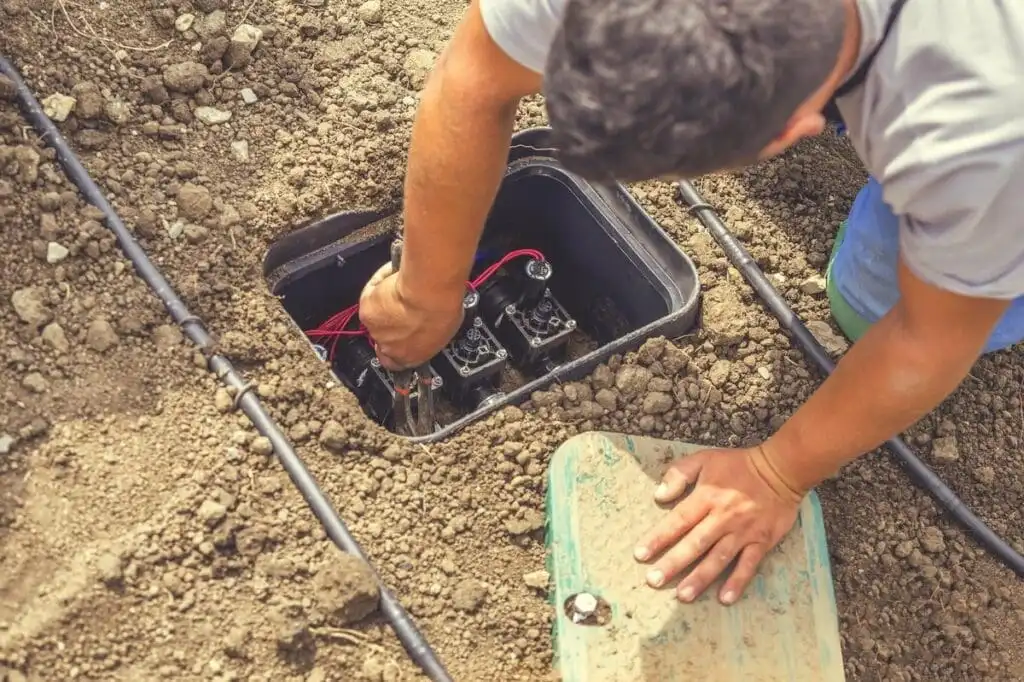
Step-by-Step Approach
1. Open the irrigation controller and locate the terminal strip — the row of screw terminals where zone wires connect. Count the occupied terminals to confirm how many zones the system has.
2. Note where the wiring exits the controller. The wire bundle typically exits through a conduit at the bottom or side of the housing — the direction this conduit points gives you the initial bearing for the wiring run.
3. Run each zone individually and walk the property to observe where water appears. The valve box for each zone is somewhere between the controller and the active heads for that zone.
4. Look for the wiring trench path — along fence lines, bed edges, the house foundation, or across open lawn in straight runs. Slightly different grass texture or color can reveal the buried trench line.
5. Probe suspect areas using a thin metal probe at 6-inch intervals in a grid pattern. Valve boxes produce a hollow sound and reduced resistance compared to solid soil.
Method 2: Valve Locator or Wire Tracer Tool
A valve locator or wire tracer is the fastest and most precise method for locating buried valve boxes, particularly on properties where the box has been underground for many years or is in a densely planted area where probing is impractical.
How the Tool Works
The transmitter connects to the zone wire at the controller terminal and sends a signal through the wire circuit to the valve. The handheld receiver, walked across the property, produces an audible tone that peaks directly over the valve location — narrowing a search from the entire property to a specific square foot in minutes.
Where to Get One
Valve locator tools are available for rent at some equipment rental companies and irrigation supply stores in the Tulsa area. Professional irrigation technicians carry these as standard equipment. For multiple missing valve boxes or a large property, a professional service call may be more cost-effective than renting or purchasing the tool.
Important Note on Wire Breaks
The valve locator works on the zone wires. If a zone wire has been cut or is damaged between the controller and the valve, the signal will not reach the valve. In this case, the tool is useful for identifying where the wire break occurred — its own valuable diagnostic.
Method 3: Following Irrigation System Logic
On properties where the original system was installed by a professional contractor following standard practices, valve box locations follow logical patterns that can be worked out from first principles.
Near the Backflow Preventer
On many residential systems, the primary valve manifold is located in a box within 10 to 20 feet of the backflow preventer, where the main supply line splits into individual zone lines. Start your search in a radius around the backflow preventer before expanding.
Along the House Foundation
When the controller is mounted on the house, the wiring exit point is typically near the controller location. Valve boxes are often placed in beds along the foundation within 20 to 40 feet of the controller. On many Broken Arrow and Bixby new-construction homes, the valve manifold is in the same bed as the backflow preventer.
In Landscape Beds
Installers often place valve boxes in foundation beds, side yard beds, or areas with established ground cover where the box lid remains accessible. Check under mulch in beds near the zone areas the valve serves.
Along Fence Lines
On larger residential lots, secondary valve boxes serving back yard or side yard zones are frequently placed along fence lines. Check along the base of fences, particularly at corners, for boxes covered by grass growing over the lid.
Common Valve Box Locations in Tulsa-Area Residential Systems
Foundation bed adjacent to the backflow preventer or within 20 feet along the foundation
Near or at the meter connection point for systems with manifold installed close to supply
Corner of the house where front yard zones meet back yard zones in the wiring run
Along fence lines — particularly in areas where a zone serves the back yard exclusively
At the base of large trees or in established shrub beds where the box lid has not been disturbed
Check under ground cover and mulch in beds throughout the property — not just in grass areas
Method 4: Systematic Probe Search
When wire tracing is not available and the wiring path cannot be identified, a systematic physical search of likely areas using a probe tool is the fallback method. This is slower but reliable in open lawn areas.
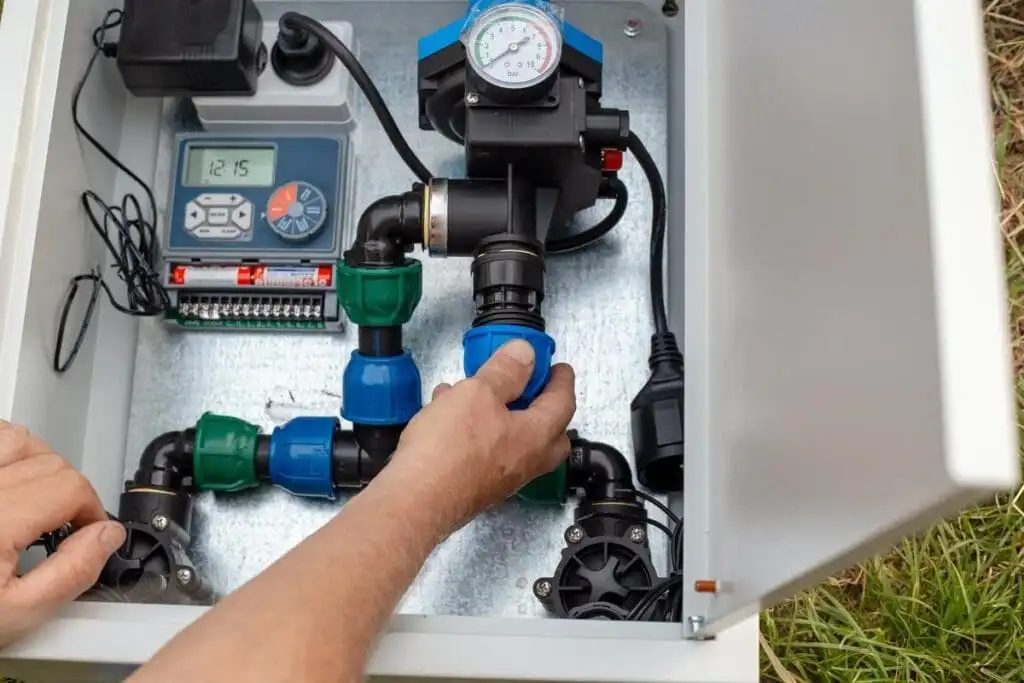
Probe Search Steps
1. Identify the search area based on which zone the missing valve serves. Run that zone and observe which heads activate — the valve is upstream of all of them, somewhere between the controller and the nearest active head.
2. Mark the search boundary. Place flags at the corners of a search grid approximately 10 feet on a side in the most likely area. If the first grid produces nothing, expand the boundary.
3. Probe at 6-inch intervals across the grid in parallel rows using a thin metal probe pushed straight down with moderate force. Solid soil produces resistance; a valve box produces a hollow feel and reduced resistance as the probe hits the plastic lid.
4. When you feel a hollow resistance, probe around the perimeter of the hollow area to define the box footprint before digging. Standard residential valve boxes are roughly 10 by 14 inches for manifold boxes and 6 by 6 to 9 by 9 inches for single-valve boxes. Mapping the perimeter before digging prevents damaging the box lid or the valves inside.
Finding buried valve boxes: common questions
How do I find a sprinkler valve box without a tool?
How do I find sprinkler valves with a locator?
Why can I not find my sprinkler valve box?
Where are sprinkler valves usually located?
What if a zone wire is broken?
Need Help Locating Buried Valve Boxes in Tulsa?
Once located, the box should be raised to grade if buried, marked on a property diagram, and checked annually during spring startup to confirm the lid is clear and accessible before irrigation season begins. Our professional irrigation technicians serve Tulsa, Broken Arrow, Bixby, and surrounding areas with valve location, repair, and full system diagnostics.