What Drives the Cost of Lawn Fertilization
Before comparing prices, it helps to understand what you are actually paying for when a lawn care company fertilizes your property.
Square footage of your lawn. This is the biggest variable. A 3,000-square-foot lawn in a Tulsa neighborhood requires less product and less time than a 15,000-square-foot property in south Broken Arrow or Bixby. Most companies price per application based on your lawn's measured size. The larger the lawn, the higher the cost per visit, though the price per square foot typically goes down as the property gets bigger.
Product quality and type. Not all fertilizers are the same. The bag of generic fertilizer at a big box store is not the same product a professional company applies to your lawn. Professional-grade fertilizers come in different formulations: slow-release, quick-release, granular, liquid, organic, and synthetic. Each has different costs and different performance characteristics. Premium slow-release fertilizers cost more per bag but feed your lawn more evenly over a longer period, which means better results with less risk of burn or waste.
What is included beyond fertilizer. A "fertilization" visit from a professional company rarely means just fertilizer. Most applications include some combination of fertilizer, pre-emergent herbicide, post-emergent weed control, or targeted spot treatments depending on the time of year and what your lawn needs. When comparing prices, you need to know whether you are comparing an application that includes weed control and prevention to one that only puts down fertilizer. Those are very different services at very different values.
Number of applications per year. In Oklahoma, warm-season lawns like Bermuda typically need 6 to 8 applications per year to stay healthy and weed-free through our long growing season. Some companies offer fewer visits at a lower total cost, but fewer applications often means less coverage, more gaps in weed prevention, and weaker results. The number of visits matters because Oklahoma's growing season is longer than northern states, and our weed pressure is aggressive from March through October.
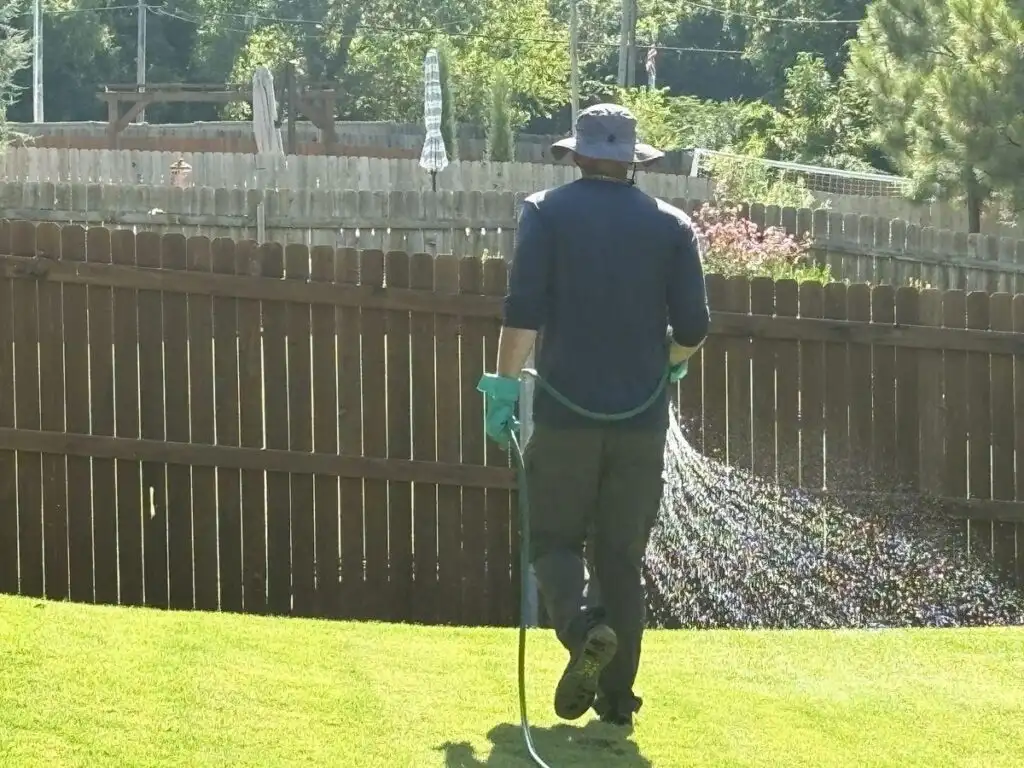
A Complete Lawn Care technician applying a liquid treatment to a Tulsa-area lawn. Each application includes products selected specifically for Oklahoma turf conditions.
What Price Alone Does Not Tell You
This is where most homeowners get stuck. You call three lawn care companies, get three prices, and the natural instinct is to compare the numbers. But the number by itself does not answer the most important questions.
Are the products designed for Oklahoma turf? Oklahoma sits in the transition zone, where warm-season grasses like Bermuda and cool-season grasses like Fescue both grow. Our clay-heavy soil, extreme summer heat, and specific weed pressures require products formulated for these conditions. A national company using the same product mix across 30 states is not going to deliver the same results as a local company selecting products specifically for Tulsa-area lawns. At Complete Lawn Care, we work with an agronomy expert who helps guide our product selection based on what actually works in Oklahoma soil, not what works as a national average.
Is the fertilizer blend right for your grass type? Bermuda and Fescue have very different nutritional needs and very different timing requirements. Bermuda needs its heaviest feeding during the heat of summer when it is actively growing. Fescue needs its heaviest feeding in fall when it is in peak growth mode. A company that applies the same product on the same schedule regardless of grass type is not giving your lawn what it needs. That matters more than whether the application costs $50 or $80.
Has anyone tested your soil? Your soil's pH and nutrient levels directly affect how well your lawn can absorb the fertilizer being applied. If your soil pH is too high or too low, nutrients get locked up and your grass cannot use them, no matter how much fertilizer goes down. A company that fertilizes without ever testing your soil is guessing. Complete Lawn Care offers soil testing as a service and recommends that every homeowner have their soil tested at least once a year. The results tell us exactly what your lawn needs, so nothing is wasted.
Who is making the application? The person applying the product matters. An experienced, trained technician who knows your property and understands Oklahoma turf science is going to do a better job than someone reading instructions off a bag. Employee turnover at some companies means you get a different person every visit, and nobody builds a relationship with your lawn. At Complete Lawn Care, our low turnover means the same team member often services the same properties, and they know what your lawn looked like last month and what to watch for this month.
Do Not Be Fooled by the Subscription Model
This is something more Tulsa-area homeowners need to understand. Some lawn care companies have moved to a subscription billing model where you pay a fixed monthly amount, usually spread over 12 months, regardless of when services are actually performed.
On the surface, this looks convenient. A flat $49 or $59 per month sounds manageable and predictable. But here is what is actually happening.
You are paying year-round for services delivered seasonally. In Oklahoma, your lawn is dormant from roughly late November through February. There are no fertilizer applications happening during those months. But under a 12-month subscription model, you are still paying. The company is collecting monthly payments during the winter for work they will not perform until spring. They are financing their off-season cash flow with your money.
Monthly pricing obscures the actual cost per application. If you are on a program that includes 7 applications per year, and you are paying $59 per month for 12 months, your annual cost is $708. Divide that by 7 applications and you are paying about $101 per application. That same company could charge $85 per application billed at the time of service, and it would cost you $595 for the year, saving you over $100. The monthly model is designed to make the price appear lower by spreading it out, but the math often works against you.
Subscriptions often come with contracts. Many companies that use monthly billing also require annual contracts with cancellation fees or penalties. If you are unhappy with the service in June, you may be locked in through December. This is the same model that makes people frustrated with cable companies and gym memberships. Nobody needs another subscription, especially one tied to a contract for a service they can evaluate after the first visit.
At Complete Lawn Care, we charge per application. You pay for work when it is performed. No monthly subscriptions. No 12-month contracts. No off-season payments for services not rendered. If you are on our 7-step lawn care program, you are billed for each of those 7 applications when they happen. If you ever want to stop, you stop. We believe our results speak for themselves, and we would rather earn your business every visit than lock you into a contract.
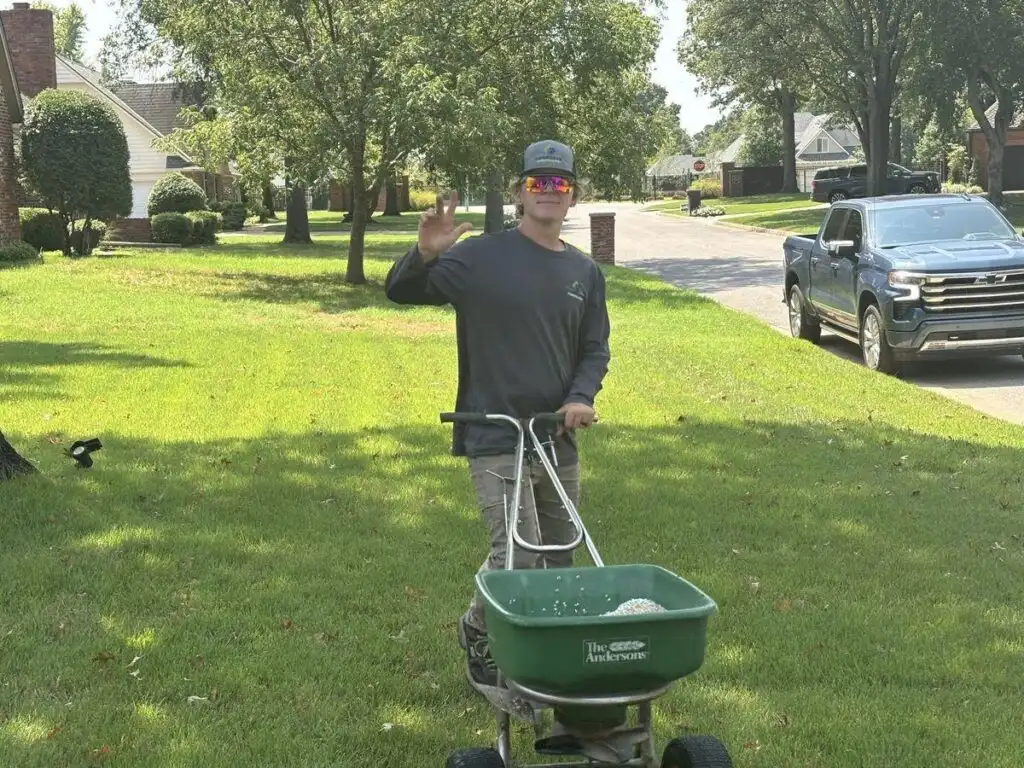
A Complete Lawn Care team member applying a granular treatment in a Tulsa-area neighborhood. We charge per application, not monthly subscriptions.
Questions to Ask Before Comparing Prices
When you are calling around for lawn fertilization quotes in the Tulsa area, these questions will help you compare apples to apples instead of just comparing dollar amounts.
How many applications are included per year? Oklahoma lawns typically need 6 to 8 applications. If a company offers 4 or 5, you may be getting less coverage. If they offer 10 or more, ask why. More applications is not always better; it is about the right product at the right time.
What is included in each application? Does the visit include only fertilizer, or does it include pre-emergent, post-emergent weed control, and spot treatments? A $50 application that is fertilizer-only is a very different value than a $75 application that includes fertilizer plus weed prevention and control.
Are the products tailored to Oklahoma, or are they national formulations? This question alone will separate local companies from national chains. A local company with Oklahoma-specific products is making intentional choices about what goes on your lawn. A national company using the same product in Tulsa that they use in Ohio is not.
Do you offer soil testing? If the answer is no, the company is applying products without knowing what your soil actually needs. That is guesswork, not science.
How do you bill: per application or monthly subscription? Per-application billing is straightforward. You pay for work when it happens. Monthly billing means you are paying during months when no work is being done, and your annual total may be higher than you realize.
Is there a contract, and what are the cancellation terms? If a company needs a contract to keep you, ask yourself why. A company confident in its results does not need to lock you in.
How long have you been in business locally? Lawn care companies come and go. A company with a long local track record has survived because their customers are satisfied. A company that opened last year and offers the lowest price in town may not be around next year to honor any commitments.
What About Doing It Yourself?
DIY fertilization is absolutely an option. A bag of lawn fertilizer from a home improvement store costs $15 to $40 and covers 2,000 to 5,000 square feet. Add a basic broadcast spreader for $50 to $150, and you can fertilize your own lawn for significantly less than hiring a professional. For a homeowner who wants to learn and is willing to invest the time, DIY can work.
But there are real trade-offs to consider.
You need to know what product to buy for your specific grass type and soil conditions. You need to calibrate your spreader correctly so you do not under-apply or over-apply. You need to time your applications based on soil temperature and seasonal conditions, not just when you remember to do it. And fertilizer is only one piece of a complete lawn care program. Pre-emergent herbicide, post-emergent weed control, insect management, and disease prevention are all separate products with different timing requirements. Most homeowners who start with DIY fertilization eventually realize that doing it right takes more knowledge, more products, and more time than they expected.
The value of a professional program is not just the fertilizer in the bag. It is the expertise behind the application: knowing which product, how much, when, and why. It is soil testing. It is adjustments based on what your lawn is actually doing, not what a bag label says. And it is having someone monitoring your lawn throughout the season who can catch problems early before they become expensive.
How Complete Lawn Care Approaches Pricing
We are not going to publish exact pricing here because every lawn is different. A 4,000-square-foot Bermuda lawn in midtown Tulsa has different needs and costs than a 12,000-square-foot Fescue lawn in south Broken Arrow. Quoting a price without measuring your property and evaluating your turf would be exactly the kind of guesswork we try to avoid.
What we can tell you is how our pricing works.
Our 7-step lawn care program includes 7 applications per year, timed specifically to Oklahoma's growing season. Each application includes the right combination of fertilizer, pre-emergent, post-emergent, and specialty treatments for that time of year. We bill per application, not monthly. You pay for work when it is performed. There is no contract. No subscription. No cancellation fee.
Our products are selected with the help of an agronomy expert who works with our team to guide product selection, application timing, and ongoing adjustments based on real results. This is not a one-size-fits-all program out of a franchise manual. Every application is intentional, and we adjust throughout the season because turf conditions, weather, and soil biology are always changing.
We also offer soil testing, weekly mowing, pest control, mosquito control, landscape maintenance, and irrigation service. When your fertilization, mowing, and irrigation are all managed by the same company, every service supports the others. Your mowing crew knows what was applied and when. Your turf team knows how the lawn is being maintained. That coordination produces better results than hiring three separate companies who never talk to each other.
For more than 25 years, Complete Lawn Care has been a trusted lawn care provider in the Tulsa area. We believe great results don't come from guessing. They come from experience, science, and continual improvement. That's why we invest heavily in leadership training, research and development, and product testing, ensuring our team stays current on the latest turf products, application methods, and correction strategies. We've also implemented one of the few agronomy-supported programs in Tulsa, working directly with an industry expert who helps guide our application timing, product selection, and ongoing improvements based on proven agronomic science. Every lawn is different, and every application is intentional. At Complete Lawn Care, we don't guess at what might work. We apply what does work. Your lawn deserves the best.